FA-RDP: Diffusion Policies That Switch Frequency When Contact Hits
Contact-rich robot tasks have a split personality. Before touch, several approach trajectories can be equally valid. After contact, force feedback has to be fast or the grasp fails. FA-RDP (Frequency-Adaptive Reactive Diffusion Policy) is a new method from Shanghai Jiao Tong University, Shanghai Innovation Institute, and Noematrix that lets one diffusion policy switch sampling rate mid-episode instead of picking one frequency forever.
The tradeoff standard diffusion policies lose
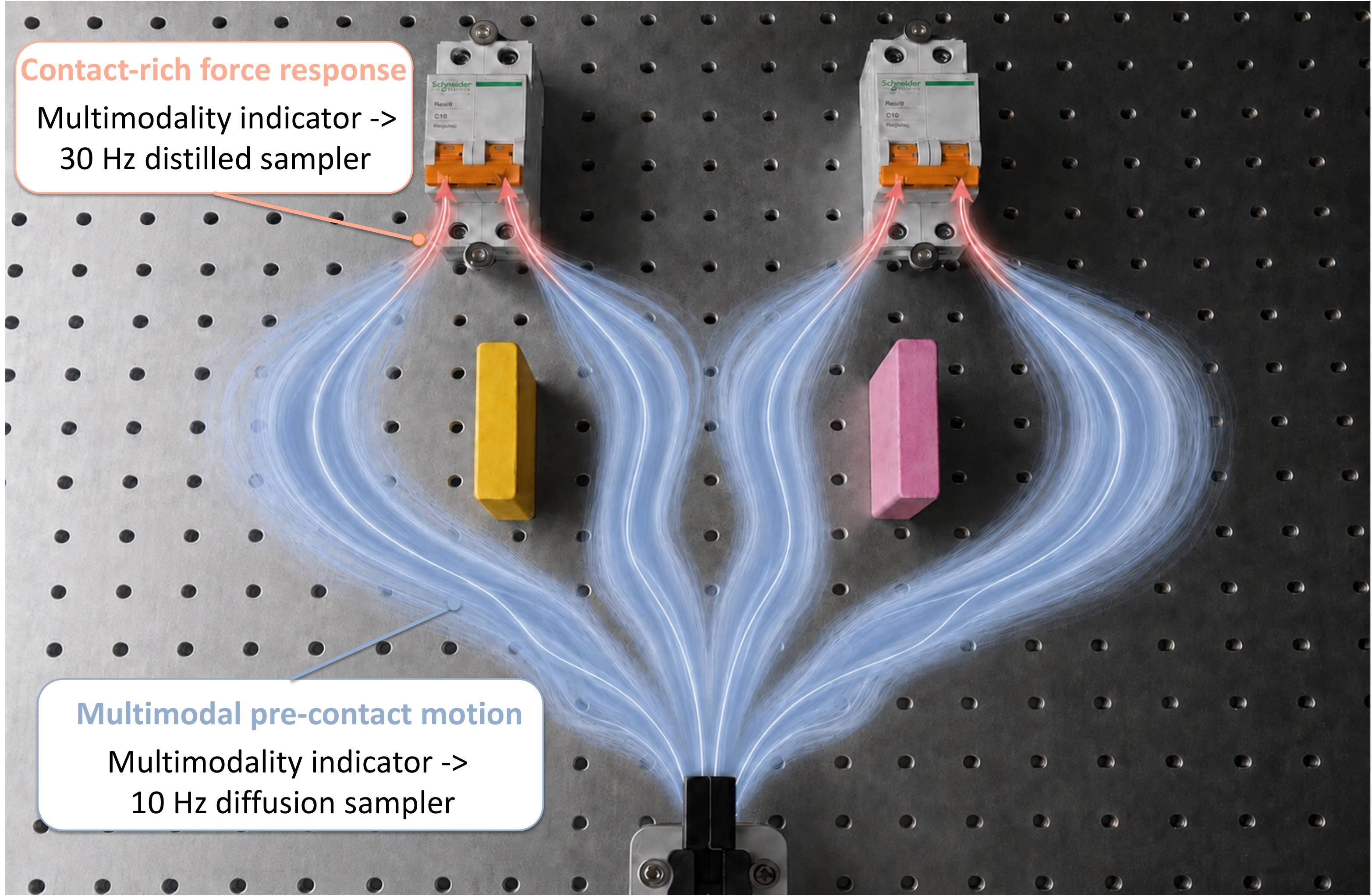
The authors’ project page and arXiv abstract (arXiv:2607.28596) put the problem cleanly. Fixed low-frequency, multi-step diffusion sampling preserves diverse pre-contact modes but reacts slowly to force. High-frequency sampling improves reactivity but collapses distinct approach modes.
FA-RDP’s answer:
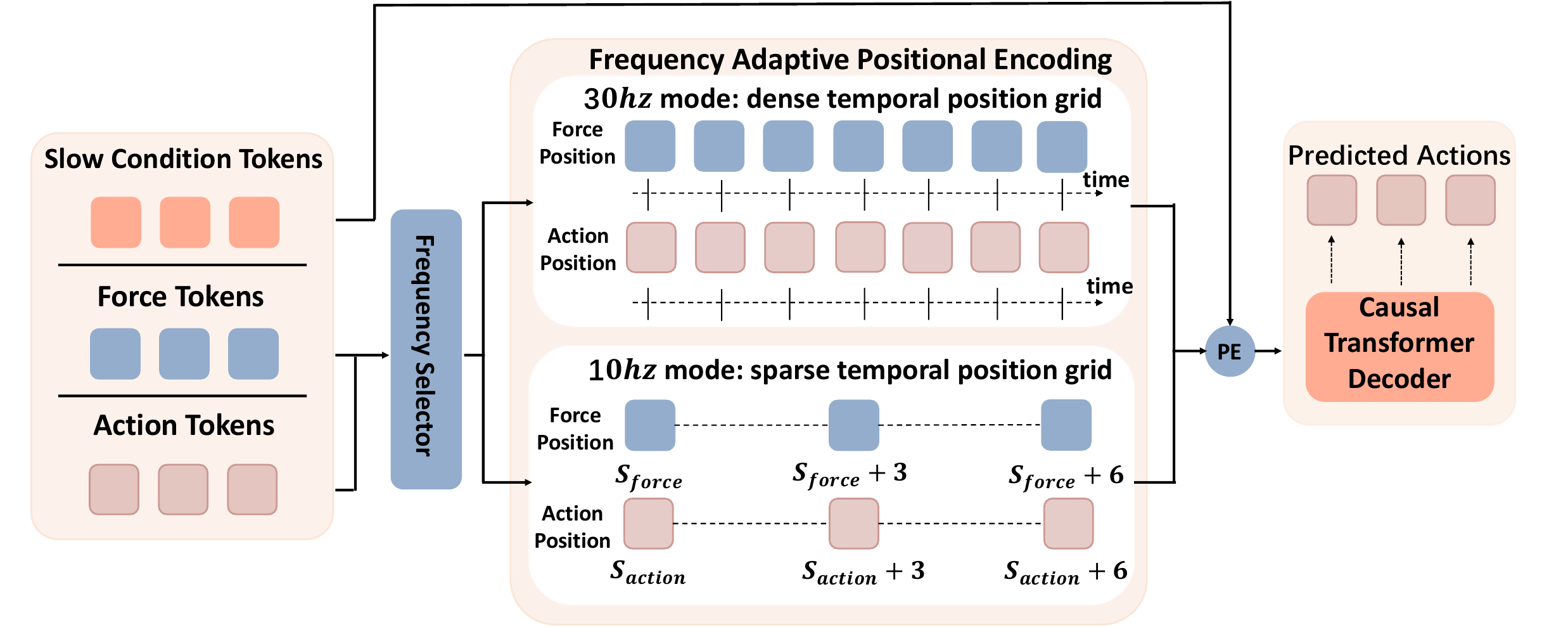
- A shared multi-frequency visual-force Transformer that can predict action chunks at low or high frequency
- A learned multimodality indicator that selects multi-step low-frequency sampling before contact and one-step high-frequency sampling as ambiguity drops
- Manifold Consistency Distillation (MCD) so the high-frequency path can run as a one-step sampler on the robot’s action manifold
In their framing, low frequency runs around 10 Hz for approach; high frequency around 30 Hz once contact demands force response.
Numbers on three contact-rich tasks
On box flipping, switch toggling, and button pressing (20 trials each), the project reports:
| Method | Avg. success |
|---|---|
| Diffusion Policy (DP) | 10.0% |
| RDP | 35.0% |
| ImplicitRDP | 51.7% |
| Regression + force | 20.0% |
| FA-RDP | 81.7% |
Indicator-guided switching lifts average success from 61.7% (always high-frequency) to 81.7%. The authors also show the low-frequency path covers multiple approach modes that a high-frequency-only policy collapses to one.
Code is listed as coming soon on the project site.
A Human’s Take
This is the kind of paper I want more of: not “diffusion, but bigger,” but “diffusion, but the control loop matches the physics phase.” Contact is where factories lose money and demos die.
I’ll believe the 81.7% harder once the code lands and other labs rerun the three tasks. Until then, the core idea—slow and multimodal before touch, fast and distilled after—is already worth stealing.