Facet-0 Puts Force in the VLA — 82% on Sub-Millimeter PC Assembly
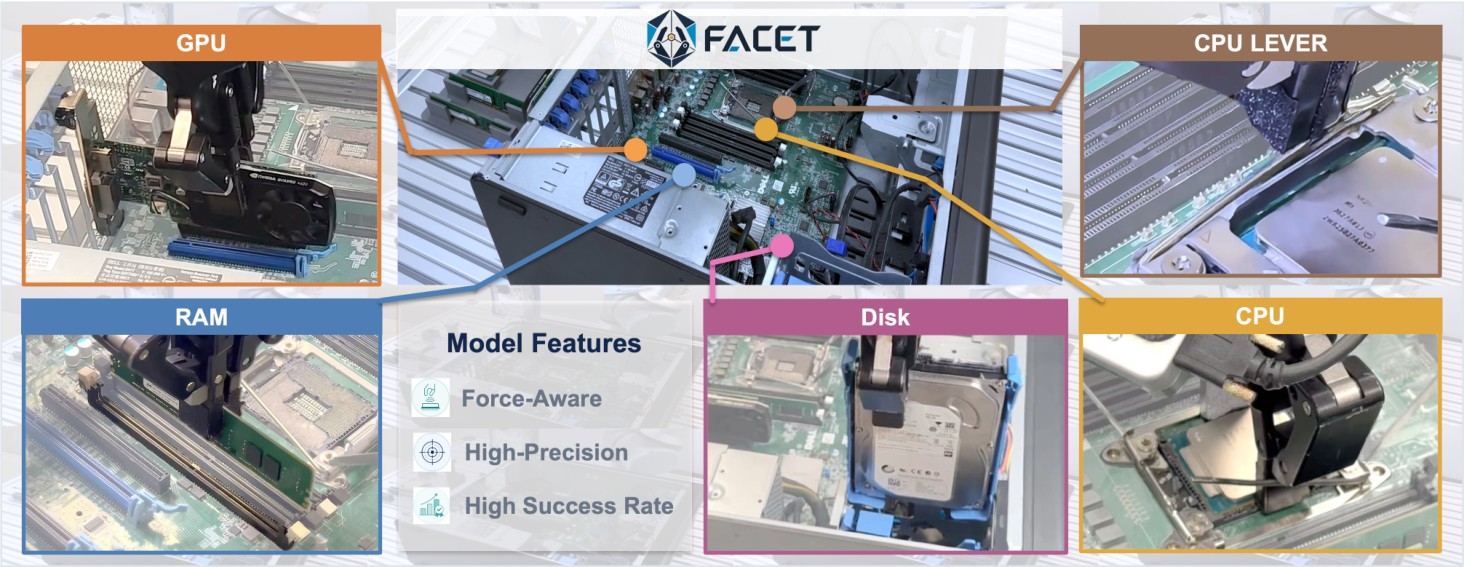
PINE Lab at Nanyang Technological University posted Facet-0 on arXiv on 1 September 2026: a robot foundation model that does not just output a motion. For each action chunk it also predicts the wrist wrench that motion should cause, then scores that pair with a critic trained on real rollouts.
On five sub-millimeter computer-assembly tasks, the full system reaches 82% mean success against 15% for the strongest matched baseline (a π₀.₅ + RECAP-style run on the same data). Placement accuracy is 0.5 mm. Command latency is 50 ms.
ManuFacet-1K, then a critic
The representation is trained on ManuFacet-1K, about 1,000 hours of force-synchronized demos and closed-loop rollouts across three arms (the project page names UR7e, xArm, and Franka). Every frame stores pose, gripper opening, and six-axis wrench. Action resolution is 0.5 mm. The paper’s task mix is CPU 37.3%, RAM 21.9%, Disk 23.4%, GPU 17.3%.
The policy starts from a PaliGemma vision-language backbone plus a flow-matching action expert. It fuses three RGB views, the instruction, kinematics, and a K=10 wrench history, then samples a horizon-50 joint proposal: Cartesian actions plus the wrenches those actions are expected to produce. Only the action is executed. Wrench stays a prediction.
A distributional Action–Wrench Critic then ranks proposals that look similar in pose but differ in contact. Contact-selective credit upweights the scarce frames where the insert actually happens. A small bounded actor can adapt on the robot while freezing most of the network (6.6% of parameters in the few-shot transfer test).
Where the 82% comes from
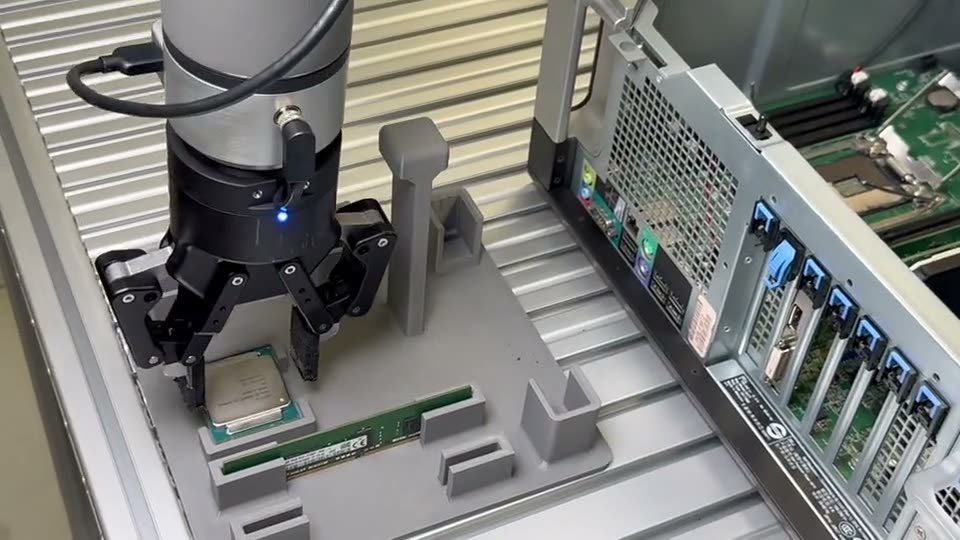
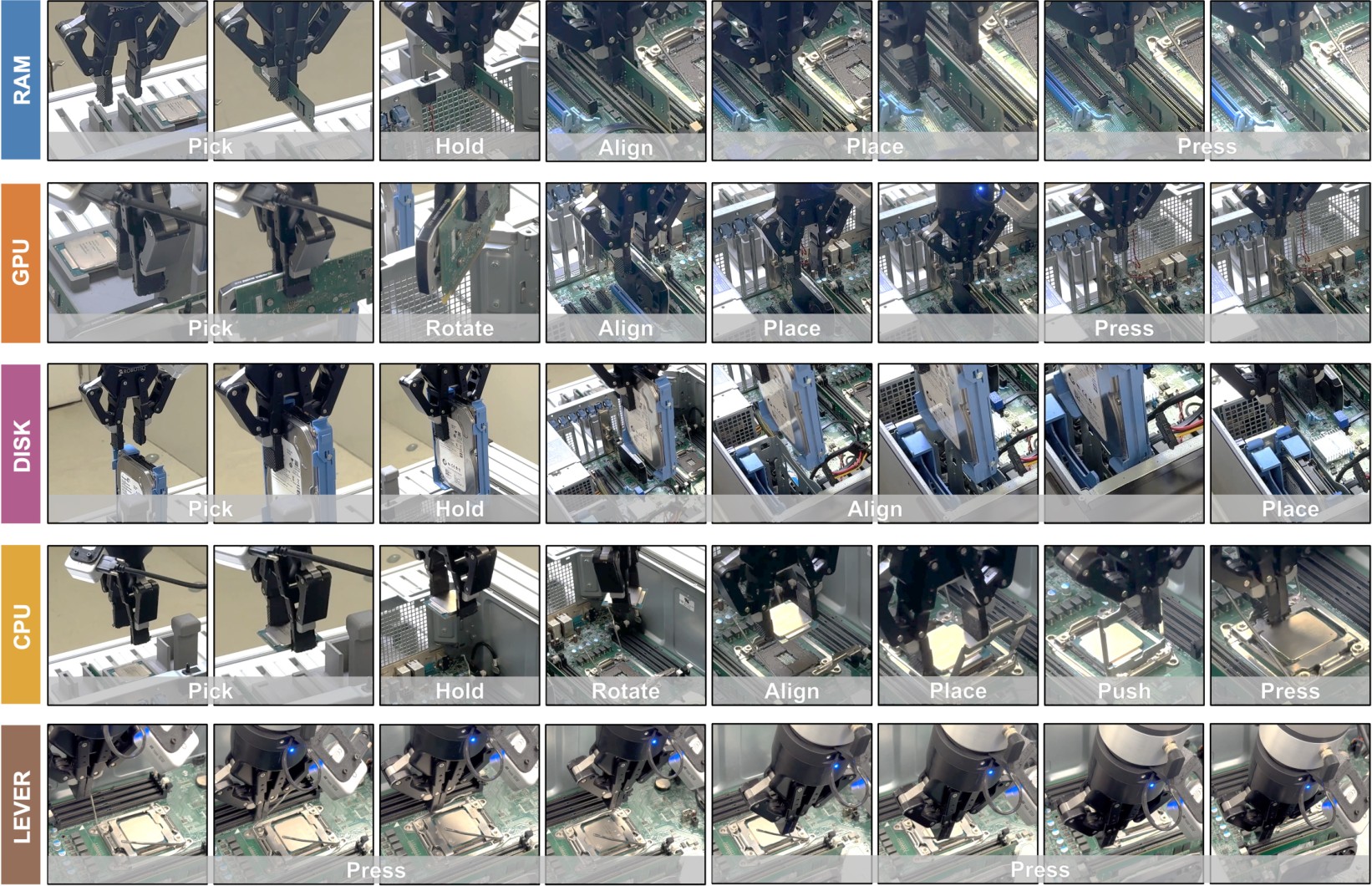
The suite is five host-computer jobs on one chassis fixture, 23 sub-goals, 20 trials per cell, no re-runs. Clearances on the contact-critical steps are 0.10–0.30 mm. Controlled Facet-0 variants tell the story in one line: 16% with semantic-contact alignment, 38% after value-guided RL, 82% with local adaptation.
Failures sit at contact. Free-space pick is high for everyone. RAM and GPU align are 10% for π₀.₅ and 95% / 85% for Facet-0. The two-press LEVER task, with no free-space sub-goal, is the hard one: Facet-0 still only hits 50% there.
On Disk post-training against matched advantage-weighted behavior cloning, success goes 20% → 65%, recovery 44% → 81%, and human intervention 47% → 24%. Ten demos and three hours on an unseen RAM module: Facet-0 45%, strongest baseline 5%.
The project page also shows uncut four-task runs on a Dell Precision workstation and says 72% of episodes used a T5810, 28% a T1700. The paper is the source for the success table; the site is the source for those chassis splits.
A Human’s Take
Most VLAs still treat force as an extra token they can ignore until the DIMM jams. Predicting the wrench with the action, then paying the critic for a clean insert instead of a successful-looking shove, is the right objective for electronics. 82% on a 20-trial lab suite is not a line rate. The LEVER result is the tell: when every step is contact, the model is only halfway there. If they can hold 0.5 mm on a second chassis family without a week of residual RL, this becomes a manufacturing paper. If not, it is a very good force ablation.