FACT Trains World-Action Models on Failures Without Copying Bad Moves
Most world-action models learn to imagine the future from successful demos. Ask them what a bad action does and they still paint a successful grasp. FACT, from Quanquan Peng, Yutong Liang, Rui Yan, Nicklas Hansen, and Xiaolong Wang at UC San Diego, flips the order: act first, then imagine the future that action actually caused.
The paper hit arXiv on August 10. The project page is up at fact-wam.github.io.
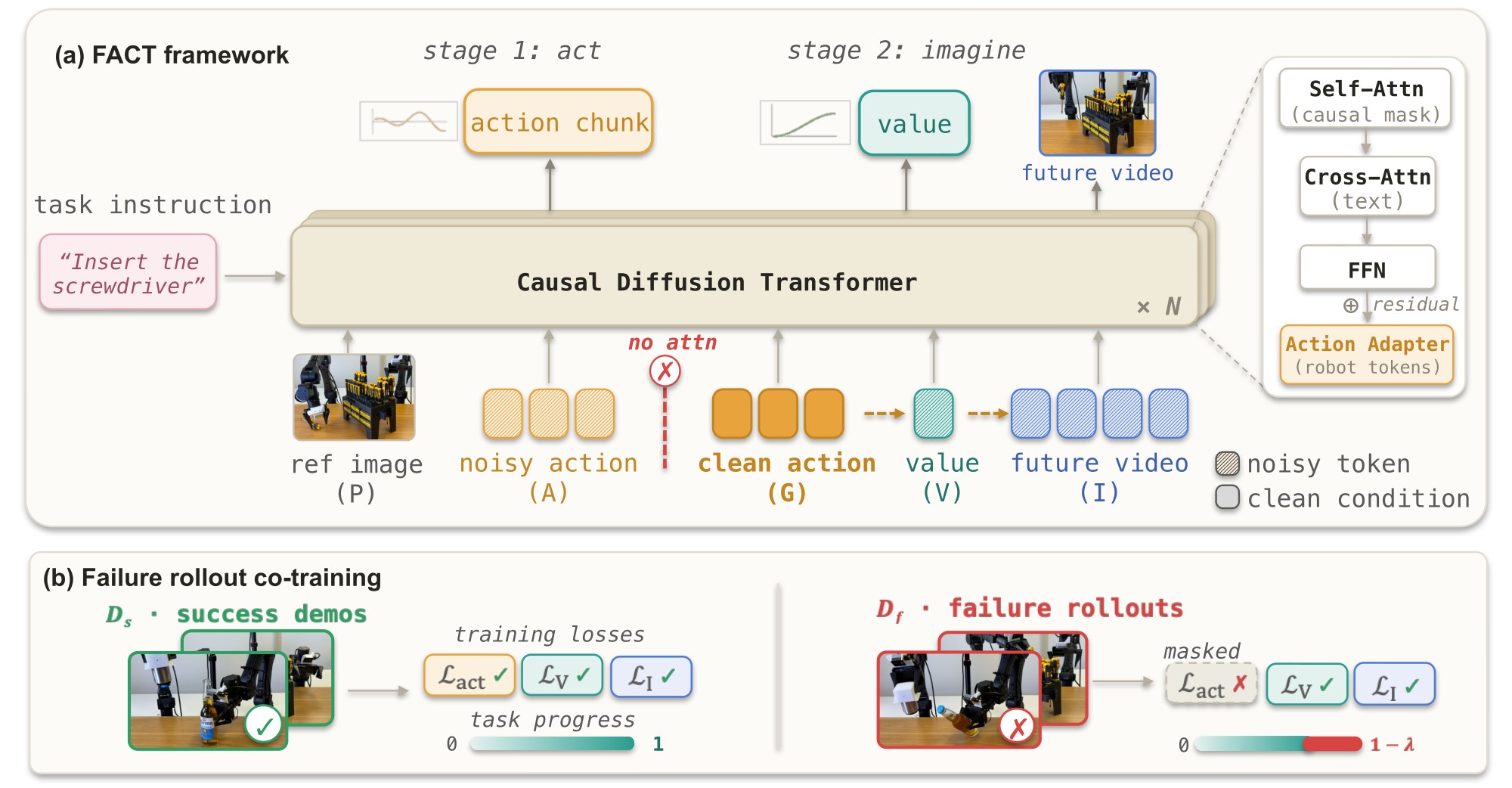
Failures teach consequences, not behavior
FACT is a causal diffusion transformer on a WAN2.2-5B video backbone with a light action adapter. Token order is observation, noisy predicted action, a clean teacher-forced action slot, value, then future video. Value and video attend to the clean action, not the noisy one.
On successful demos, all three losses fire. On failure rollouts the action-imitation loss is masked. The observed failed video and a lowered progress target stay. That is the whole trick: bad moves are not cloned; they are labeled as what went wrong.
At test time the model can stop after the action. Or it can sample N candidates and rank them with the progress head. Scoring only helps after failure training. Without failed outcomes, optional scoring did not help (79%).

Numbers that come with the failure mix
On 50 RoboTwin tasks, about 1.3K rollout failures were added. Video co-training moved average success from 81.8% to 85.6%. Failure co-training reached 87.5%, next to Motus at 87.8%, while the project page says FACT runs about 3× faster at deployment.
Real bimanual cell, no robot pretraining:
- Cube tasks: 200 expert demos; other seen tasks: 50; about 30 failure rollouts per cube task
- Each table cell: 20 trials
- Seen-task success: Motus 64%, FACT 82%, plus failures 89%, plus N=4 scoring 92%
- Unseen color/shape variants: 67% → 77% → 82% with scoring, next to π0.5 at 85% (π0.5 had large-scale robot pretraining FACT did not use)
- If failure actions are not masked, success drops to 63%
- Future-prediction PSNR on failure rollouts: 19.51 → 25.92; success futures stay about 26.1 dB
- On a three-task RoboTwin slice, mixing more failures raised success from 32.7% to 57.3% with no early saturation
Action chunks are H = 48. Future video is supervised at five offsets along the chunk.
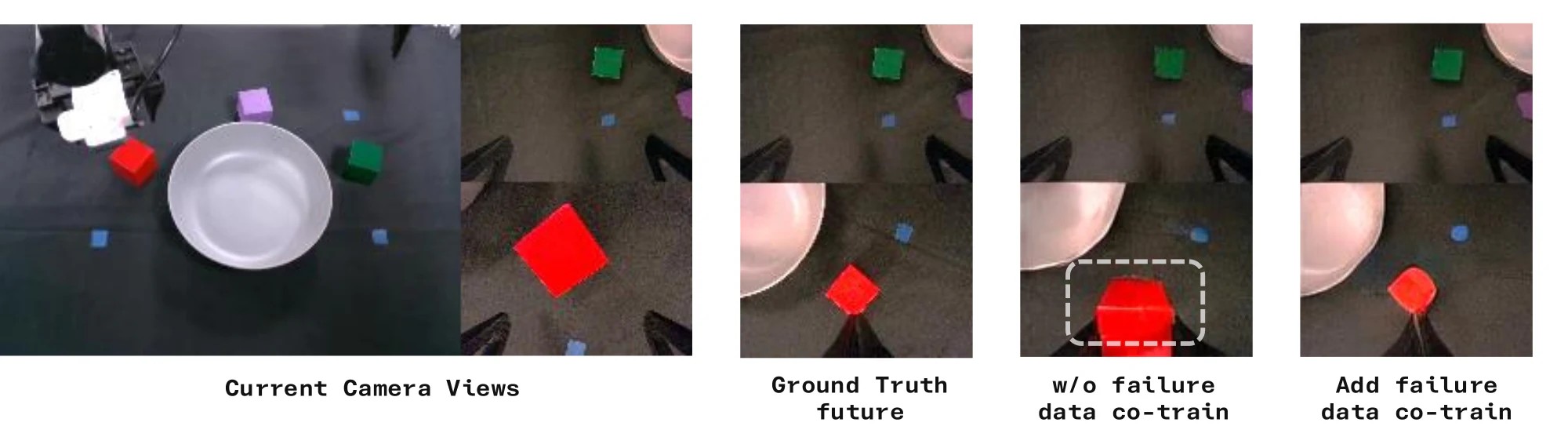
A Human’s Take
Throwing away failed rollouts is how you train a liar. FACT’s mask is the unglamorous part I trust: do not clone the miss, do learn what the miss looked like. The 3× speed note versus Motus is the other half. I care whether that progress head still ranks actions when the lighting and the objects are not from the same table. Until then, this is the right argument for keeping the crashes in the dataset.