FailureSpot Marks the Instant a VLA Starts to Blow It
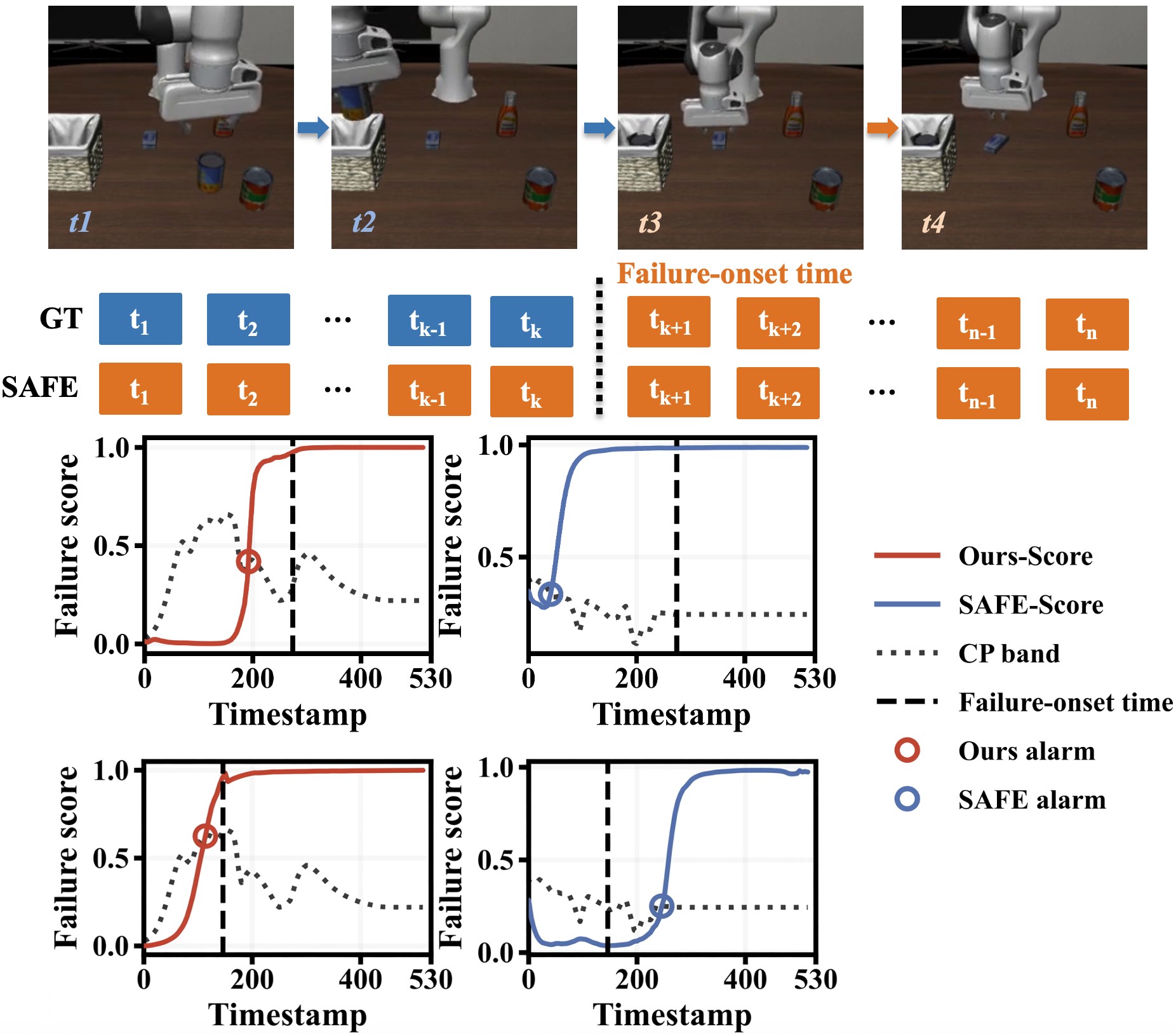
A VLA can look fine for two seconds and then freeze, flail, or miss the can. Most failure detectors still stamp the whole unsuccessful rollout as bad, including the part that was still working. FailureSpot, arXiv:2609.04277 from Jie Ma, Zongxi Liu, and Yi Zhu at Wayne State University (3 September 2026), trains a timestamp-level detector instead.
Weak labels, then the hard 15%
Dense per-step labels are expensive. FailureSpot pretrains on unlabeled action chunks using three cheap signals: inconsistency between overlapping chunks, tiny (idle) magnitudes, and huge (flailing) magnitudes, plus exponential moving averages. Then it ranks trajectories by detector entropy and asks a human for timestamp labels on only the top 15%. Fine-tune. Alarms go through a conformal band fit on successful rollouts, same family of trick SAFE used.
They roll 50 trajectories on each of LIBERO-10’s 10 long-horizon tasks for three policies: π0 (81.4% success, chunk H=50, execute K=5), π0-FAST (61.4%, H=10, K=5), and OpenVLA (53.8%, one action at a time). Three tasks are “seen”; seven are held out.
On unseen tasks, timestamp-level AUROC for FailureSpot-MLP hits 90.5 (π0), 85.8 (π0-FAST), and 63.0 (OpenVLA). Trajectory-level AUROC on π0 unseen is 81.8, ahead of SAFE-MLP’s 67.7. OpenVLA is the weak spot: no overlapping chunks, so the consistency signal has less to chew on.
What the failures look like
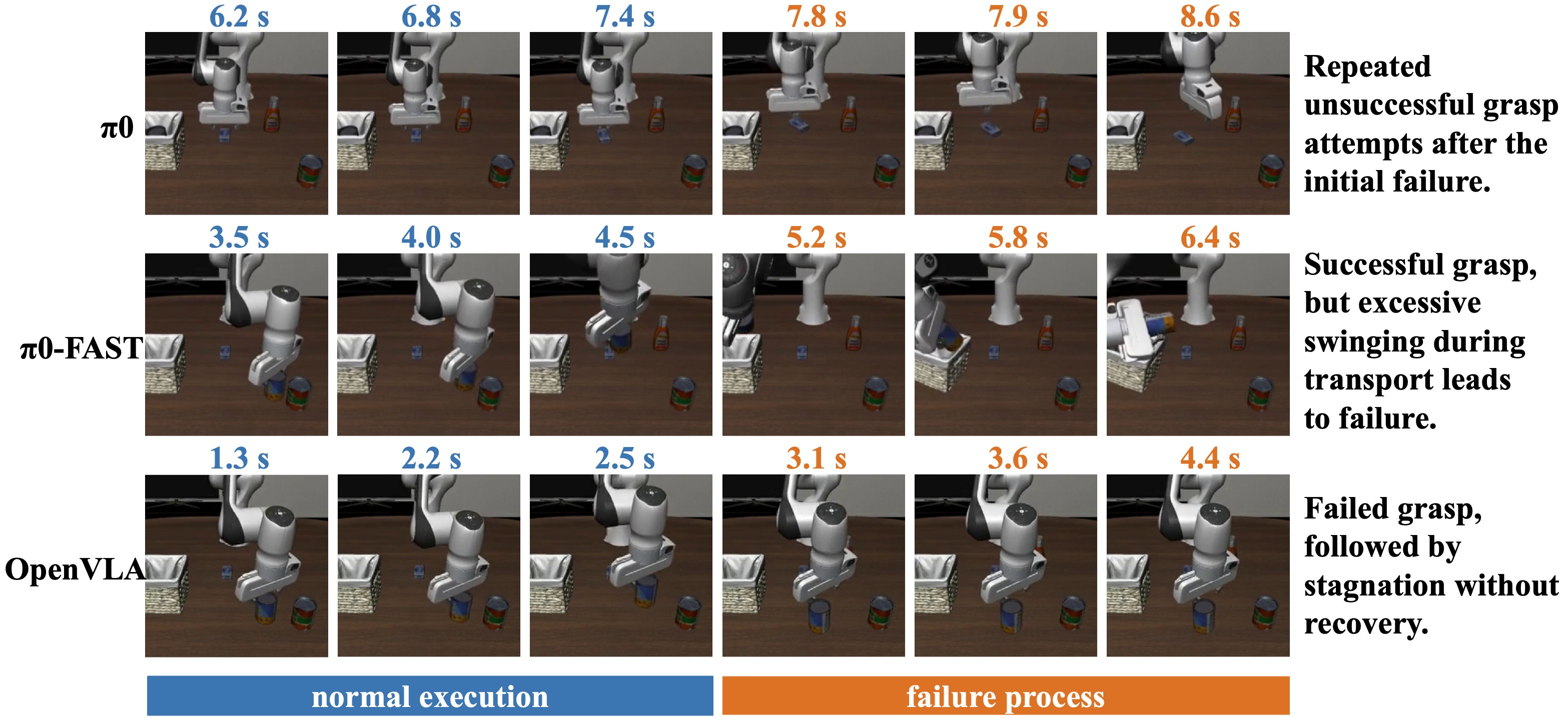
Inspecting failed rollouts, the authors name three modes: repeated useless grasps, gripper stagnation (magnitudes near zero), and large motion that does not advance the task. π0 tends to retry the grasp. π0-FAST swings. OpenVLA stalls. That split is why they kept both magnitude and consistency in the weak label.
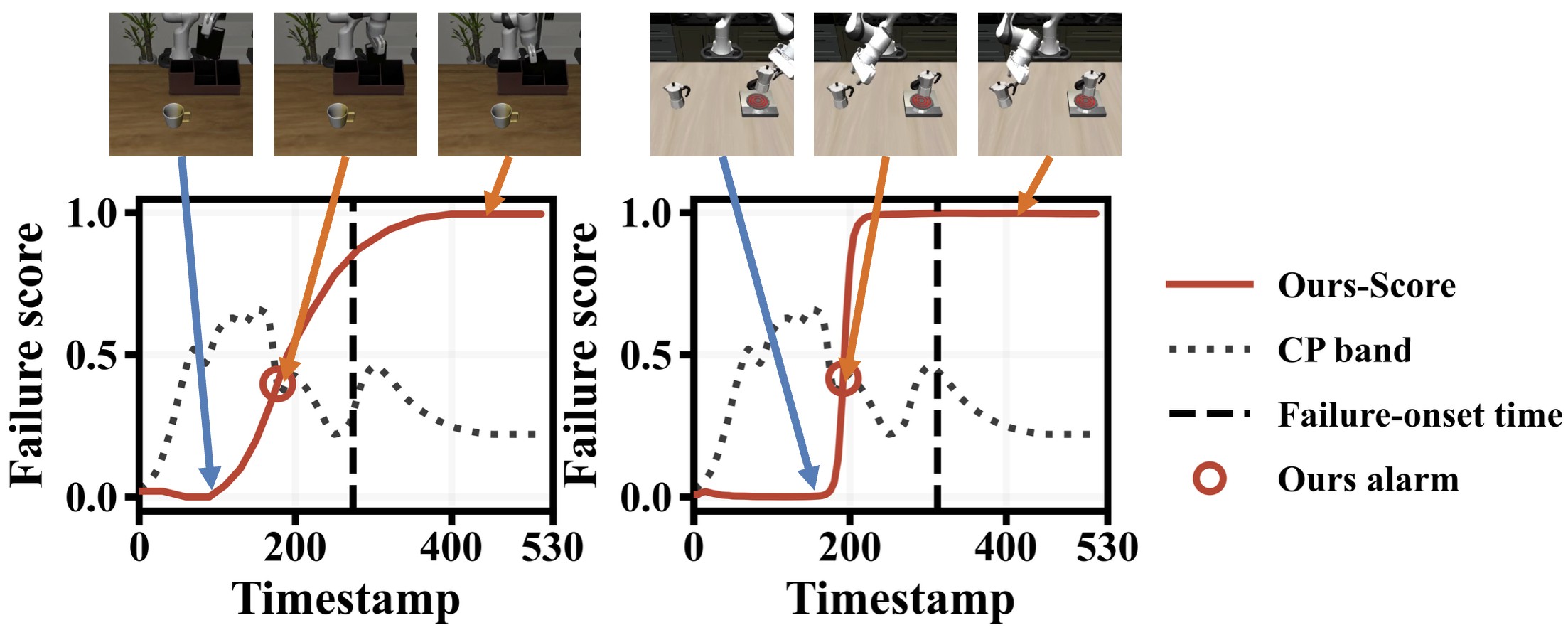
This is simulation on LIBERO, not a physical cell. The paper’s next sentence is using the onset time to interrupt and recover. That work is not in this PDF.
A Human’s Take
I have wanted a detector that says “it died at frame 173,” not “this episode failed.” Labeling 15% of the training set is a fair trade if the onset is actually early enough to stop a smash. OpenVLA still looking mushy is a reminder that chunked policies leak more signal than one-step transformers. Show me this on a real arm before I trust the conformal band.