FARM Reads Failure Out of a Frozen World Model
Most failure monitors train a second brain. FARM asks whether the world model you already run is already muttering “this is going badly.”
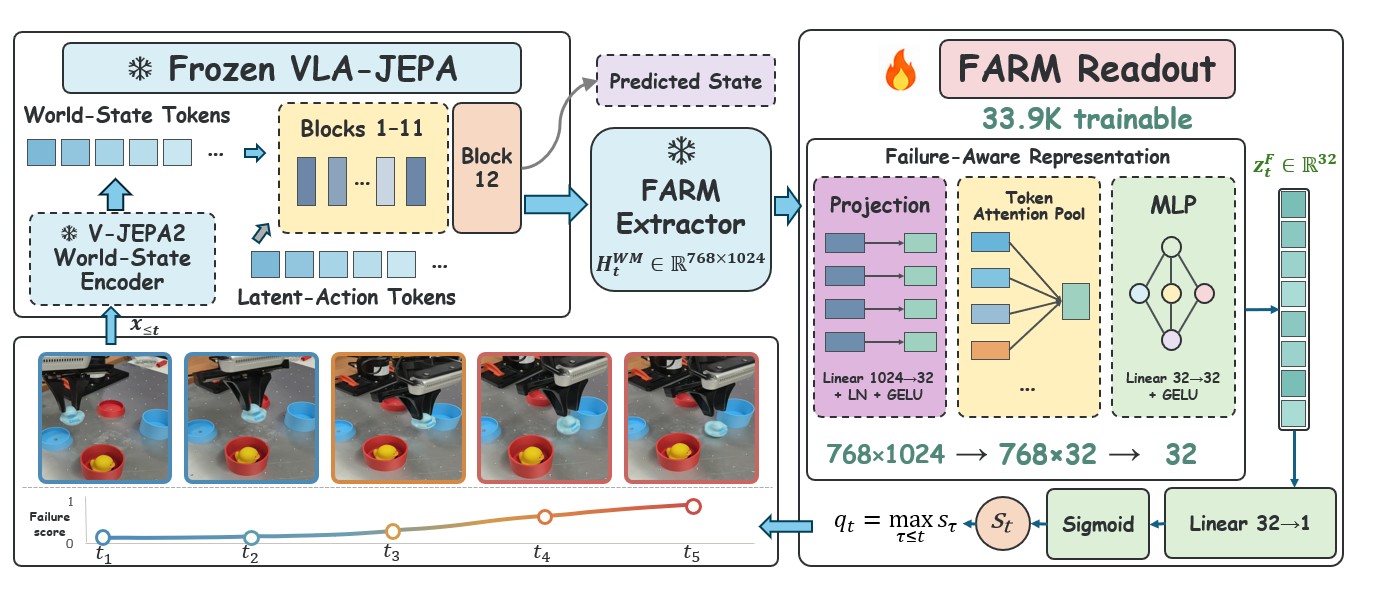
Haoran Pei and colleagues at the Institute of Automation, Chinese Academy of Sciences, with Harbin Institute of Technology, posted the paper September 10. They freeze VLA-JEPA, pull the last predictor block’s 768 × 1024 tokens, and train only a 33,985-parameter readout. That head emits a per-step score (s_t) and a causal risk (q_t = \max_{\tau \le t} s_\tau).
Code: github.com/HaoranPei-casia/FARM.
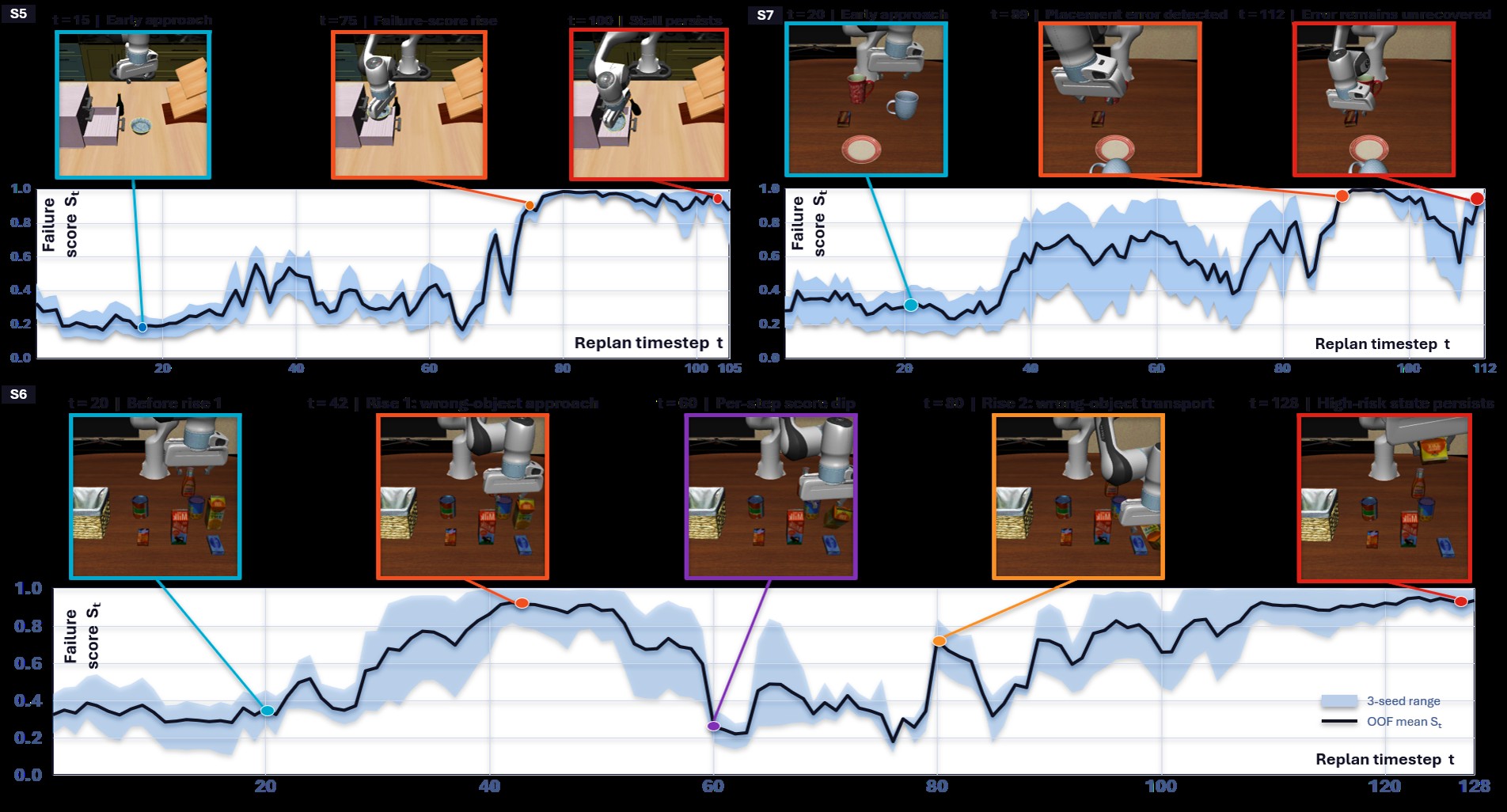
Simulation first
The sim set is 500 LIBERO trajectories (246 success / 254 failure) across 10 tasks, with one LIBERO-10 task swapped for a LIBERO-Goal drawer job because the original almost never failed. Seven source tasks, three held-out.
Five-fold out-of-fold on the 350 source trajectories: 85.68 / 88.59 pooled AUROC / AUPRC. A linear probe on seven coarse hidden-state stats only reaches 77.19 / 78.81 pooled. Using earlier predictor blocks is weaker than the final WM state.
On the fixed 10-task split, FARM leads 15 matched baselines on all four Seen metrics, 5.42 / 4.88 Macro AUROC / AUPRC points over SAFE-MLP. Strict-unseen is harder: STAC-Single wins zero-shot there; with 35 labeled target trajectories per task, FARM leads the SAFE readouts again.
Partial history already works. At 25% of the horizon, pooled AUROC / AUPRC are 75.07 / 80.75. At 75%, 81.63 / 85.53, within about two points of the full trace.
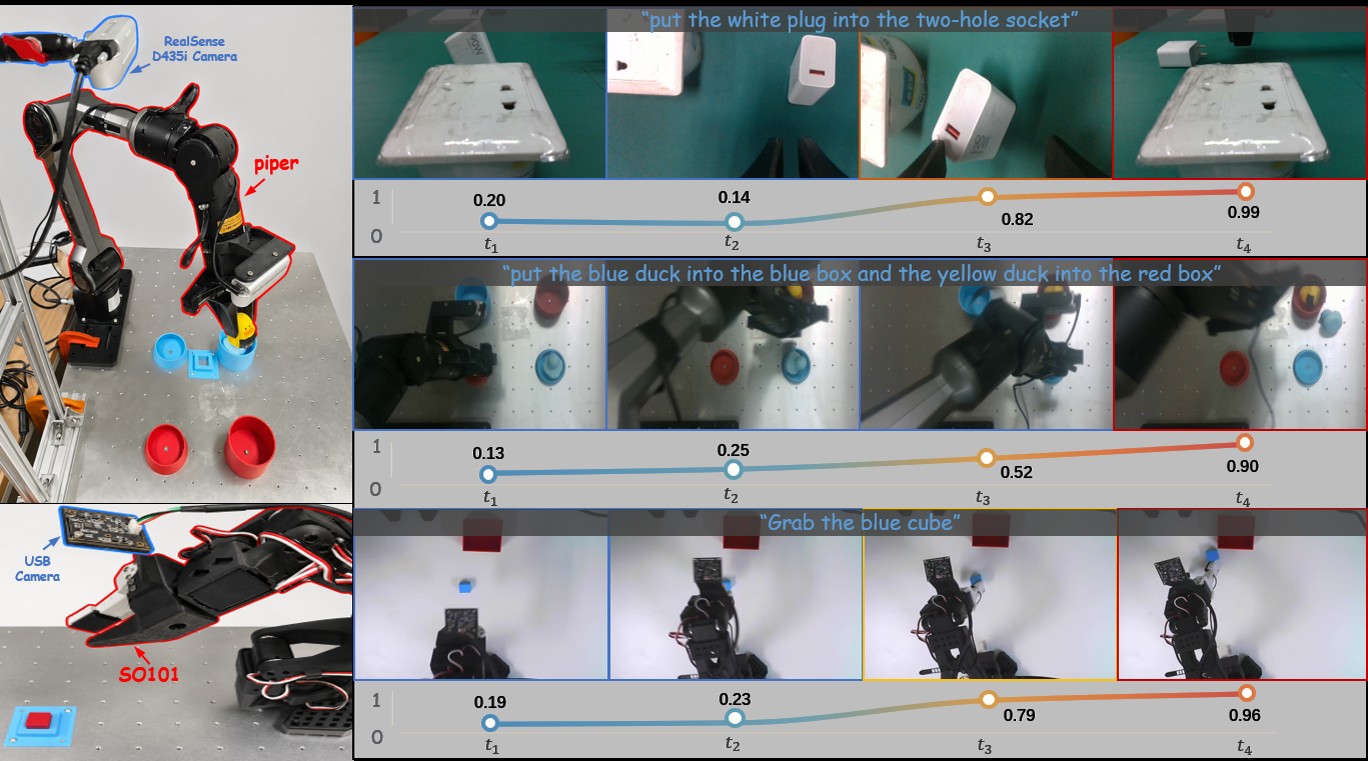
Four real-robot rooms
They keep the backbone frozen and try two source readouts (Core vs Expanded) plus readout-only adaptation:
| Robot / policy | Expanded zero-shot AUROC/AUPRC | Core zero-shot | Adapted |
|---|---|---|---|
| PIPER X / π0.6* | 84.70 / 79.13 | 41.35 / 35.43 | 98.48 / 98.41 |
| PIPER X / VLA-JEPA | 90.91 / 93.20 | 72.73 / 90.11 | 95.73 / 97.80 |
| SO-101 / Eval-RL | 69.85 / 68.46 | 57.80 / 42.76 | 82.88 / 73.06 |
| Franka / π0-FAST-DROID | 55.89 / 55.82 | 51.58 / 54.66 | 75.78 / 74.31 |
Zero-shot is not uniform. How you train the source readout matters as much as the frozen features. Adaptation updates only those 33,985 weights.
Once the WM state is already on an RTX 5090, the readout adds 0.2256 ms mean CUDA time (0.2393 ms P99), about 4,433 steps/s. That number excludes world-model inference.
Limits they own: you need internal states and labeled outcomes; unseen tasks stay harder than matched ones.
A Human’s Take
I will take a 34k-parameter whistle on a frozen predictor over another full-size critic any day, if the score actually rises before the mug hits the floor. The transfer table is the adult slide: Core vs Expanded is a reminder that “the representation contains failure” is not the same as “your probe found it.” Adaptation is allowed. Pretending zero-shot is free is not.