ETH Puts Legs on a Hand, Then Makes It Type
A walking robotic hand has to do three jobs with the same fingers: move, hold itself up, and poke the world. Amirhossein Kazemipour, Hehui Zheng, and Robert Katzschmann at ETH Zurich’s Soft Robotics Lab posted a paper on 15 September showing that an off-the-shelf WUJI right hand can learn those skills without a new finger design or a custom position controller.
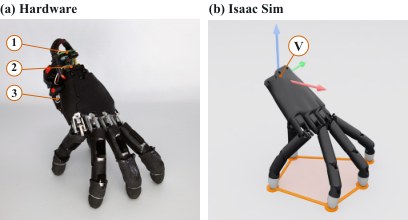
The finished robot weighs 818 g. The stock hand is 738 g. A dorsal pack adds a Raspberry Pi Zero 2 W, a BNO085 IMU, and a four-cell battery. Onboard power and compute make the platform untethered.
Fingers as legs
The hand has 20 actuated joints, four per finger, and they are not backdrivable. Firmware low-pass-filters position commands at 3 Hz. Each joint is limited to 1.0 A during the experiments.
Policies run at 50 Hz on the Pi as a 32-bit ONNX model. A 500 Hz serial driver talks to the motors. Crawl commands come in over a dedicated 2.4 GHz gamepad link. Wi-Fi stays out of the locomotion loop.
The researchers keep the unequal fingers and opposed thumb. They do not mirror the hand into a hexapod. A stance-calibrated control frame levels the palm’s natural tilt, and a footprint reward pulls each fingertip toward its own nominal stance. Fore-aft steps are cheaper than sideways or vertical drift, so the policy can choose when a finger lifts.
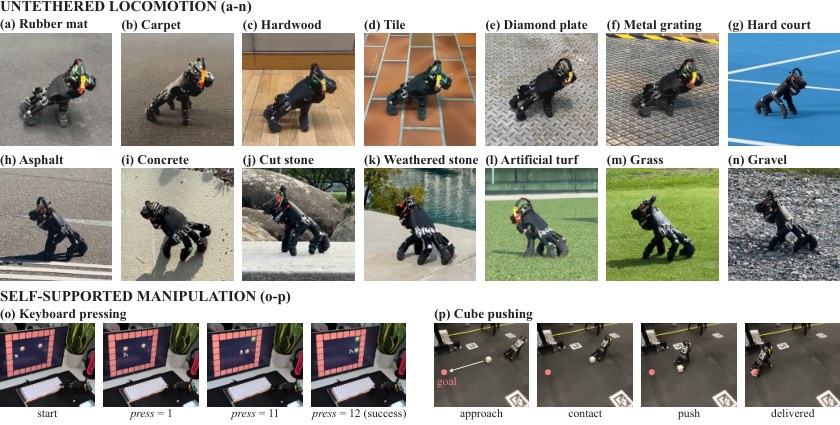
In simulation, that reward moved the hand faster than quadruped rewards adapted to the same body. On hardware, the crawl policy crossed 14 surfaces: rubber, carpet, hardwood, tile, diamond plate, metal grating, a hard court, asphalt, concrete, cut stone, weathered stone, artificial turf, grass, and gravel.
Steering is lopsided. Without a yaw command the hand drifts right at about 6°/s. A constant correction straightens it. Across 21 trajectories, mean path speed was 0.093 m/s. Closed-loop IMU heading worked for ±15° steps and a 30° right turn; 30° left turns ran into the command limit.
Typing while standing on itself
A separate recovery policy started from fallen poses. The hand righted itself in 21 of 25 hardware trials (84%): 11 of 14 thumb-side falls and 10 of 11 wrist-side falls. Four stalls came from fingers catching on each other.
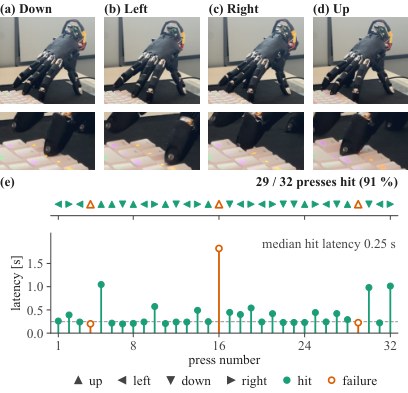
Keyboard pressing is the party trick. The hand supports its own weight, then hits arrow keys without vision. In a 32-command sequence it scored 29 correct presses over 72.5 s, with a maximum tilt of 7.7°. Median command-to-keystroke latency on hits was 0.25 s. All three misses were Up commands that clipped Right Shift. The same interface completed 9- and 12-move Sokoban solutions.
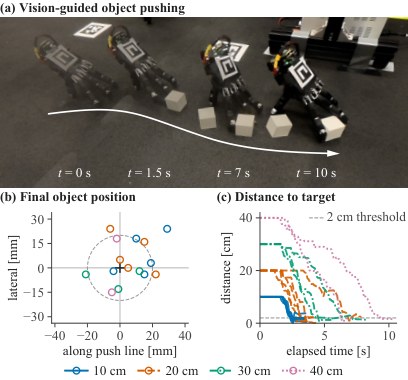
With an overhead camera, one policy approached a 40 mm, 41.4 g PLA cube and pushed it to targets 10–40 cm away. Across 15 deliveries, final target error averaged 17 mm.
A Human’s Take
I’m so here for a hand that crawls onto a keyboard and finishes a puzzle while holding its own weight. The useful idea is not “Thing from the Addams Family.” It is a compact manipulator you could drop near a tight opening, let it walk the last meter, and retrieve later. The heading bias and the four recovery stalls are the honest part: five unequal fingers are a terrible chassis, and they still made it work a shift on gravel.