Flex-π Predicts RGB, Depth, and DINO Futures From One Checkpoint
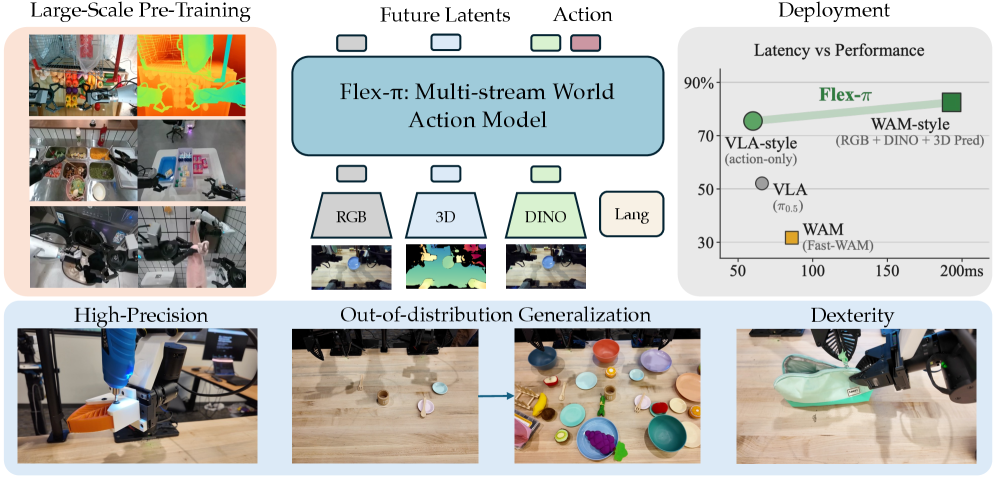
University of Washington and Allen Institute for AI researchers posted Flex-π on August 11 (arXiv:2608.10860). It is a 6-billion-parameter world-action model that jointly denoises RGB, 3D pointmaps, and object-centric DINOv3 features along with the next actions. One trained checkpoint can run from a fast action-only path to full joint future generation.
The free-lunch encoder
Most world-action models only predict RGB latents trained for pixel reconstruction. Flex-π’s claim is that a frozen Wan-2.2 video VAE already reconstructs 3D pointmaps almost losslessly (the paper reports PSNR 31.1 dB and 3.1×10⁻³ MSE in the VAE’s normalized space). Depth comes from Depth Anything 3; semantics from frozen DINOv3. No extra camera, no extra pretraining of those encoders.
A Mixture-of-Transformers backbone (5B visual trunk initialized from Wan-2.2-5B, plus a ~1B action expert) denoises every stream with actions. During training the team randomly drops input streams and still forces the model to generate the missing futures. They call that cross-modality forcing. Removing it cut RoboTwin success by 21% in their ablation.
Real bimanual numbers
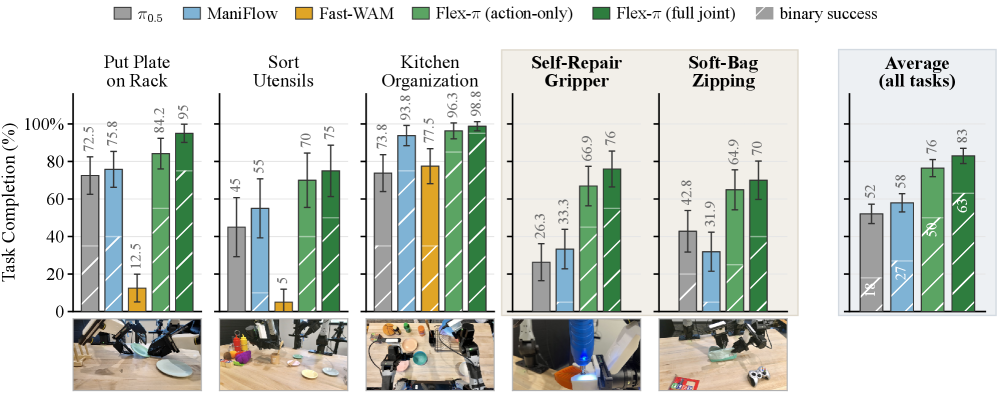
The policy was pretrained on about 500 hours from 100 AGIBOT World-Beta tasks, then fine-tuned per domain. On a real bimanual YAM cell it beat π0.5, ManiFlow, and Fast-WAM on five contact-rich tasks, including an eight-stage self-repair gripper job with a 4 mm bit into a 4.5 mm socket (±0.25 mm).
Project-page bars (task completion):
- Kitchen organization: Flex-π full joint 98.8% vs π0.5 73.8%
- Soft-bag zipping: 70% vs π0.5 42.8%
- Self-repair gripper: 76% vs ManiFlow 33.3%
- Action-only mode already beat every baseline; full joint added more
- Action-only latency: 60 ms on an RTX 5090; full joint about 193 ms
On RoboTwin (50 tasks) Flex-π hit 94.6% action-only. On LIBERO, a dropout-free fine-tune reached 99.2% overall, matching the strongest published VLA they list.
The authors are Ge Yan, Jinghao Liu, Yuzhi Fan, Lei Cai, Minwen Liao, Jesse Zhang, and Dieter Fox. Toyota Research Institute funded compute.
A Human’s Take
The part that made me sit up is not another 6B WAM. It is that the same frozen video VAE already “sees” pointmaps, so they get geometry supervision without a depth camera at deploy. Action-only at 60 ms beating π0.5 is the practical knob. I still want a third lab to rerun the self-repair screwdriver task. Sub-millimeter insertions are where papers love to live and factory bits love to snap.