FlexWorm Plans Suction Steps Instead of Handing You a Gait
Suction worms are great at clinging to walls and awful to program. Most still run a hand-written gait. A Peking University team led by Meng Guo posted FlexWorm on August 17, accepted at IEEE RA-L: a planner that treats each suction pad as a discrete contact mode and the soft body as a continuous deformation.
The hardware in the lab is a pneumatic worm with two soft segments, three suction pads, and four chambers per segment.
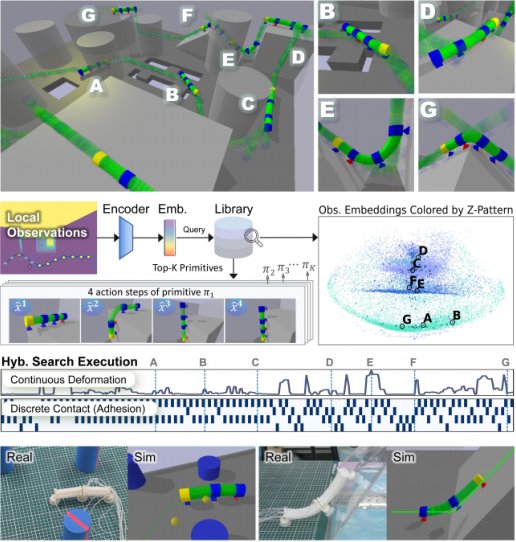
Search the contacts, solve IK only on the free bits
The core planner is IKHS, block-wise inverse-kinematics hybrid search. Attached pads become anchors. The planner only solves IK on the free segments between them, then checks collision, suction pose, and a load-deformation manifold built from about 10³ hardware measurements and 5×10⁵ finite-element samples.
PaHS sits on top. Offline IKHS rollouts (1,500 episodes, more than 40,000 short segments, about 6,000 library entries) become reusable primitives. Online, the planner retrieves the nearest ones, refines them with IK, and falls back to full IKHS if retrieval fails.
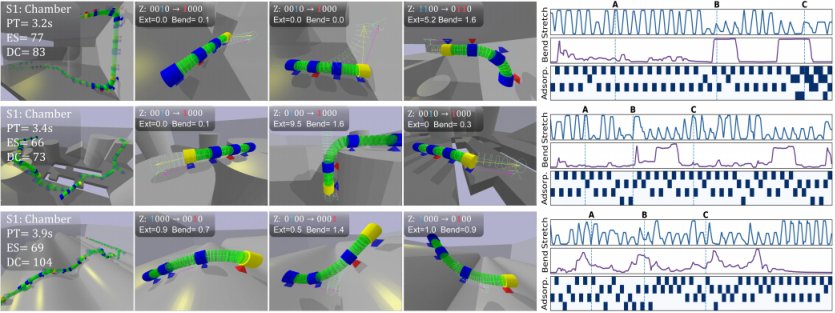
In simulation, both IKHS and PaHS hit 20/20 on three scenario sets (floor-wall-ceiling, clutter, strong curvature). PaHS cut planning time from 20.4 / 11.9 / 15.6 s to 1.7 / 1.0 / 1.8 s, about 12×, 11.9×, and 8.7×. Retrieval hit rates were 92%, 99%, and 93%.
Baselines that just replay primitives, warm-start a long optimizer, or beam-search a discrete grid all lost on success and time. Replay without IK refinement is how a wall transition goes from green to an illegal suction pose.
A real worm, a small table, a 45-degree slope
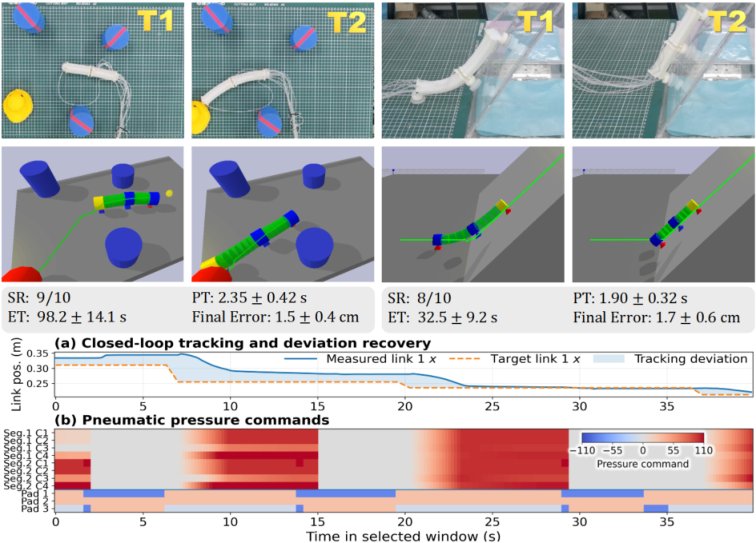
Hardware ran in a 60 cm × 40 cm workspace on plastic mats with movable obstacles. Nine motion-capture markers fed state back to the planner. They show planar navigation and a 45° slope transition, with closed-loop pressure commands and online recovery when adhesion or actuation drifted.
A Human’s Take
A suction robot without a planner is a party trick you retune every time the wall changes. This paper treats the interesting part as the hybrid decision: which pad sticks, then how the body bends.
The 12× speedup is just a library of moves they already proved were legal. That is the right kind of learning for a machine whose physics you do not fully trust. Table-scale is still table-scale. I want the same stack in a pipe or an aircraft bay before I call it inspection-ready.