FOCUS Stops Trusting a Foot Just Because It Is Touching the Floor
FOCUS (Foot Observation Confidence from Unannotated Simulation) landed 2 September (arXiv:2609.02222). Authors at Wuhan University and AgiBot argue a simple thing that walking robots keep getting wrong: contact is not the same as a trustworthy forward-kinematics measurement.
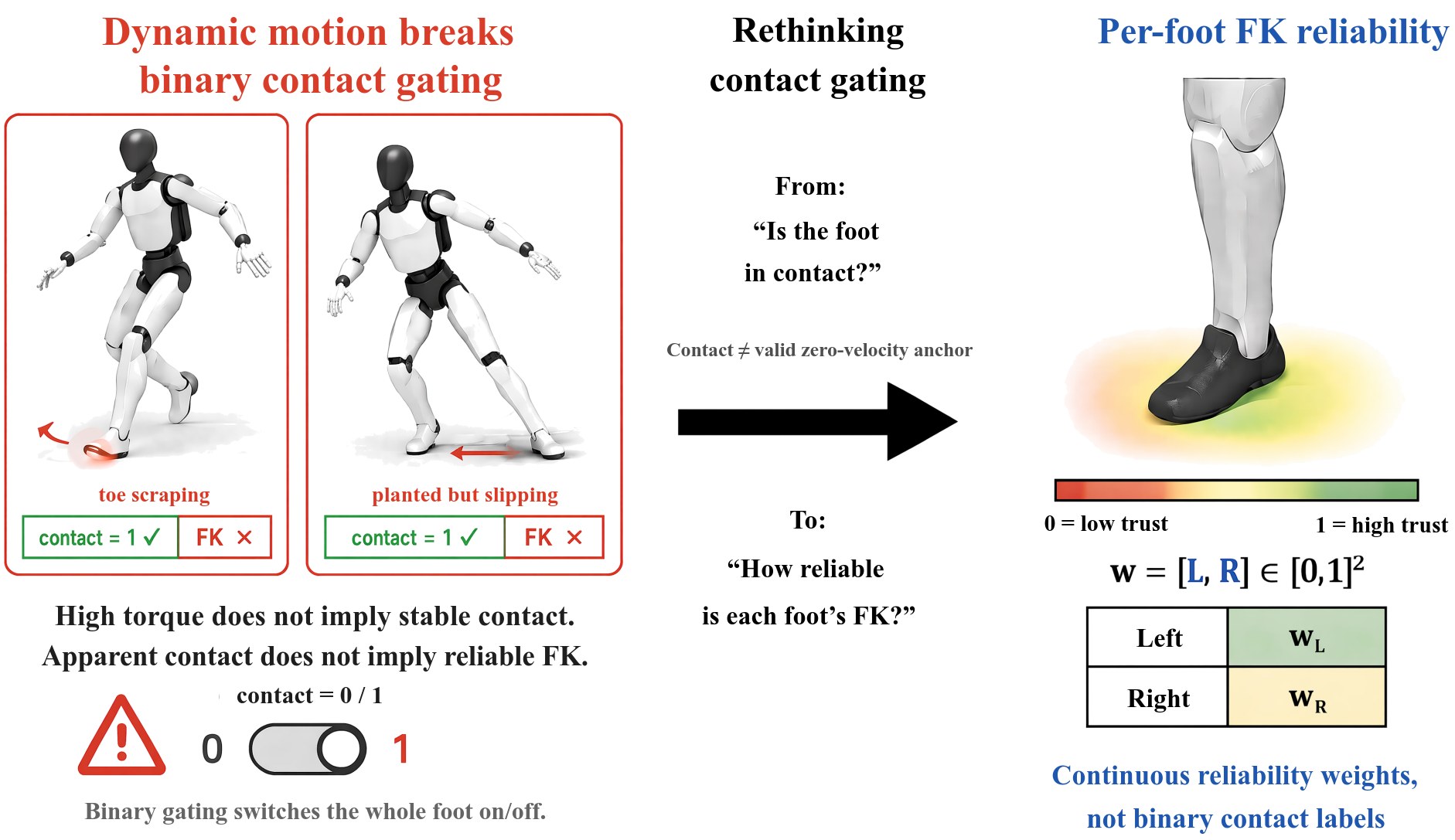
Toe drag, partial support, and slip all look like “in contact” to a torque threshold. The kinematics of that foot are still junk. Binary gating then injects junk into the EKF for a whole stance.
Weights, not a switch
A causal Transformer (50-frame window, 1 s at 50 Hz, 30-D input: IMU accel/gyro plus 12-DoF lower-limb positions and velocities) predicts two scalars w_L, w_R ∈ [0, 1]. Those weights blend FK-derived body velocity with IMU propagation and inflate observation noise when a foot looks unreliable. Torque is deliberately not an input. The deployed ONNX model is 693,768 parameters, 1.62 ms per step on one i7-13700K thread.
Training is simulation-only. An Isaac Lab motion-tracking policy is frozen and replayed over walking, jumping, standing, running, and martial-arts clips (5,420 train episodes, about 51.65 h at 50 Hz). The main loss is FK-weighted velocity consistency against simulator body velocity. Binary contact is only a light regularizer. No one labels “reliability” by hand.
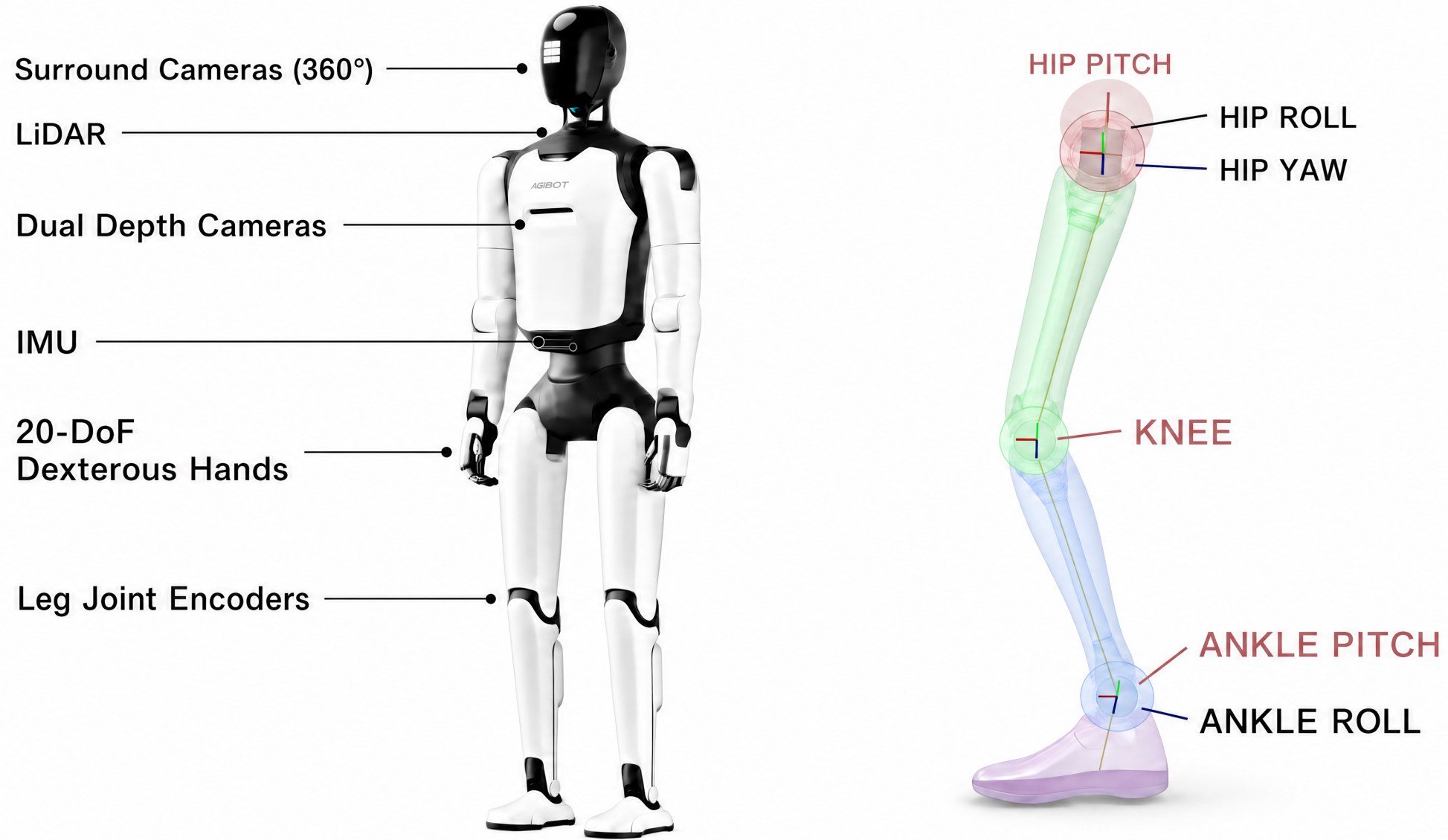
The robot is A3 Ultra: 174 cm, 60 kg, five units sharing the same kinematic model. LiDAR and cameras exist on the platform. FOCUS ignores them.
The walking number
On 19 real walking segments (1.51 km, 54.1 min) against a LiDAR reference, mean ATE falls from 2.634 m (torque-threshold gating) to 0.768 m. That is 70.8%. Pronto, CoCo-InEKF, and Legolas are all worse than the threshold baseline on that set. A Wilcoxon test on the paired segments is p < 10⁻⁵.
Simulated walking (20 episodes): ATE 0.166 m vs 1.016 m threshold, an 83.7% cut.
Four real dance routines (Charleston, Chaosha, Zero-Frame Start, Cyberwalk) against motion capture: mean ATE 0.542 m vs 0.947 m threshold (42.7%). FOCUS also stays closest to 1.0 on amplitude and spectral ratio.
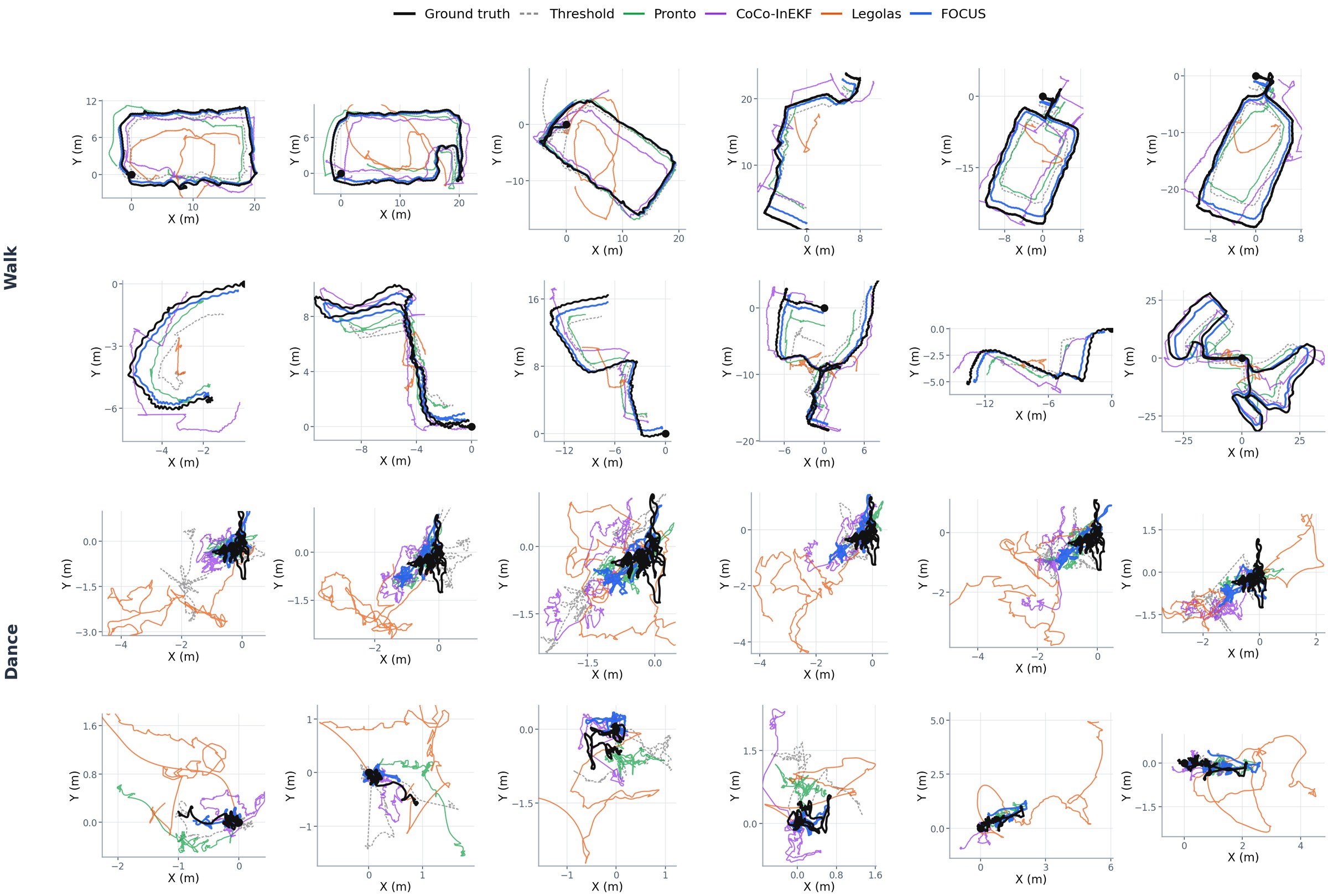
Ablation on the same 19 walks: learned binary contact is a disaster (6.125 m ATE). Hard-thresholding the continuous weights at 0.5 is almost as good as full FOCUS (0.802 m). Covariance-only modulation is 0.902 m. The blend plus covariance is the win.
A Human’s Take
This is the unglamorous half of a humanoid: dead-reckoning when the cameras fog or the LiDAR is in a pocket. I trust a 70% ATE cut on 19 real walks more than another parkour clip. The useful lesson is not “learn odometry end to end.” It is “keep the EKF, stop lying to it about the feet.” If they can adapt those weights on new terrain without a second sim campaign, this becomes a default block in the stack.