FreqFM Conditions VLA Flow Matching on Action Frequency
Robot action chunks are not white noise. On AGIBOT’s real-robot logs, more than 99.9% of the energy in a 30-step horizon sits in the lowest three DCT bins, with more than seven orders of magnitude between the loudest and quietest frequencies. Standard flow-matching VLAs still generate those chunks in time.
FreqFM, from Haochen Niu, Wang Chuang, and colleagues at AGIBOT and Xi’an Jiaotong University, treats frequency as an explicit conditioning axis for the whole flow pipeline. The paper, posted 9 September, plugs into existing π0 and π0.5 action experts without changing the VLA backbone.
Three stages, one spectrum
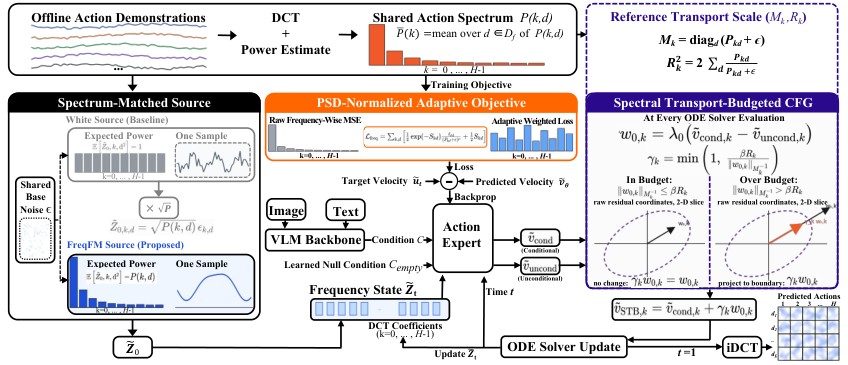
A discrete cosine transform along the action horizon exposes per-frequency power. FreqFM then:
- Matches the source. The Gaussian start of the flow is rescaled so each frequency has the same second-moment spectrum as the training actions, instead of a flat white prior.
- Reweights the loss. Coefficient-wise errors are PSD-normalized, then balanced with learned per-frequency scales so high-energy low frequencies do not own the gradient.
- Budgets classifier-free guidance. Extra CFG residuals are clipped in units of each frequency’s own transport scale, which is tightest on the quiet high-frequency bins that make jerky motion.
The authors freeze those statistics from the training set. They do not condition the spectrum on the current image or instruction.
Benchmarks
Each FreqFM model is trained 20k steps against a paired temporal flow-matching baseline with the same architecture, data, optimizer, and budget.
On LIBERO, both sides are near saturation; FreqFM’s gains are +0.7 and +1.2 points depending on backbone. The larger jump is LIBERO-Plus, a perturbation suite: +5.5 on π0 and +9.3 on π0.5. Camera, robot, and noise — the three perturbations where the temporal baseline is weakest — show the biggest lifts. Light and background, already above 87 points for the baseline, are the only two where π0 regresses.
VLA-Arena totals improve +2.6 and +4.2 points. The Extrapolation category regresses on both backbones, which the paper reads as the cost of a fixed training-set spectrum.
Ablations on LIBERO-Plus: a time-domain copy of the three stages helps much less than FreqFM. Removing the matched source costs 4.2 points. The transport budget changes success only 1.9 points, but it cuts mean absolute jerk of executed arm trajectories by 56% on LIBERO (0.442 to 0.193) at a comparable success rate.
Six tasks on an A2
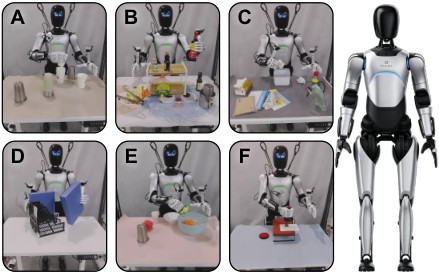
The real robot is an AgiBot Expedition A2. Policies see one chest camera and two wrist cameras. Tasks: cup stacking, kitchen tidy, table cleanup, folder filing, toy storage, and stamp-and-handover. 30 trials each, 24 subtask stages in total.
Averaged across the six tasks, π0.5 sits at 57.8% success / 70.6% subtask success. FreqFM reaches 67.8% / 79.0%. Toy storage is already near ceiling and does not move. The gains concentrate on fine alignment: cup stacking +23.3, folder filing +13.4, stamp-and-handover +13.3 points.
Limits: the source and the guidance budget are global, not observation-conditioned. Smooth action dimensions have to be designated per embodiment.
A Human’s Take
I like that they measured the spectrum on the robot they actually run, then went back to the A2 for cup stacks and a stamp. A 9.3-point LIBERO-Plus bump is the headline; the jerk cut is the part I would watch in a factory. If the next version estimates frequency stats from the current scene instead of the training corpus, the Extrapolation miss on VLA-Arena is the obvious place it should help.