FS-MPC: Sampled Control That Doesn’t Fall Over on a Unitree H1
Sampling-based model-predictive control is easy to throw on a GPU and hard to trust on a machine that can fall down. Chaoyi Pan, Guanya Shi, and colleagues at Carnegie Mellon, with Zachary Manchester’s group at MIT, posted FS-MPC (Feedback Sampling MPC) on arXiv August 19. The claim is simple: if you sample through a feedback policy instead of open-loop noise, the rollouts stop exploding.
They put it on a real Unitree H1 for walking a room and stuffing a cylinder into a cart.
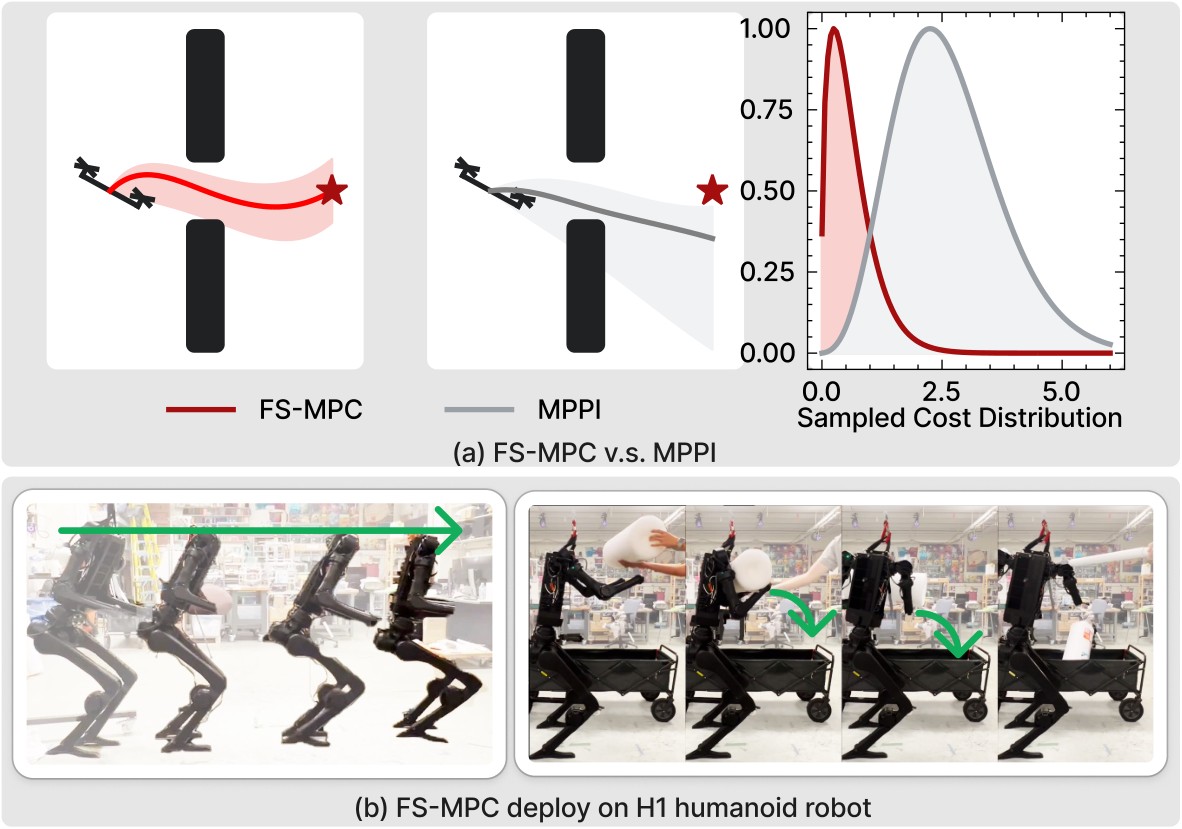
The problem they are actually solving
Standard MPPI draws control sequences from a Gaussian, rolls them open-loop, and softmaxes the cheap ones. On a car or a quasi-static arm that is fine. On an unstable humanoid, almost every sample diverges as the horizon grows. The paper proves that for an unstable linear system, the number of samples you need grows exponentially with horizon.
FS-MPC’s trick is a duality: for linear-quadratic problems, the best sampling covariance is the same as injecting noise into the optimal iLQR feedback. You do not sample a giant correlated sequence. You sample locally, apply feedback, and the joint distribution comes out right.
On nonlinear and contact-rich systems they mix two proposals. Some samples use the local feedback (or a learned PPO stabilizer when the dynamics are not differentiable). The rest stay isotropic for global search. The mix ratio depends on how many samples you can afford.
In simulation they report 43.4% lower cumulative cost than standard MPPI when the feedback controller itself is suboptimal. Tables cover acrobot, quadrotor, a quadruped on a hill, H1-2 pick-and-place, and an Allegro in-hand reorient. FS-MPC beats both MPPI and iLQR on the contact-rich end.
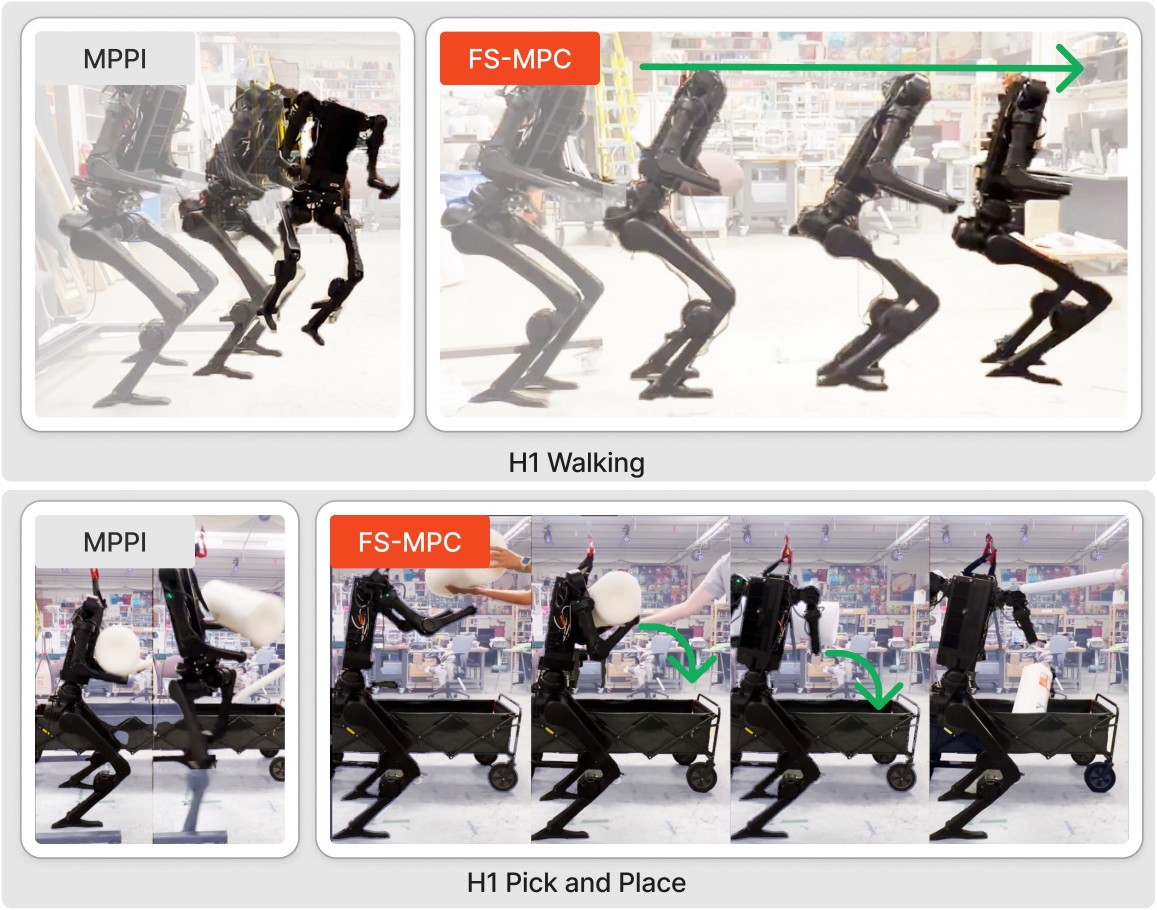
On the H1
Hardware uses proprioception plus a Vicon mocap stream, fed into a MuJoCo MPC stack, then joint-position commands. MPPI failed to keep the robot up. FS-MPC walked the room. Tracking error versus iLQR was only a modest improvement; the authors blame mocap delay and weak contact sensing. For the cart task, MPPI produced noisy motion that crashed. FS-MPC placed the cylinder.
Runtime settings they actually used: 8 local samples, 24 global, softmax temperature 1.0. NSF and several Carnegie fellowships funded the work. Shi notes a concurrent Amazon Scholar appointment; the paper says the research was done at CMU, not Amazon.
A Human’s Take
I have watched too many “sampling MPC on a humanoid” clips that work until the horizon gets honest. Feedback in the sampler is the right diagnosis. The H1 cart task is the receipt I care about: contact, balance, a moving target. I still want onboard state, not Vicon. If this only flies in a mocap cage, it is a methods paper. If it holds with the robot’s own estimators, it is a controller.