FUSE Looks Around Before It Decides What Can Scoop the Food
If you ask a robot to “scoop food,” the right tool might be a spoon, a cup, or a ladle, and the first camera pose may hide all of them. FUSE (Functional Understanding through Semantic–Geometric Exploration) treats that as its own task: active functional affordance grounding. The paper is arXiv:2608.12683, posted 13 August 2026, by Zhou Chen and Sathyanarayanan N. Aakur.
Passive affordance methods pick a mask from the frame they already have. Active object search usually hunts a named class. FUSE is asked for a function, then has to decide where to look until one object is grounded well enough to point at.
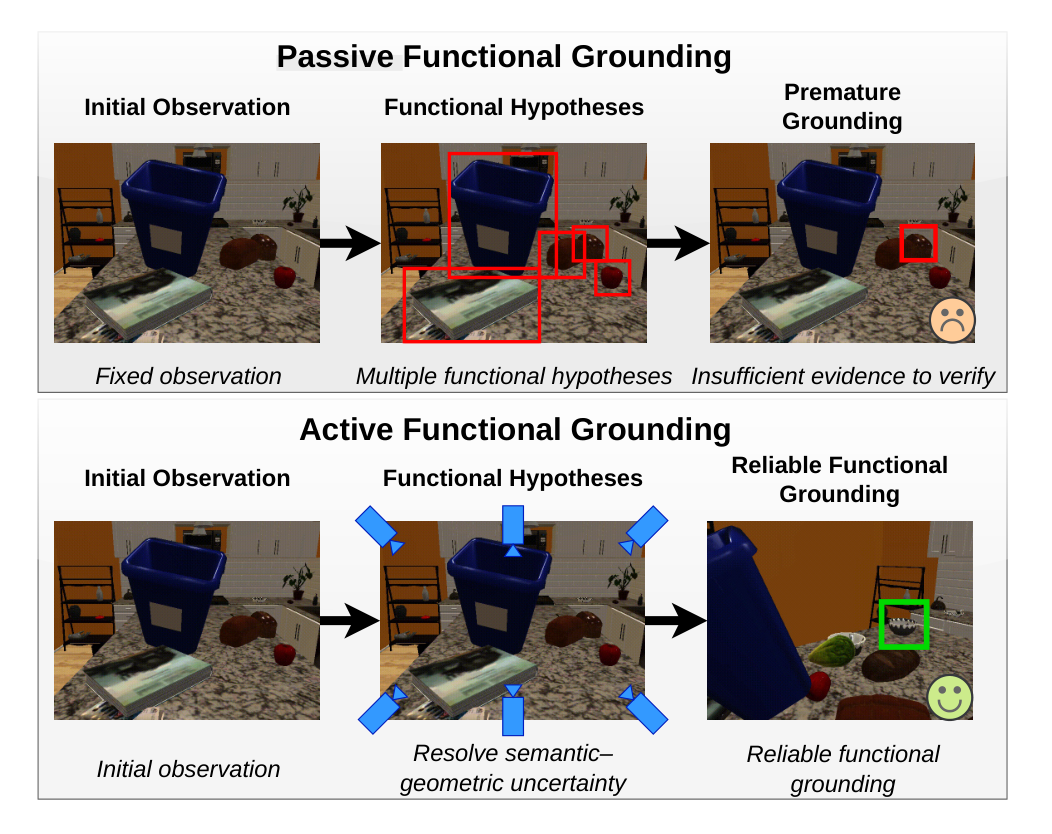
How it chooses the next look
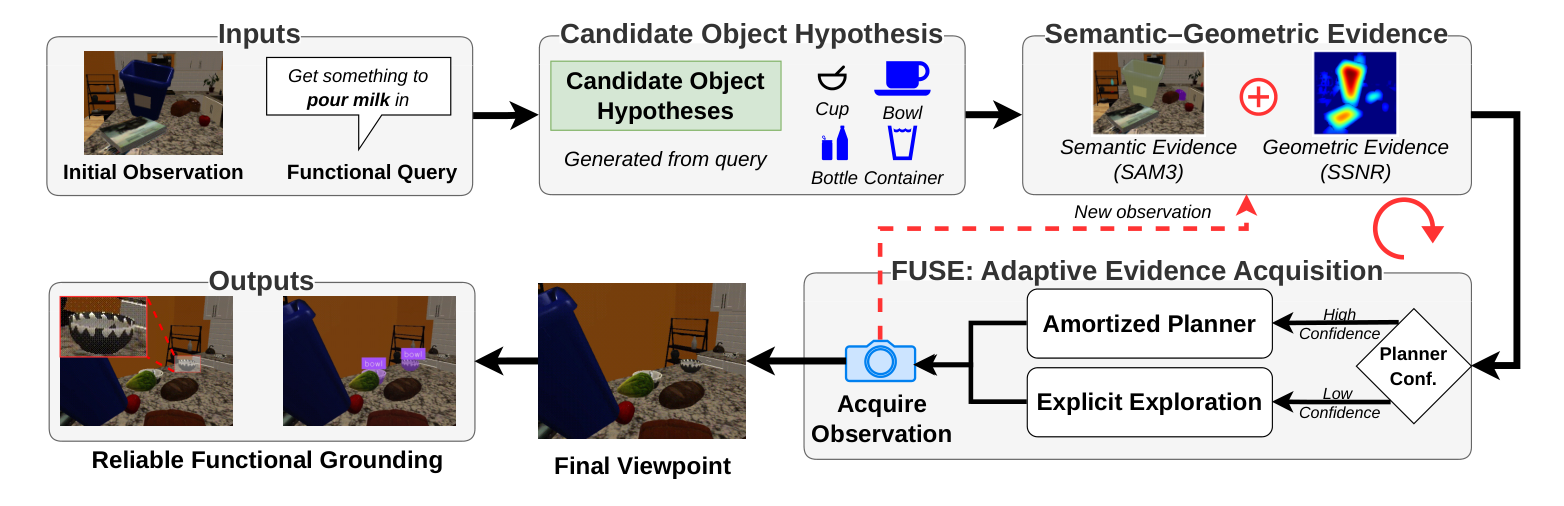
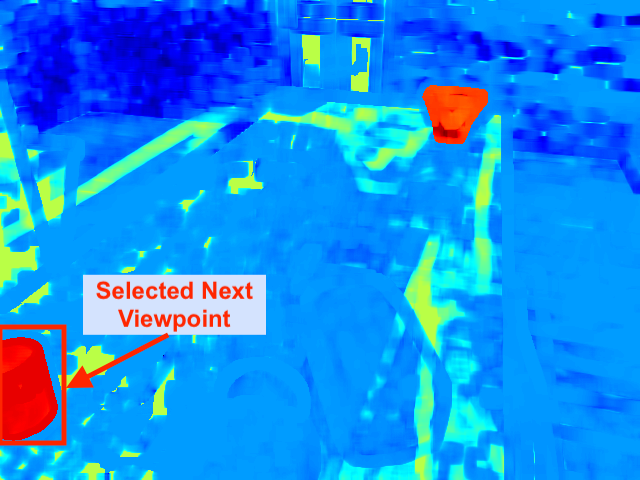
A functional query first becomes a set of candidate object names. SAM3 paints semantic evidence for those names. A 3D Gaussian scene, started from four seed views via COLMAP, renders what the model thinks it should see. The mismatch, via a structural SNR map, is geometric uncertainty. Those two maps add into an acquisition score that picks the next pan or tilt.
When that search is expensive, a small amortized planner (CLIP image features plus a three-layer MLP) guesses the same action values in one pass. If the action distribution is confident (entropy at or below 0.8), FUSE takes the cheap guess. If not, it refines the Gaussians and does the full search. Exploration stops after K = 5 non-improving fused scores or T = 30 steps.
The Habitat table they built
They evaluate 100 randomized tabletop scenes in Habitat. Each episode hides a target among 7–14 distractors and starts from a view where at least one valid target is partly occluded. Success is SAM3 IoU > 0.5 against a valid target at the returned viewpoint.
With CRAFT-E as the affordance source, they report:
- Static (no move): 42% success
- One canonical bird’s-eye move: 32%
- Random walks: 56%
- VLM Active (Gemini, with the oracle label): 65%
- Explicit search only: 70%
- Amortized only: 66%
- FUSE: 72% success, 70.91% mean IoU
- Oracle-label FUSE: 77%
On paired episodes, FUSE is 1.33× faster than full explicit search and calls the expensive 3DGS refine on 33.41% of decisions (2.97 refinements per episode). Swap the hypothesis source and FUSE still works; weaker name lists (CRAFT at 53%) cannot be rescued by better looking.
The authors say they will release the Habitat benchmark. Future work listed: real robots, dynamic scenes, and tying this to actual grasping. Funding includes NSF and a USDA award.
A Human’s Take
I like that the one-shot “canonical view” was worse than sitting still. Extra motion without a reason is not a strategy. FUSE is still a tabletop sim with a name list upstream of the camera. That 72% is a looking score, not a scooping score. Put a real arm behind it and then we can talk about the spoon.