FWBC-VLA Wipes a Board and Opens a Loaded Door Without a Force Sensor
A wheeled-legged quadruped with an arm can lean into a whiteboard or a door closer. The VLA that picks the next pose usually has no idea how hard that lean is. FWBC-VLA, posted 3 September by a team spanning Zhejiang University, Shanghai AI Lab, Tsinghua, Zhongguancun Academy, Deep Robotics, and others, estimates that load from joint torque residuals instead of bolting on a force/torque sensor.
The hardware is a Deep Robotics M20S with a CM1 6-DoF arm, a 1-DoF gripper, and three RealSense D435i cameras (base, hand, third person). The contact-rich tests are whiteboard wiping and door opening, including a closer the paper pegs at 50 N at the handle.
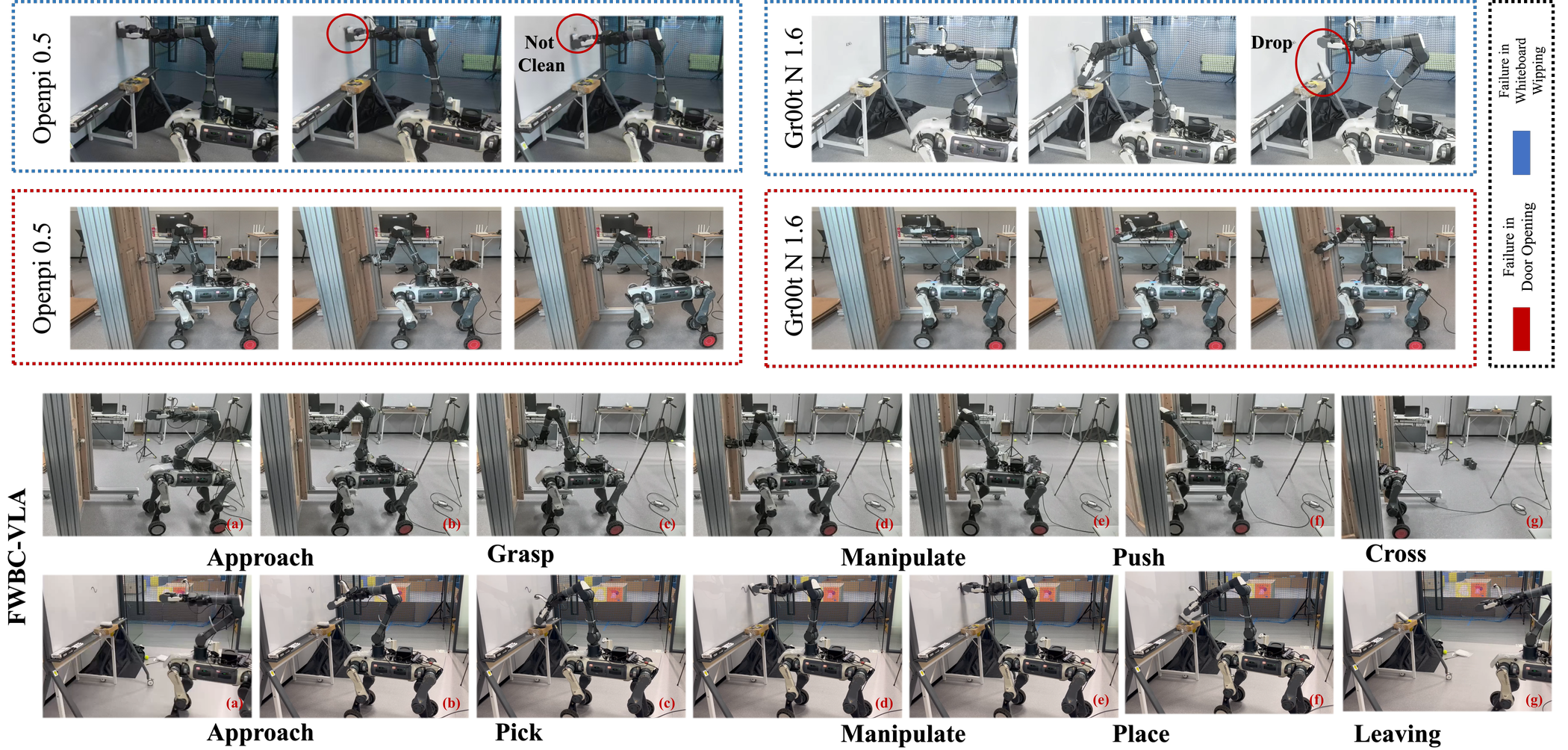
Residual torque in, two loops out
HSR-Force is a pair of LSTMs running at 200 Hz. One watches torque-and-motion history; the other watches current arm, leg, base, and IMU state without torque history so sustained contact is not swallowed as “normal dynamics.” A fixed gate mixes them. The residual is summarized as strength plus its one-step change, then packed into force tokens for the VLA action expert.
The backbone is pretrained π0.5, fully fine-tuned on a WL&Arm teleop set the authors say they will release: more than 5,000 episodes at 15 Hz for loco-manipulation, 200 Hz joints for estimation. Task mix: bottle pick-and-place 41%, whiteboard wiping 25%, door opening 21%. Calibration loads are 0.36 kg and 0.72 kg on a force gauge.
A second path takes the same residual, projects it through Jacobians into end-effector and body wrenches, and emits a bounded base-velocity correction for the whole-body controller.
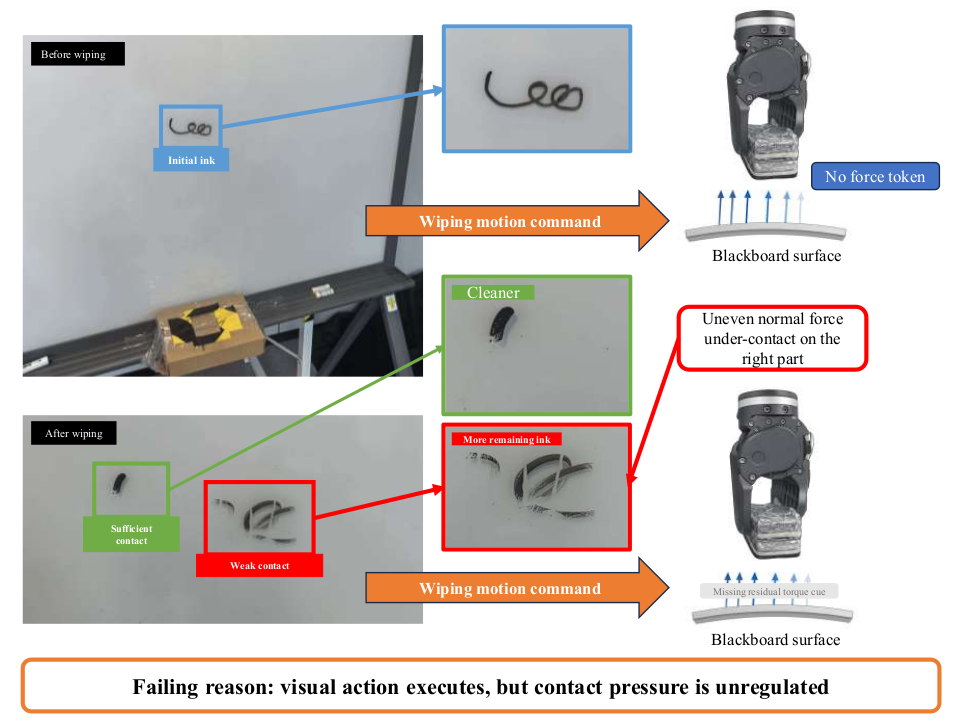
What the contact stages actually do
On four contact-critical stages, the paper’s ablation table is blunt. No force: 12.0% average. Force tokens only: 35.0%. Full FWBC-VLA (force interface plus body compensation): 65%. Pushing a door with the closer goes from 0% without compensation to 52%. Board cleaned goes from 8% / 32% to 76%.
The authors also run OpenVLA, StarVLA, π0.5, GR00T N1.6, ACP, ForceVLA, and a ground-truth force variant. They say FWBC-VLA leads every reported stage on both tasks, and that the estimator version sits close to the real F/T-sensor control.
Limits they list: they have not fully mapped how estimator error hits task success, and the stack is still a VLA sitting on top of a separate WBC, not a single whole-body policy.
A Human’s Take
I am here for “we refused to buy the wrist sensor.” Residual torque is a messy proxy, and they treat it as one. The number that sold me is the door closer: force tokens get you to the handle, and the body compensator is what keeps the chassis from walking away while you lean 50 N into a spring. If the 5,000-episode dump actually ships, this is a useful recipe for every wheeled-leg arm that was never designed for a mini F/T cell.