Galaxea G0.5 Puts Reasoning and Action in One Token Stream
Galaxea’s G0.5 is a pretrained vision-language-action model that keeps the language model as the actor. One transformer decoder writes reasoning tokens and action tokens under the same next-token loss, instead of handing a hidden state to a separate flow-matching expert. The paper landed on arXiv on August 12.
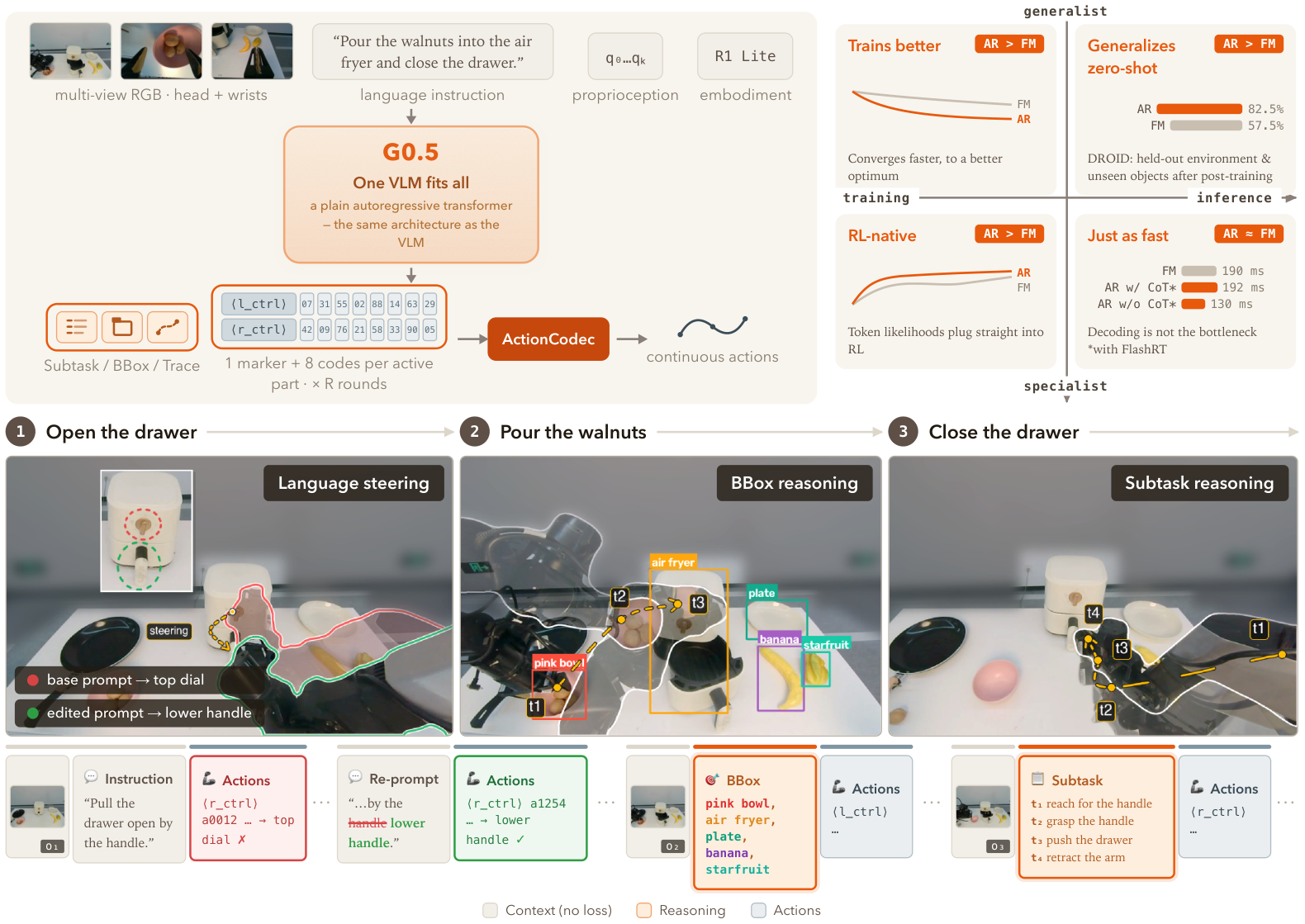
One stream, three pieces
Most recent VLAs treat the VLM as a context encoder. G0.5 argues that move hides the model’s chain-of-thought, in-context learning, and prompt steering behind a compressed bottleneck. The team’s fix is to stay autoregressive and shrink the action tokens.
- ActionCodec: a learned cross-embodiment tokenizer that maps heterogeneous robot actions into a shared discrete vocabulary. Idle control groups are dropped instead of padded.
- Native CoT: task decomposition, object grounding (bounding boxes), traces, and action hints sit in the same stream as the action codes.
- Visual memory: multi-second history is injected through the vision encoder rather than by stacking full frames at the decoder.
Because reasoning and action share weights, the paper says prompts can steer action granularity, task horizon, and out-of-distribution scene handling without extra training.
Seven test beds
G0.5 is pretrained on a mix of robot datasets and VQA samples, then scored in seven separate regimes:
- R1-Lite / R1-Pro real-world fine-tuning: 76.7% success versus 53.3% for π0.5 and 24.4% for GR00T-N1.7
- 2025 BEHAVIOR Challenge, 50 long-horizon household mobile-manipulation tasks, one generalist policy: 31.4% versus 26.3% for π0.5 and 26.1% for the challenge winner
- DROID post-training, then zero-shot to an unseen environment and objects: 82.5%
- LIBERO 98.9%, RoboTwin 2.0 93.3%, SimplerEnv-Bridge 87.3%
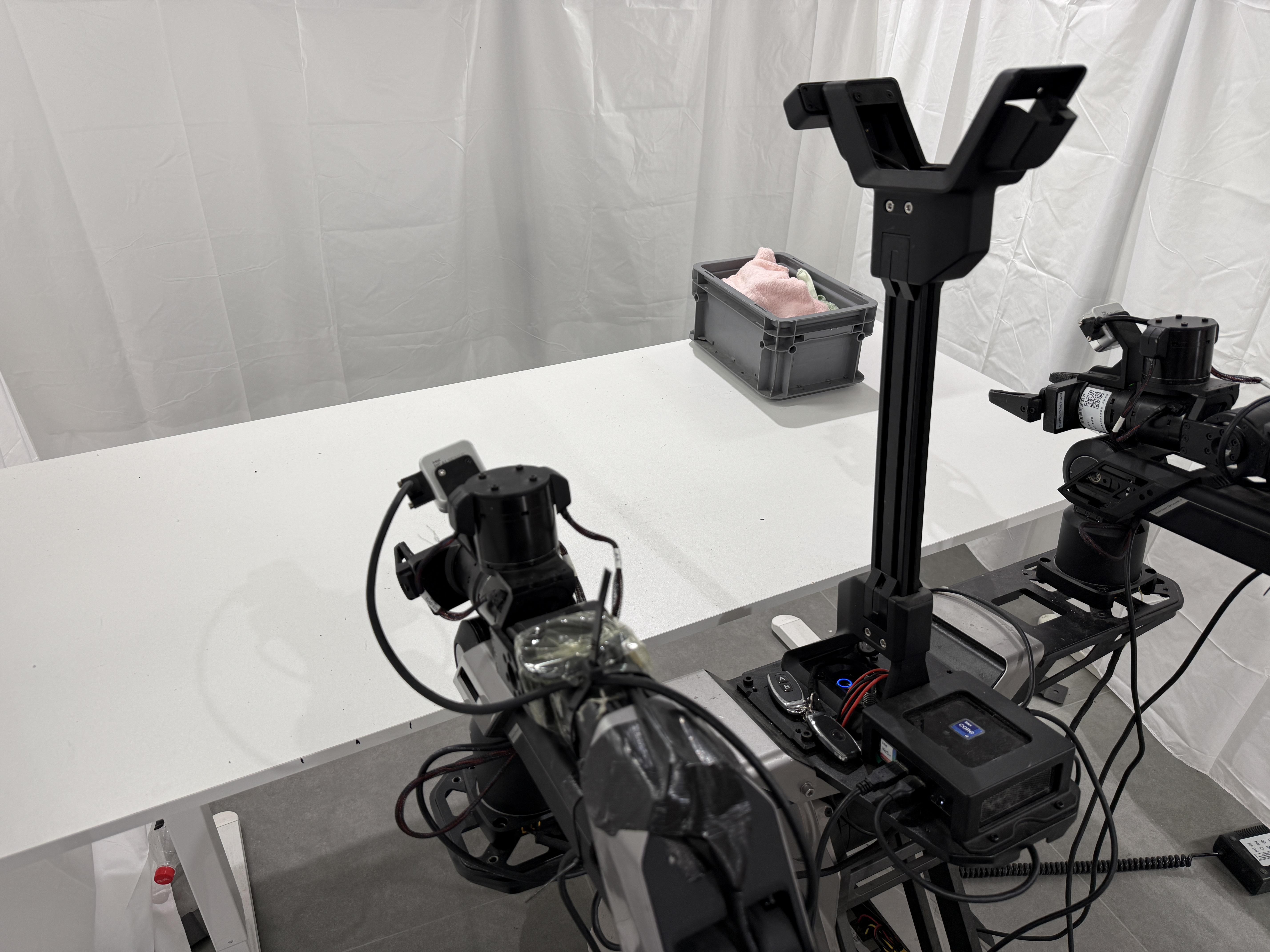
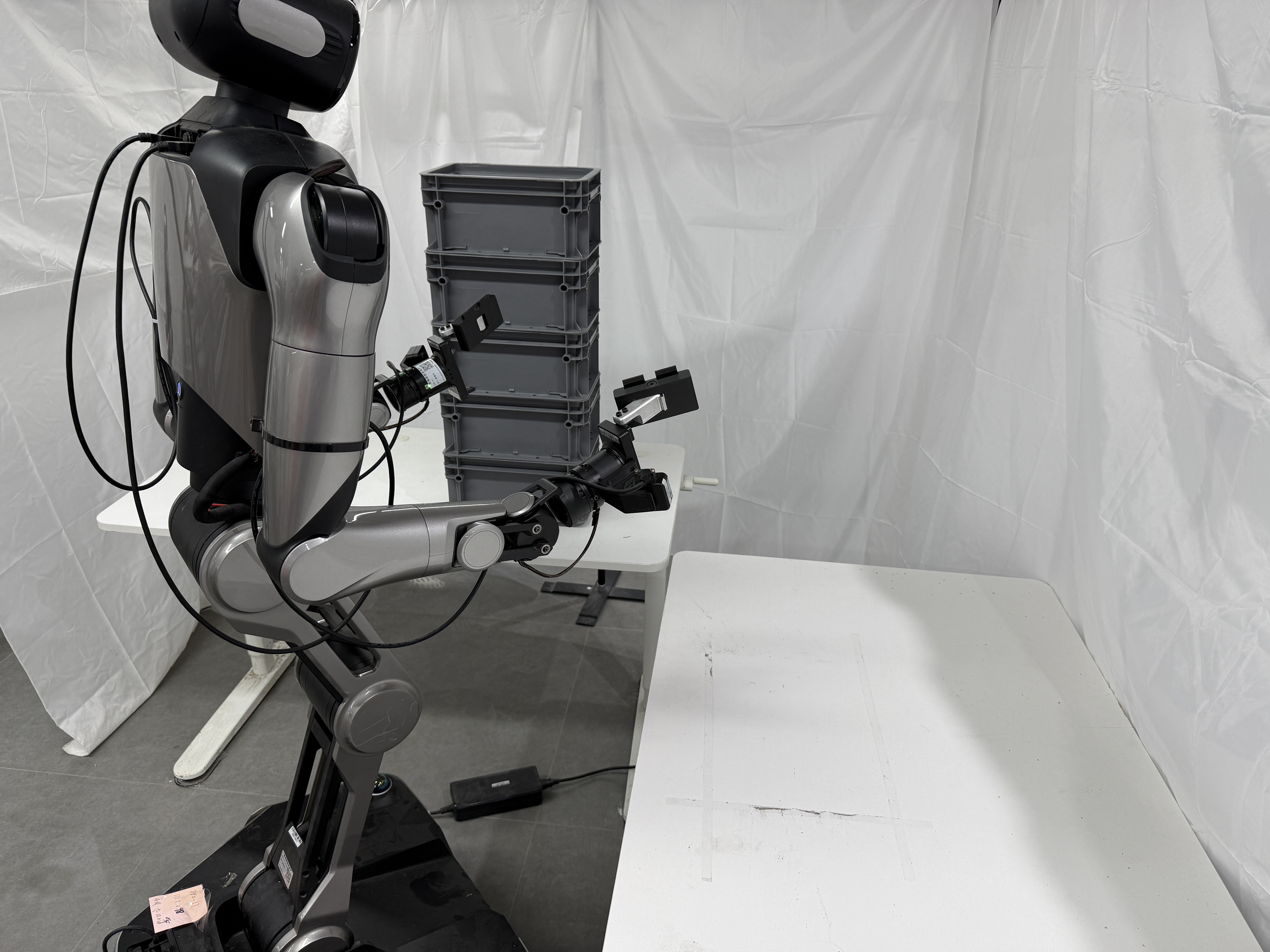
The hardware photos in the paper show an R1-Lite folding towels and an R1-Pro stacking crates. Those are specialist fine-tunes, not a claim that the pretrained checkpoint already folds laundry in a kitchen.
A Human’s Take
I’m glad someone is arguing that the VLM should stay the decision-maker. Flow-matching experts made high-frequency control cheap, and they also made the language model a feature extractor. G0.5’s numbers on R1 hardware and BEHAVIOR are the part I’ll watch: if a single decoder can hold 76.7% on those bimanual cells without a second action head, the “VLM-as-encoder” recipe has a real competitor. The thing I still want is an independent lab running the same R1 tasks with the released backbone, not only Galaxea’s fine-tune.