A Unitree G1 Just Threw a Measured Tight Spiral
Iowa State researchers Zaid Mahboob and Bowen Weng posted a paper on August 17 that does something I have not seen on a humanoid before: a spin-stabilized tight spiral with an American football. The robot is a 29-DoF Unitree G1 with a 7-DoF Dex3-1 three-finger gripper and a custom 3D-printed thumb nail for a cleaner release.
The best throw they report hits 93.6% spin efficiency, a 0.286 rad nose-angle error, 5.35 m/s linear speed, and 14.5 rad/s spin. An ideal spiral, as they define it, is 100% spin efficiency and zero nose error.
Why a football is a mean object
Most robot throws treat release as “open the gripper.” A football cares about both linear and angular momentum lining up with the long axis. If the nose is not pointed along the velocity, the ball wobbles.
The authors say they could not find a clean scientific consensus on what a “tight spiral” even is, so they wrote one. Spin efficiency is how much of the angular velocity sits on the nose axis. Nose angle is how far the nose sits off the velocity vector.
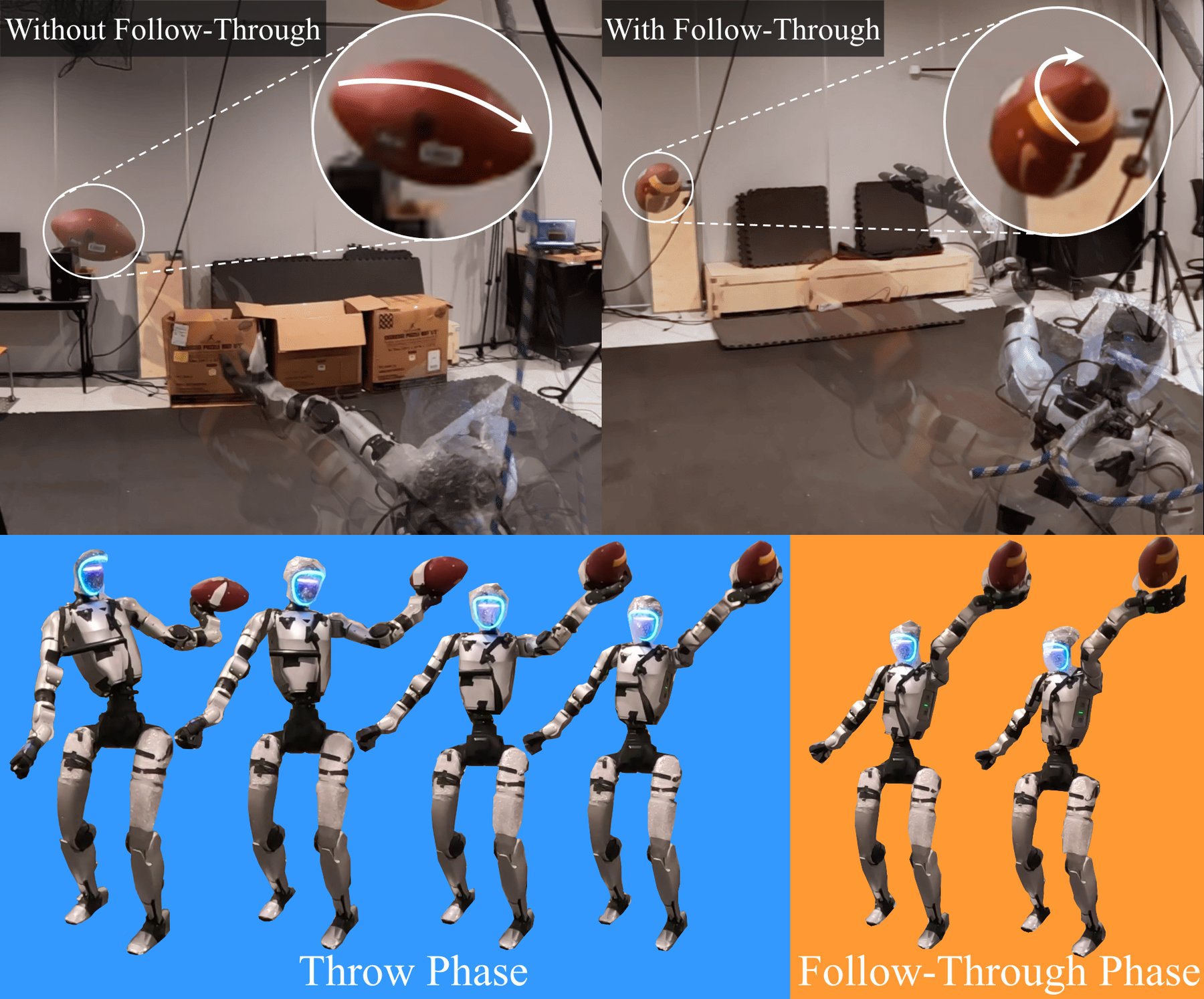
The hard part is the last sub-100 milliseconds. After the thumb opens, leftover finger contact can still shove the ball. Their follow-through phase lasted 78.5 ms on average across 61 trials, and sometimes only 30–40 ms.
Two phases, then the legs hold still
The controller splits the job:
- Throw phase: offline trajectory optimization over 0.6 s on a reduced 10-DoF waist-and-arm model, then PD tracking with feedforward torque
- Follow-through: model-predictive control on the wrist and remaining fingers to keep spin on-axis and the nose pointed
- Legs: NVIDIA GR00T whole-body control, with pelvis motion estimated by an EKF so the arm can subtract it
They ran OptiTrack at 360 Hz (six PrimeX 22 cameras) on a 0.252 kg ball inflated to 12 psi. Target release in the optimizer was 3 m/s and −6 rad/s. Hardware overshot that on the best throw.
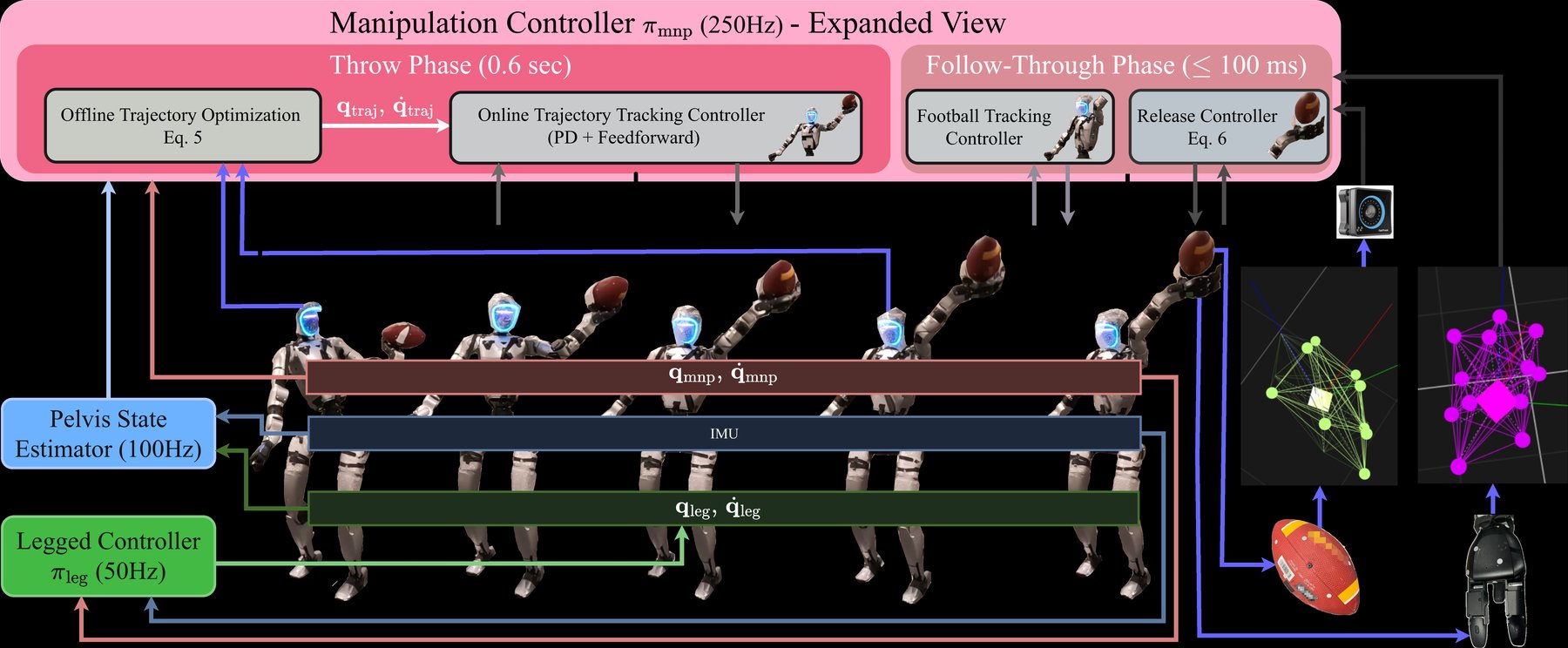
Without follow-through, average spin efficiency dropped from 67.1% at the end of the throw phase to 60.9%, and nose error grew from 18.9° to 34.7°. The worst trial fell to 18.5% spin and 48.5° of wobble. Online MPC was too slow (~500 ms per solve), so they used a lookup table built from real throws.
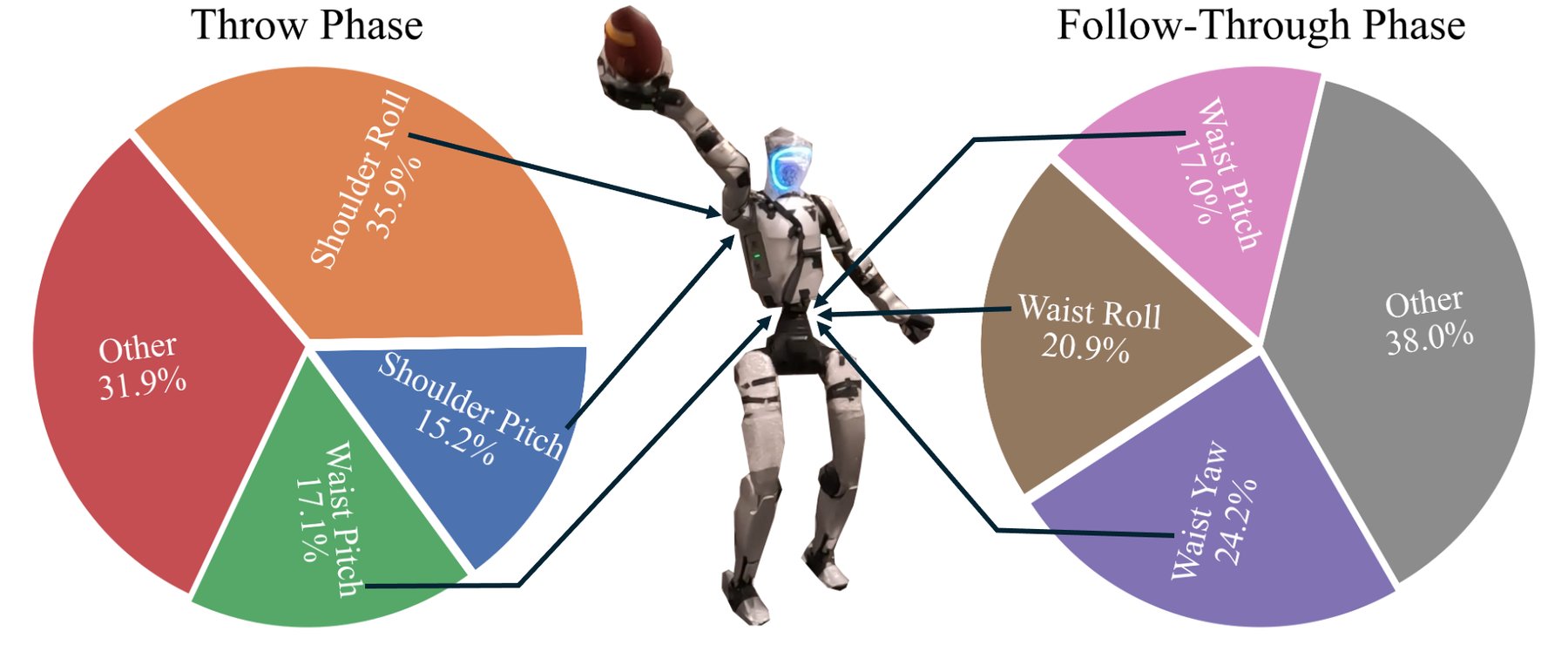
Shoulder roll, shoulder pitch, and waist pitch did most of the throw. Waist yaw, roll, and pitch took over during follow-through. There is no human-style wrist snap in this stack.
A Human’s Take
This is the kind of paper I want more of. A G1, a real ball, a definition you can argue with, and an ablation that shows the last 80 milliseconds are the whole trick.
It is still a lab throw into a motion-capture volume, not a 20-yard out. The robot needed a thumb nail, a lookup table, and a lot of OptiTrack. Fine. Someone finally measured a spiral instead of posting a clip and calling it athletics.