A Unitree G1 Learns Roofer Motions on a Pitched Lab Roof
Roofing is walking, kneeling, and putting a tool on a surface that wants to slide you off it. Songyang Liu and Shuai Li at the University of Florida posted a paper on 17 September that treats those motions as a humanoid control problem on a Unitree G1, not as a drone with a nailgun.
The hitch: a VR demo can look like roofing and still plant the robot’s feet through the shingles. Sparse Pico tracking tells you how the person moved. It does not give a metric registration to the roof.
Ground the demo to the roof, then learn
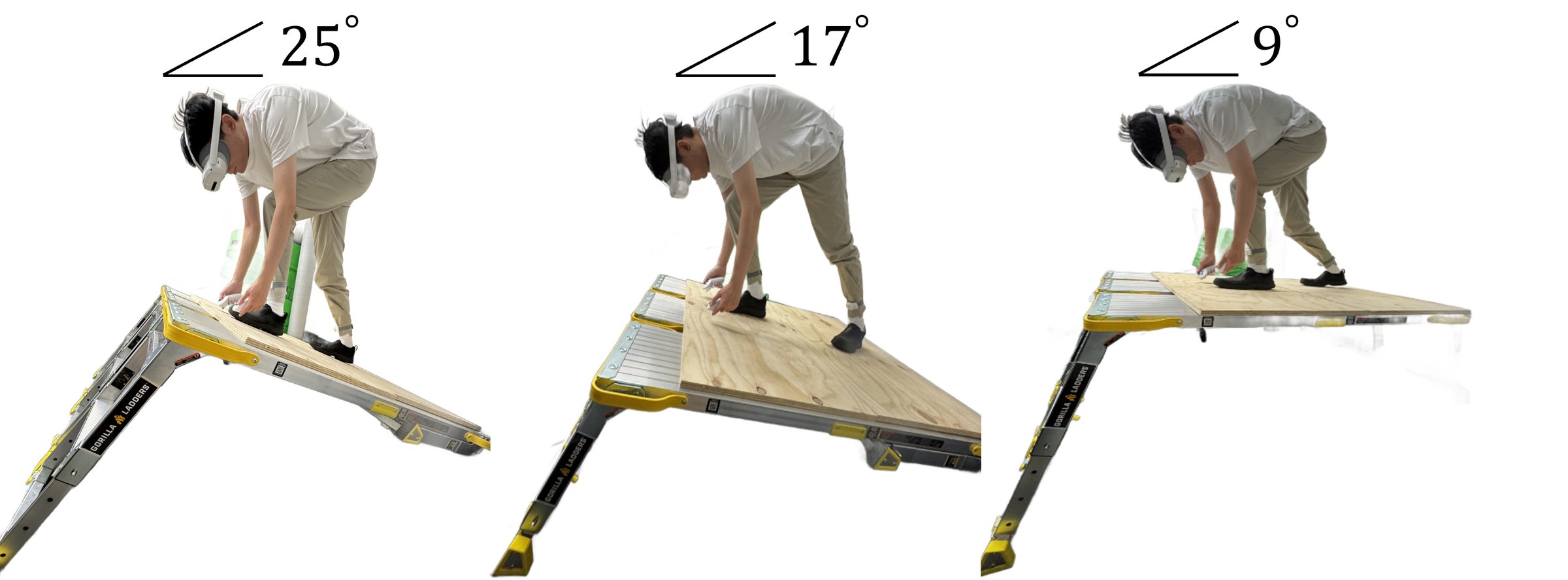
They collect whole-body demos on an angle-adjustable wooden platform at 9°, 17°, and 25°, roughly 2:12 to 6:12 residential pitch. Kit: Pico headset, two hand controllers, ankle trackers. One 1.84 m lab researcher, not a professional roofer. The multi-slope library is nine motion types × three takes × three pitches (81 sequences, about 23.5 minutes after retargeting). A separate task-semantic set holds ten raw takes used for nailgun, hammer, push, bend, and kneel.
Motion is retargeted to the 29-DoF G1, then a trajectory optimizer ties inferred foot-support intervals and annotated work phases to a measured roof mesh. Target hand-center clearances: 25 cm nailgun, 12 cm hammer, 18.5 cm push. Five sole points per foot get anchored so the ankle is not “on” the roof while a toe is in it. Phase-gated rewards then keep those relations when the tracking policy runs closed-loop in Isaac Lab.
What transferred
In simulation the method meets support, work-clearance, and nonpenetration checks across evaluated seeds. Across nailgun, hammering, and pushing they report work-clearance errors between 0.256 and 0.531 cm and 3/3 successful evaluations per task.
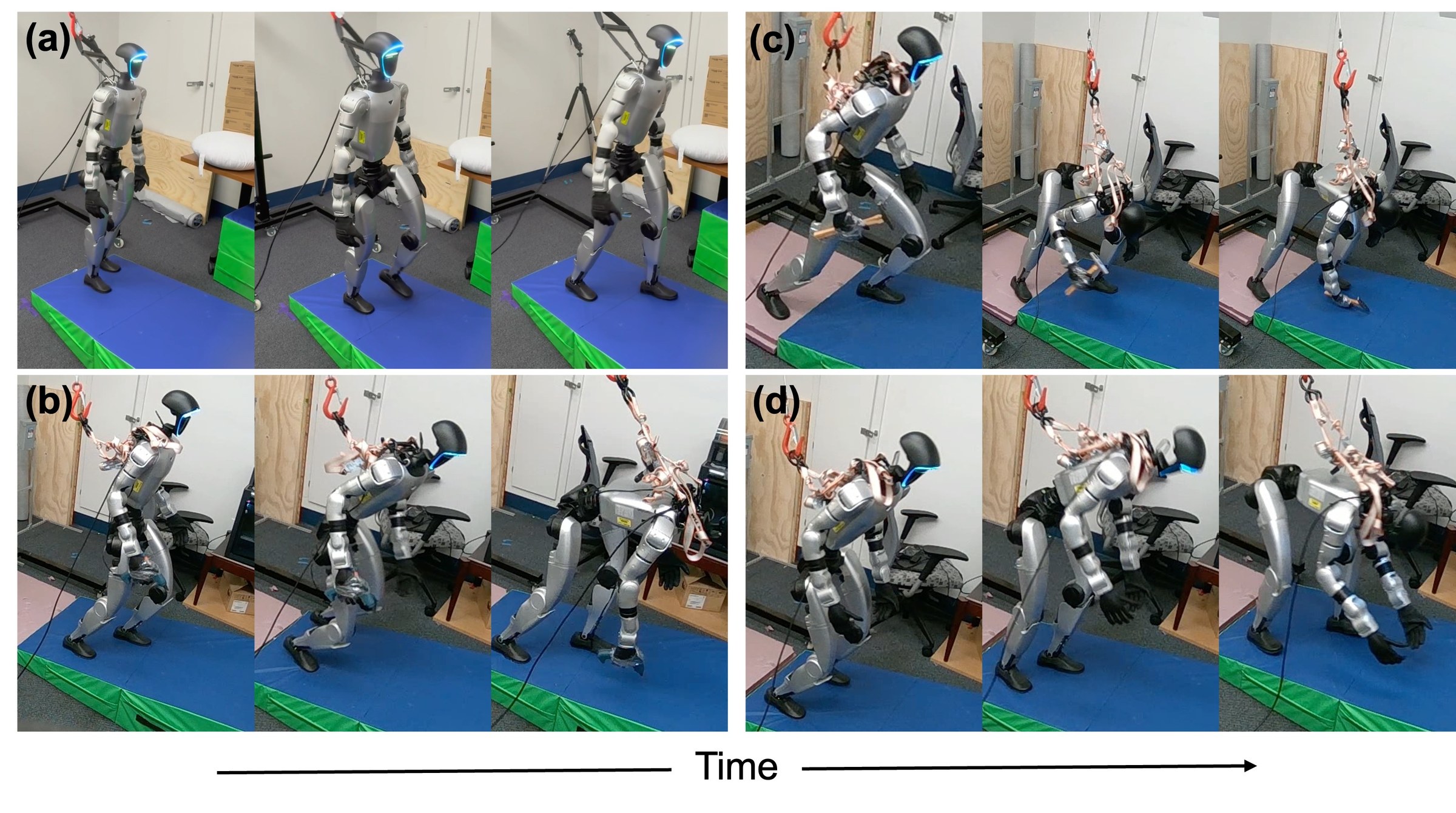
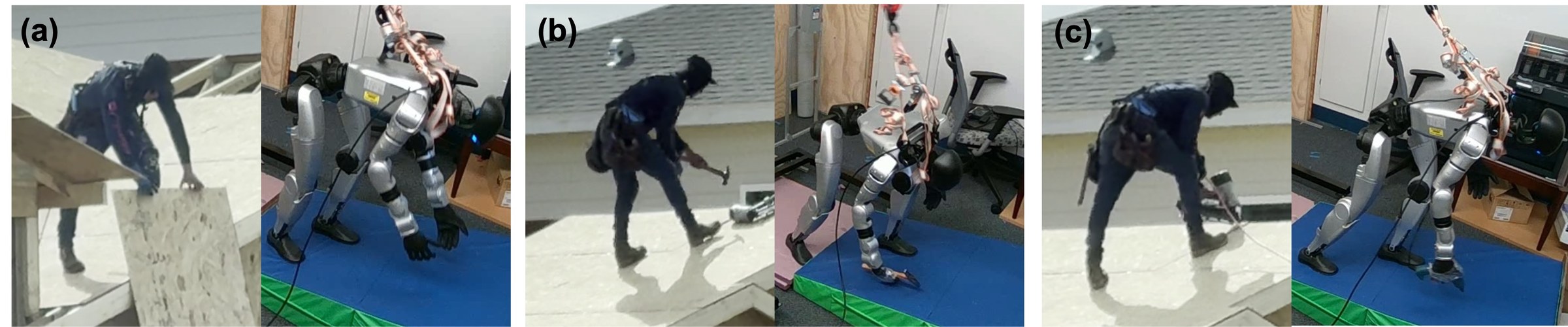
On the physical G1, with a safety hoist, they reproduce uphill walking, nailgun, hammering, and bending with mean base-frame motion errors below 80 mm. That is tracking fidelity on a lab slope, not an autonomous roofing crew. The paper is explicit: this is a motion-centric subset of roofing, not access, materials, or inspection.
A five-way nailgun ablation (raw retarget, manual offset, support correction, reference-level task correction, execution-aware learning) is there to show that a uniform height bump is not enough. Feet and hands have to be adjusted independently against the same roof.
A Human’s Take
I care that they measured the roof and then argued with the retargeter until the hand was 12 cm from the deck, not that a humanoid “did construction.” Eighty millimeters of base error under a hoist is a lab receipt. The day I take this seriously on a real pitch is the day the hoist comes off and the nail actually goes in.