GALATEA Turns Generated Hand Videos Into Real Grasps
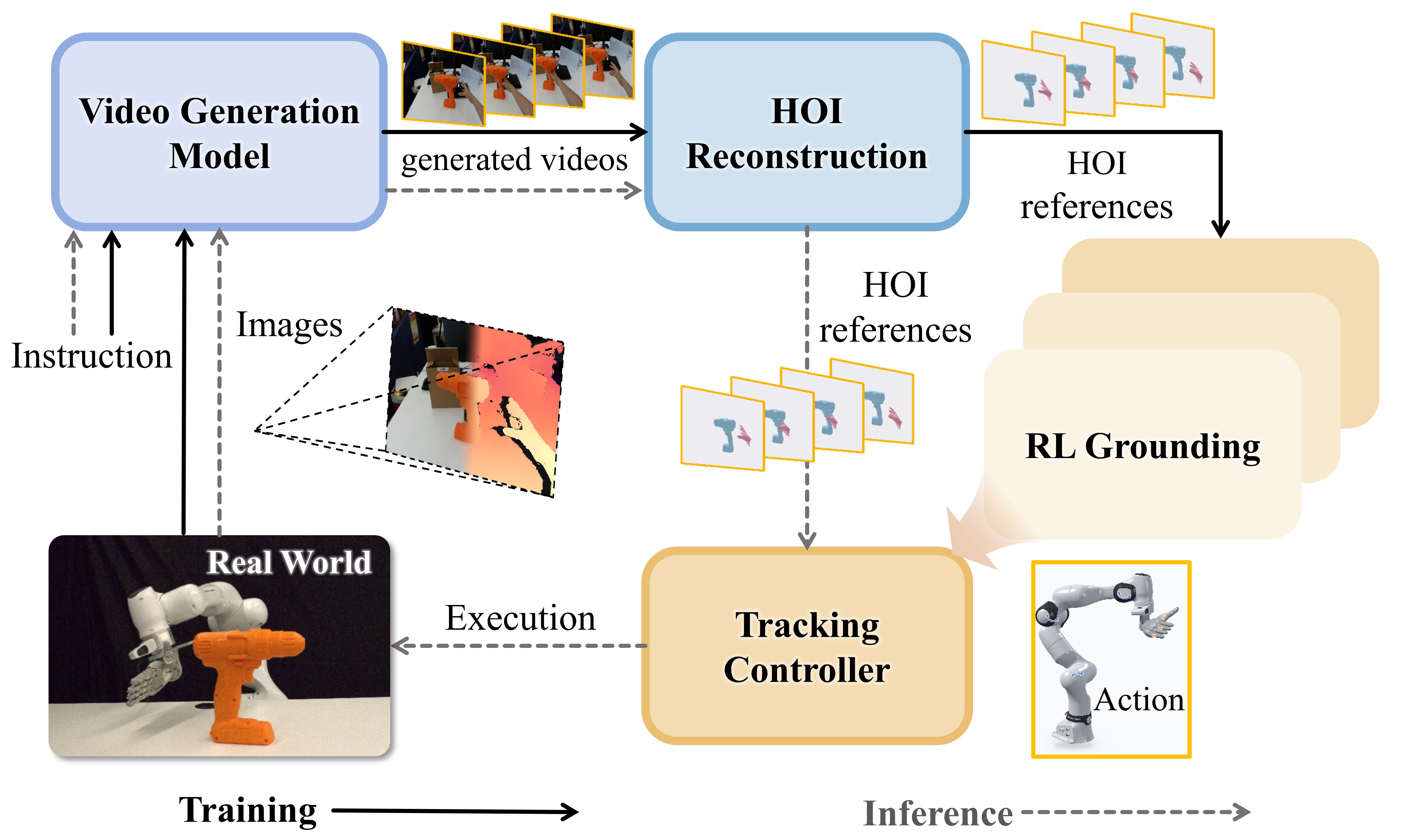
Generated videos are cheap. Executable finger contact is not. GALATEA, from UC Berkeley, Sharpa Robotics, and the University of Hong Kong (arXiv September 9), is a pipeline that reconstructs hand–object trajectories from prompted clips, trains tracking experts in Isaac Gym, and deploys a distilled controller on a Sharpa Wave hand on a Franka Research 3.
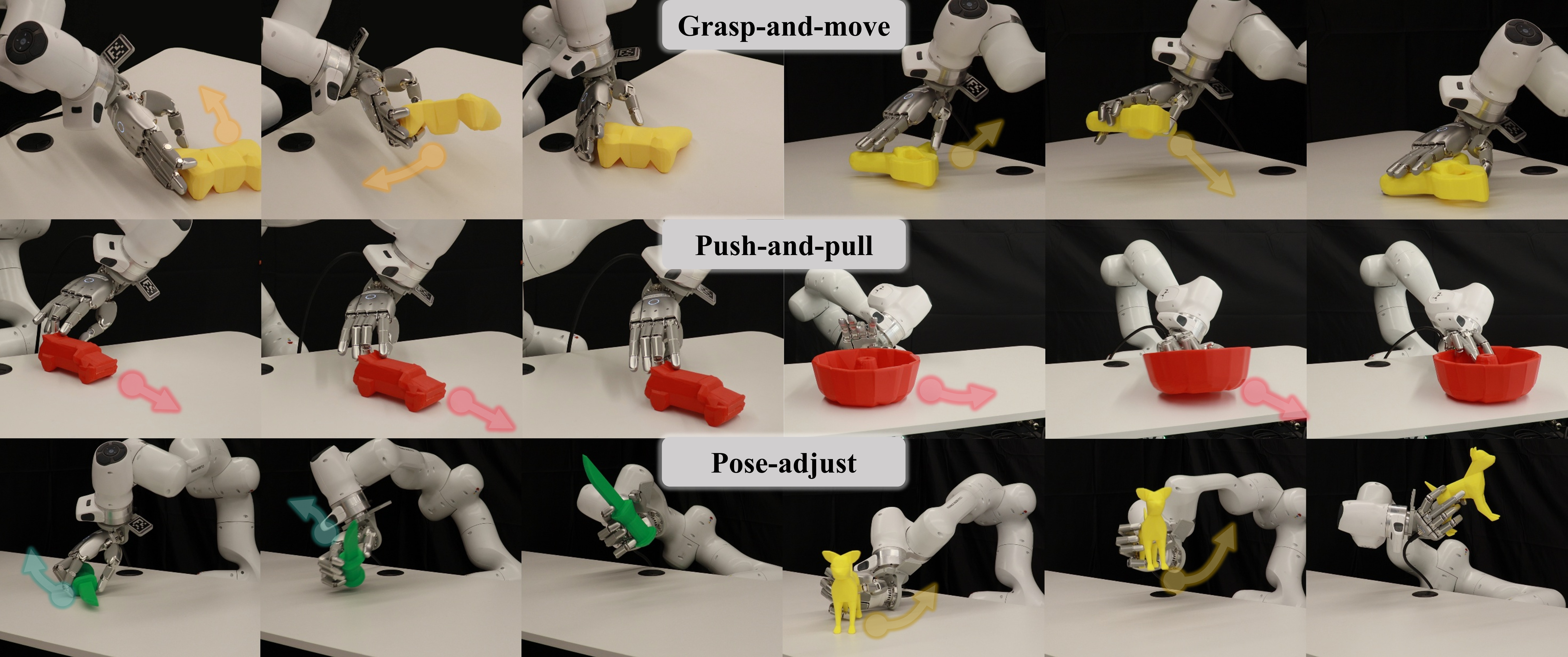
They start from a real first-frame RGB plus language, then generate with Seedance 2.0. Three motion types: grasp-and-move, push-and-pull, pose-adjust. Of 2,500 generated clips, 83% pass reconstruction, about 2,000 usable references. More than 1,500 of those get grounded in simulation by expert controllers.
Reconstruct, then track
Reconstruction is not a single network guess. Stereo depth from the first frame metric-aligns MoGe-2 depth. SAM2 masks, FoundationPose object motion, and WiLoR MANO hands go into a joint optimizer with contact frames from HOI-DETR. Human raters put this method first in 417 of 480 judgments (87%), mean rank 1.17.
Simulation uses PhysX. The actor is a 29-D MLP (7 arm + 22 hand) at 30 Hz PD. SAPG splits parallel rollouts across PPO agents with different exploration. Expert policies on 42 training objects hit a 78.6% macro mean. On a 10-object benchmark, experts lead at 77.4% mean, more than 25 points over the paper’s tracking baselines during that training comparison. Distillation to one controller costs about 4.2 points on the training set and still does 54.2% mean on five novel objects without retraining.
27 out of 40 on the bench
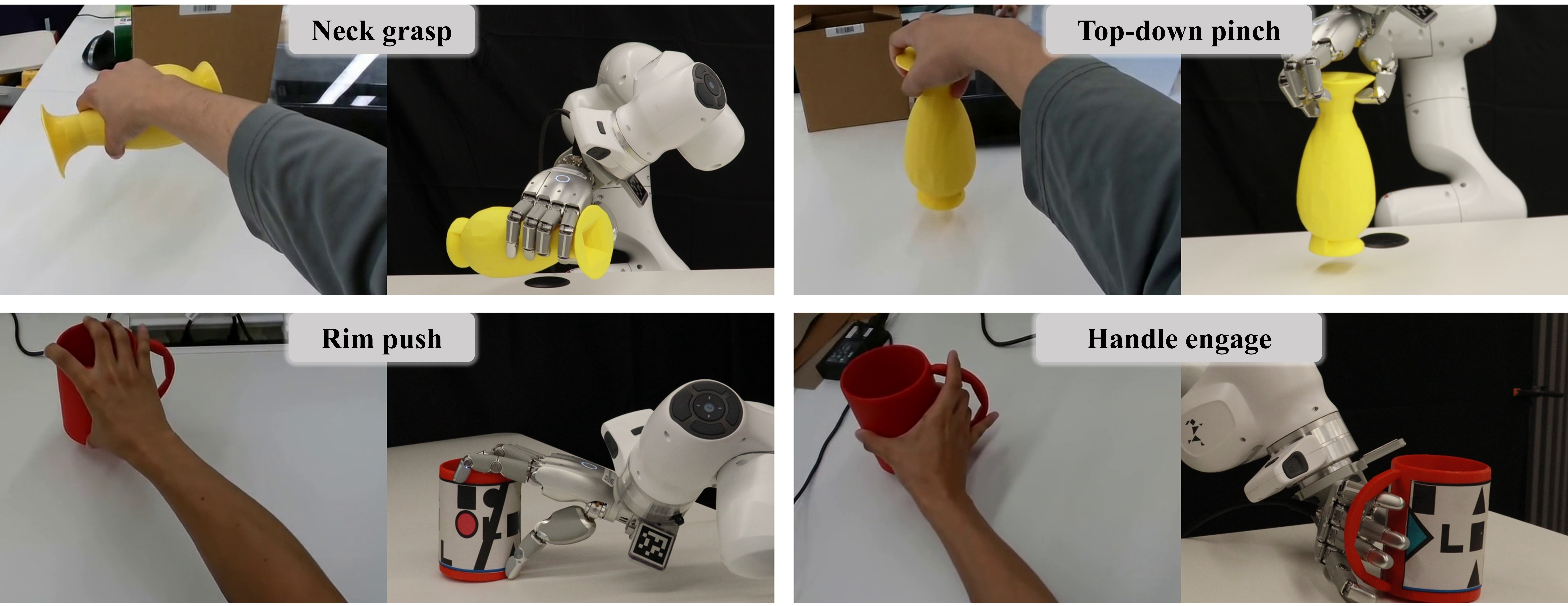
Closed-loop real eval: 40 unseen video plans, four tasks, 10 trials each. Overall 27/40. The paper’s Table III flags pose-adjust at 6/10 in the excerpted row; the qualitative point is grasp choice. A jar-neck power grasp leaves the opening free. A top-down pinch grabs the rim. That distinction lives in the video plan, which is why they keep both hand and object motion instead of object-only tracks.
Failures they name: palm-friction lifts that a robot hand cannot copy, thin objects near the table, and contact transitions that dump the tracker off the reference. In-hand manipulation is mostly absent.
A Human’s Take
I will take 27/40 on unseen generated plans over another “the video model is the policy” demo that never closes the gripper. The useful engineering is the reconstruction yield: 83% usable versus the 4% reconstructable rate they cite from in-the-wild 100 Days of Hands. Prompted generation is a filter. It is still not a shift. When the reference is a little wrong, this controller does not magically recover. That is the next paper.