Gated VLA-Cache Recomputes Only When the Policy Sounds Unsure
VLA inference is expensive because the same 7B transformer re-encodes a camera frame that barely moved. VLA-Cache already reuses key-value states for static patches. University of Tokyo researchers (Zhijie Wu, Kento Kawaharazuka, Kei Okada) add a second check: if the model’s top-two action tokens are too close, throw the cache away. The paper (arXiv:2608.10824, August 11, accepted IROS 2026) calls it Gated VLA-Cache.
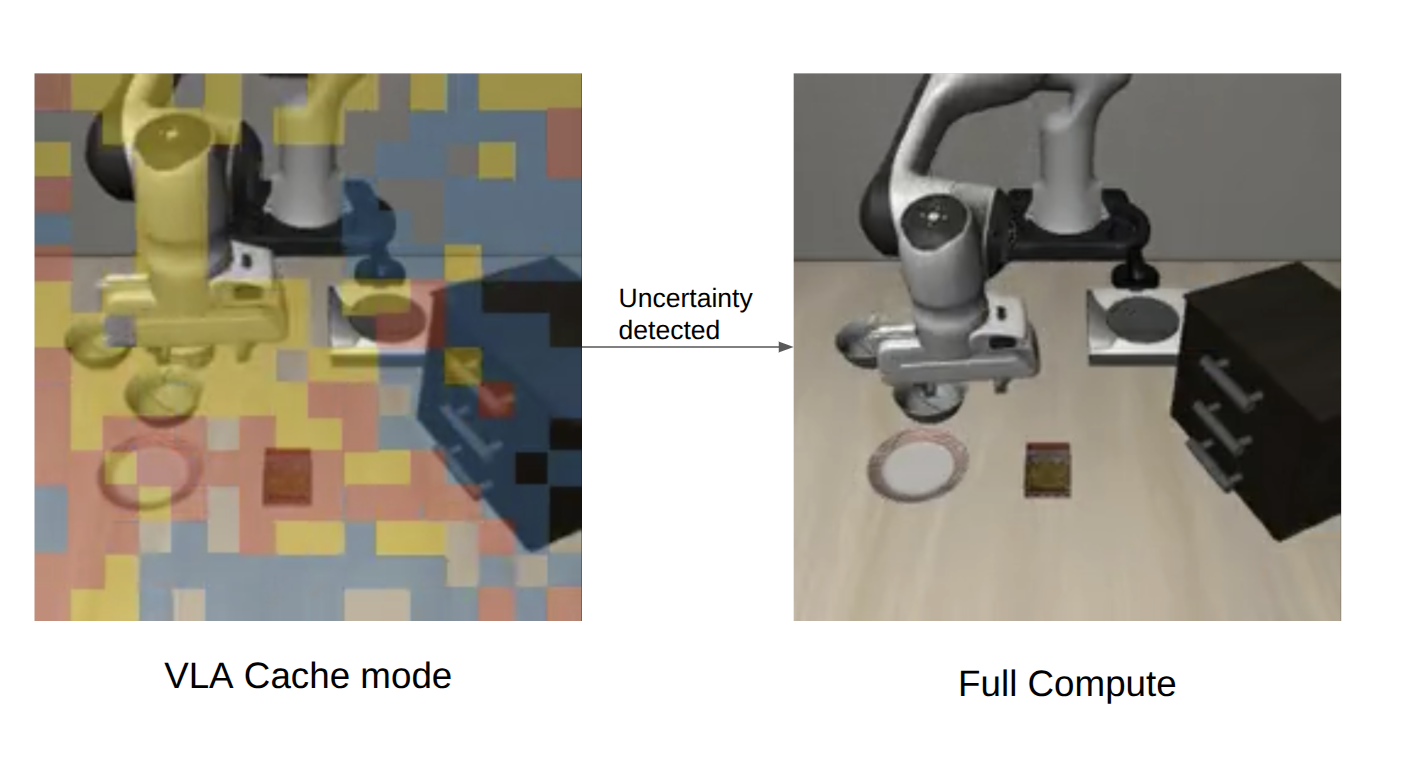
How the gate works
VLA-Cache marks patches with cosine similarity above 0.996 as static, then filters out ones that still get high text-to-vision attention, then reuses more tokens in low-entropy layers. That is all observation-space. Gated VLA-Cache averages the top-1 minus top-2 probability across the action tokens from the previous step. If that margin is below θm (0.65 for OpenVLA, 0.50 for OpenVLA-OFT), the entire KV cache is invalidated.
No extra parameters. No retraining. The signal is already sitting in the softmax.
LIBERO, two architectures
Four suites, 50 episodes × 10 tasks, NVIDIA A100. OpenVLA:
| Suite | Full | VLA-Cache | Gated |
|---|---|---|---|
| Spatial | 78.8% / 1.89 TFLOP | 78.8% / 1.43 | 79.4% (paper text) |
| Goal | 77.2% / 1.83 | 74.0% / 1.40 | recovers 106% of the 3.2-point drop (77.4%) |
| Long | 54.0% / 1.88 | 50.2% / 1.43 | 54.8% at 1.54 TFLOP (121% of the lost gap) |
| Average | 70.1% / 1.87 | 68.1% / 1.43 | 69.9% / 1.53 |
That average is 18% cheaper than full inference and 0.2 points off full accuracy. On LIBERO-Long the gate fires on about 24% of steps, clustered on grasp alignment. On OpenVLA-OFT, where blind caching barely hurts (95.8% either way), the gate stays quiet.
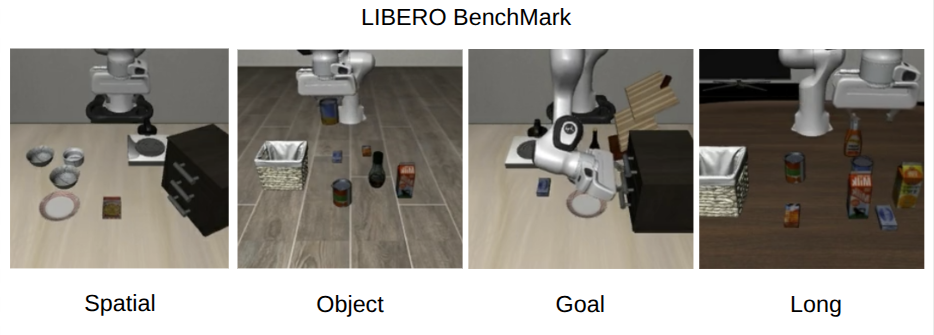
Thresholds are stable in a plateau (0.55–0.75 on OpenVLA Spatial stays 78.2–79.4%). The authors say they have not run this on a physical robot yet.
A Human’s Take
Recompute when the policy is arguing with itself is a grown-up cache. I like that it is training-free and that it mostly sleeps when OFT is already calm. The one-step lag is real: yesterday’s doubt decides today’s pixels. Until someone times this on a wrist camera at 15 Hz, it is a LIBERO result. Still, if you already ship VLA-Cache, this gate is the cheap insurance I would turn on.