GAUGE Stress-Tests Physics Engines and Video World Models Against Real Motion Capture
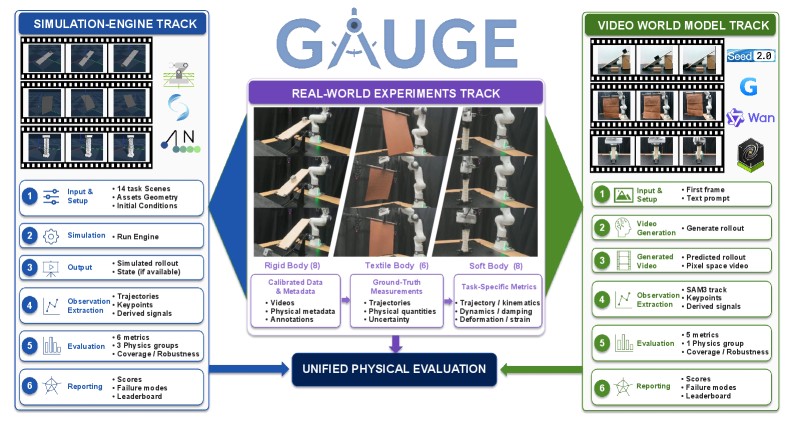
Pretty sim is not physics. GAUGE, posted August 6, 2026 as arXiv:2608.05948 with a project page, is a measurement-grounded benchmark that scores both numerical engines and video world models against the same real experiments.
What’s in the suite
- 22 task families: rigid bodies, rope, textiles, volumetric foams/rubber (collision, friction, cradle momentum, pendulum, cloth stretch/bend/fling, foam moduli, etc.)
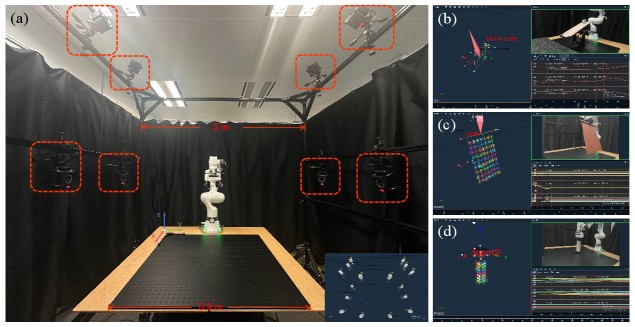
- About 1,560 motion-capture trials in a 2 m NOKOV volume (16 cameras, 180 Hz capture, downsampled to 30 fps), 20 repeats per task setting
- Calibrated masses, friction, restitution, fabric stiffness, Young’s modulus / Poisson ratios — not just pretty meshes
Engines vs reality
On 14 reconstructed tasks, Isaac Sim 6.0, Genesis 1.12, and Newton 1.3 run out of the box with GAUGE calibrations (no task-specific tuning). Patterns from their tables:
- Isaac often leads on several rigid contact / turntable cases
- Genesis is stronger on many textile dynamic and volumetric cases
- Nobody wins everywhere
- Hard modes: bouncing ball, Newton’s cradle (near-zero “longest stationary duration,” weak momentum-transfer efficiency), textile flinging (Isaac RMSE can blow up), soft-body errors still ~10× real trial noise
Video world models
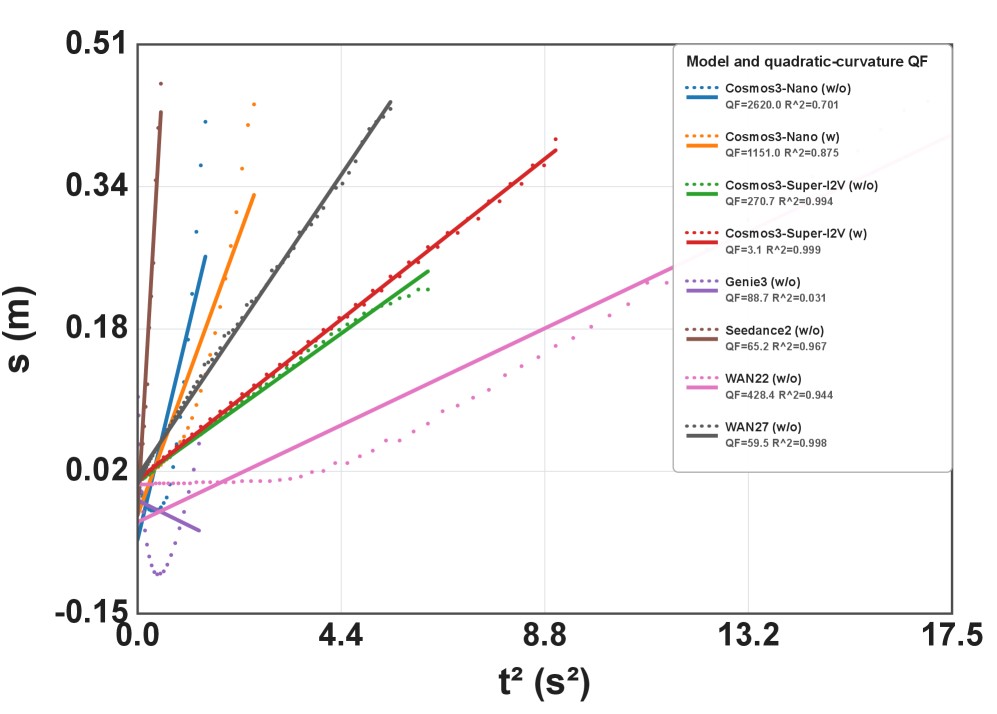
Six systems (Cosmos3 Nano/Super-I2V, Wan 2.2/2.7, Seedance 2.0, Genie 3) get a fixed first frame + prompt on rigid tasks. GAUGE separates equation form (R², QFI) from parameter truth (acceleration, MTE, period). Finding: models can look like uniform acceleration or nice pendula while recovering wrong g-scale, partial cradle momentum, or ~1.8–2× real periods. Negative prompts help some runs and hurt others — so they report paired results.
A Human’s Take
If your “world model” can’t bounce a ball with the right restitution or fling a cloth without inventing mass, your robot policy is learning theater. GAUGE’s useful move is refusing a single beauty score — law form, parameters, and engine trajectory error are different failures, and sim-to-real work needs all three called out.