AGIBOT’s GE-Act 2.0 Scales Zero-Shot Hands From 300 to 30,000 Hours
AGIBOT just open-sourced the paper for GE-Act 2.0, a world-action model trained from scratch on manipulation data instead of a borrowed video generator. Humanoids Daily dated the release September 11, 2026, a day after Unitree’s UnifoLM-WLA-1.0 drop.
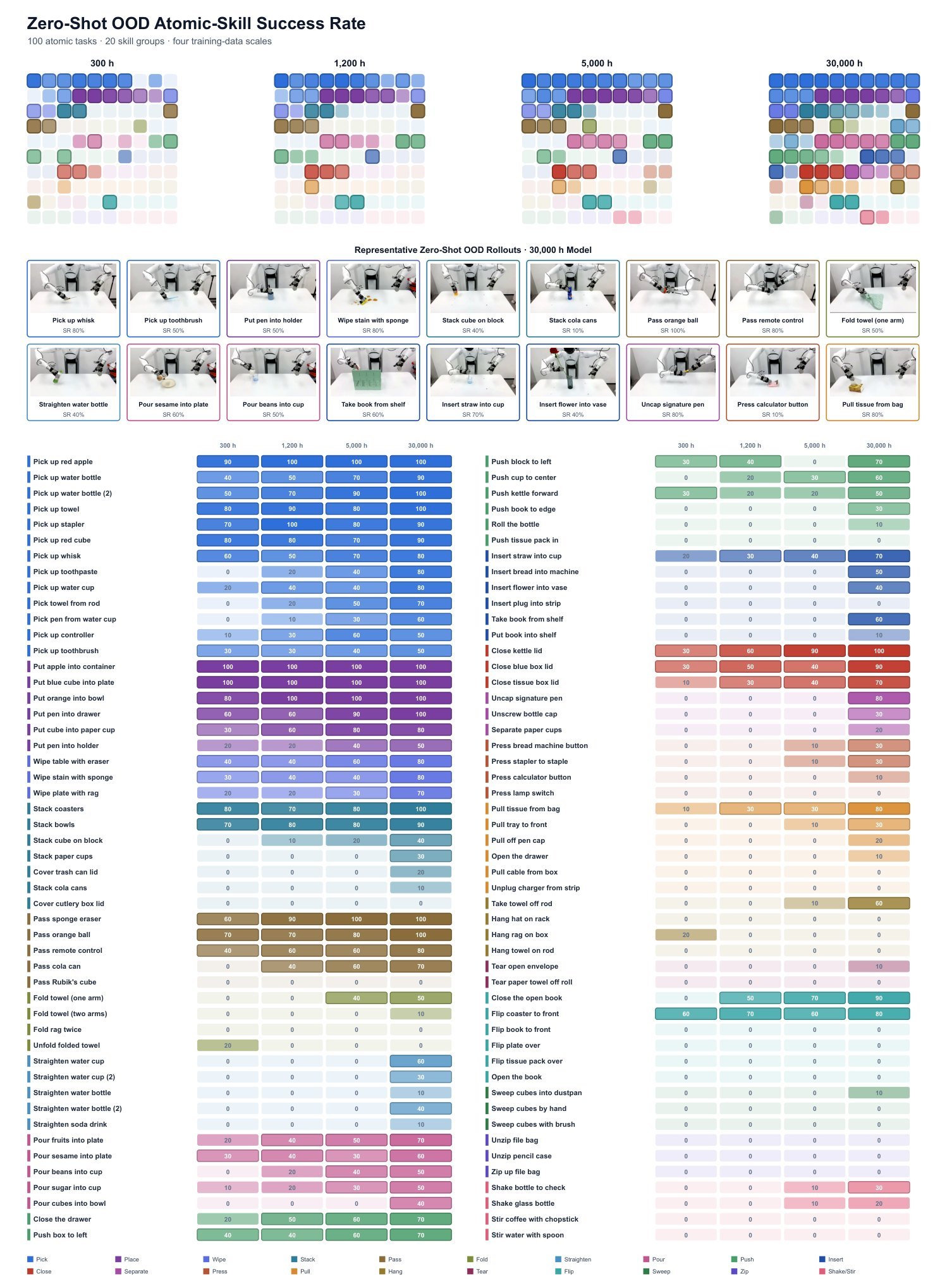
The test is blunt. No task-specific fine-tuning. New objects, scenes, lighting. 100 atomic tasks, 20 skill groups, two bodies: the biped G1-OP and the wheeled G2-90D.
What scaled
The project page and arXiv paper (2609.05588, submitted September 4) report four nested co-training pools. Same recipe, same pretrained parts:
| Co-training hours | G1-OP success | G2-90D success | G1-OP tasks with any success |
|---|---|---|---|
| 300 | 17.1% | 13.4% | 39 / 100 |
| 1,200 | 22.6% | 21.0% | 51 / 100 |
| 5,000 | 27.3% | 23.5% | 62 / 100 |
| 30,000 | 44.1% | 31.1% | 76 / 100 |
Gains cover 19/20 skill groups on G1-OP and 18/20 on G2-90D. G2-90D is under 2% of the co-training mix and still picks up 17.7 points. Ten of its skill groups have fewer than five hours of G2 data; four have less than one.
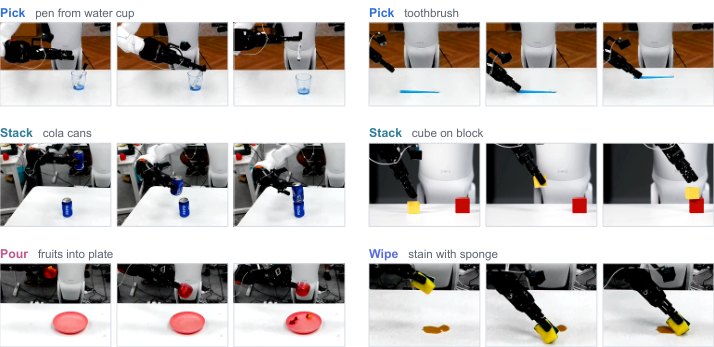
The 30,000-hour checkpoint starts finishing skills that were dead at 300 hours: folding a towel, nesting paper cups, uncapping a pen, arranging flowers. Skill hours and zero-shot success correlate (Pearson r=0.80, Spearman ρ=0.85). Wiping (824 hours) hits 76.7%. Broom sweeping (64 hours) sits near 3.3%.
How it is wired
GE-Act 2.0 is three pieces, all initialized on manipulation data:
- CoAE: a control-oriented autoencoder. Each 256×384 frame becomes 24 tokens (64× spatial downsampling). Caption-match probe: 97.95%.
- SVP: a single-step visual planner. One MeanFlow pass, not a long denoising chain.
- IDM: inverse dynamics that turns the predicted future plus proprioception into an action chunk.
KASO (knowledge-aligned selective optimization) is the glue. The planner can imagine a valid left-side grasp while the demo went right. Training on that pair is the validity gap. KASO samples several futures and keeps the ones whose implied actions match the recording. On a G2-90D four-object ablation, pick success goes from 22.5% to 37.5%.
The full pipeline is 104 ms per action chunk on one RTX 5090: 52 executable actions at 30 Hz (~1.7 s of motion). Instruction grounding on object, color, shape, and position is at least 90% of trials under the same OOD protocol. Stress tests swap “green cup” to “blue cup” mid-reach; the arm pauses about 1.5 s and redirects. “Put the cup into the shoebox” does not default to packing the shoe.
Code on the project page is still coming soon. SVP pretraining uses 39,000 hours; IDM uses 32,000. Those are separate from the 30,000-hour co-training ladder.
A Human’s Take
I like that they refused to let a fine-tune hide the pretrained model. 44% on a hundred held-out tasks is not a factory shift, and they say so. The scaling curve not flattening between 5,000 and 30,000 hours is the part I’ll watch. If the weights actually land, this is a real open stack to poke, not a teaser PDF.