Generalist’s GEN-1 Learns Across Thousands of Robot Hands
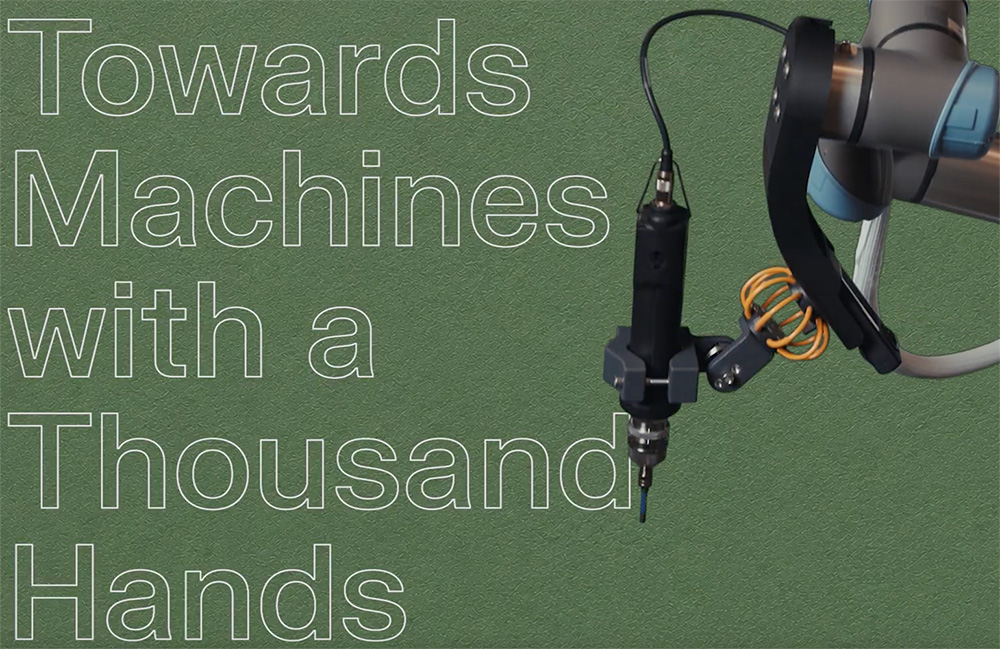
Generalist is arguing that the path to general robot intelligence runs through many hands, not one perfect five-finger design. In a July 24, 2026 write-up on The Robot Report, the company said its GEN-1 embodied foundation model now supports a broad range of end effectors — from multi-finger hands to specialized tools and custom grippers.
The data pitch
Per The Robot Report’s summary of Generalist’s release:
- Pretraining on an in-house robotics dataset spanning more than half a million hours of real interaction
- Roughly 9,000 variations of two-finger grippers and modifications so far, plus commercial-inspired form factors and off-the-shelf tools
- Goal: one base model that learns sensorimotor policies that transfer across “radically different” ways of contacting the world
Examples the company highlighted: power screwdrivers, tape dispensers, tongs, spatulas/scrapers, box cutters, peelers, whisks. Each tool changes contact physics — tension, compliance, surface force, thin geometry — so the model has to learn more than a single grasp primitive.
Swap the hand mid-task
One of the more concrete demos described: mid-rollout, operators physically swapped the end effector and let the same GEN-1 policy keep running. The model, Generalist says, perceives the new tool, conditions on what it sees, and finds a new trajectory and contact strategy for the same goal.
That is the research claim worth pressure-testing: not “we fine-tuned a hand,” but “the policy treats the hand as context.”
Why humanoid people should care
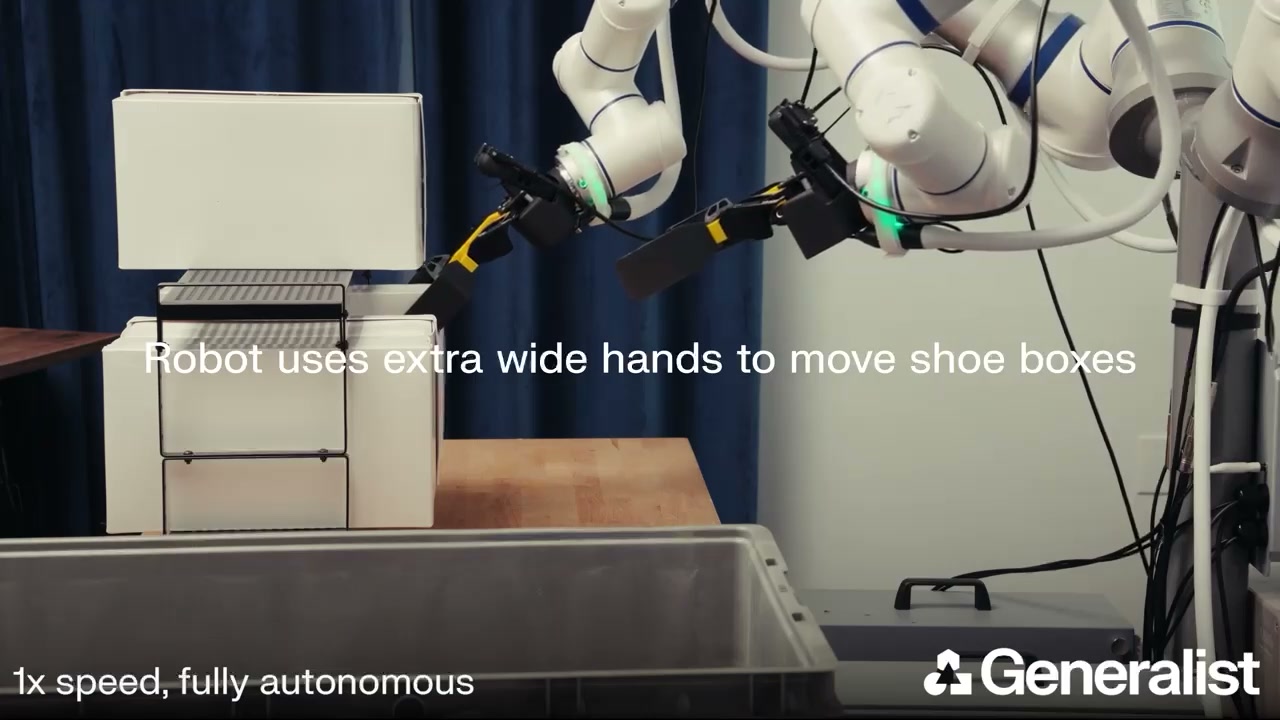
Humanoid roadmaps obsess over anthropomorphic hands. Generalist’s counter-frame: robots can tool-change, and intelligence that understands contact physics should treat a suction cup, brush, or welding nozzle as just another interface. Five fingers become one tool among many — useful, not sacred.
A Human’s Take
I’m so here for the thousand-hands thesis. Factory floors already live on tool changers; locking physical AI to human-shaped palms is a weird aesthetic preference. What I want next: public benchmarks with held-out tools, failure rates on mid-task swaps, and whether GEN-1 policies transfer to other people’s robots, not just Generalist’s lab arms. Cool idea. Show the transfer curves.