GeniWorld Turns Robot Actions Into Pictures the World Model Can Follow
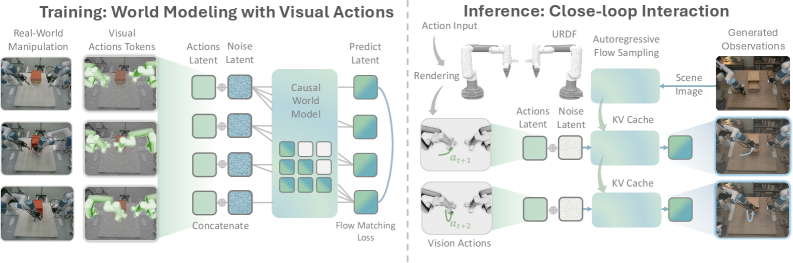
Most action-conditioned world models feed the video backbone a stack of numbers — joint angles, end-effector deltas — and hope the network invents the rest. GeniWorld, posted August 6, 2026 (arXiv:2608.06332) with a project page from Tencent Robotics X and Tsinghua, swaps those numbers for URDF-rendered visual actions: dense robot motion images that sit in the same latent space as the scene.
What they actually built
An embodiment-specific kinematic model converts action sequences into dense robot motion frames (robot only — no objects or background). A pretrained video generative model encodes those visual actions and scene observations into spatially aligned latents, then a causal DiT with flow matching predicts future frames. At inference, KV caching keeps history while the model rolls out in closed loop with policies or human teleoperators.
The authors’ claim is simple: if you condition scene dynamics on what the robot looks like when it moves, you stop forcing the network to relearn kinematics from abstract vectors every time the tablecloth changes.
Numbers from the paper
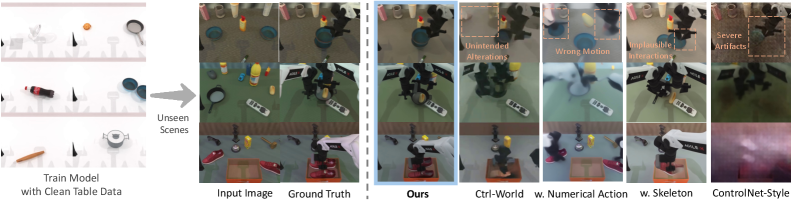
On RoboTwin Clean-to-Clean and Clean-to-Random protocols, GeniWorld beats Ctrl-World, IRASim, and EnerVerse-AC on generation metrics. Under Clean-to-Random (train on plain scenes, evaluate on heavily randomized OOD layouts), the paper reports FID 13.08 and FVD 20.15 for GeniWorld versus severe degradation for IRASim (FID 174.52, FVD 191.26 in the reported comparison).
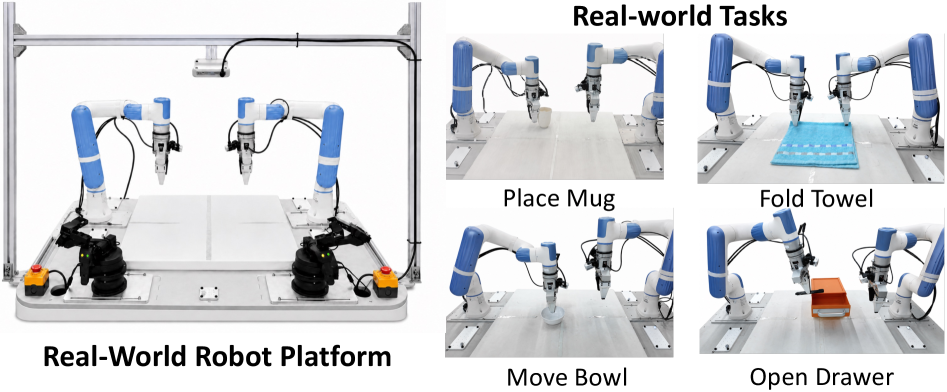
On a dual-arm Xtrainer real platform with four tasks (Move Bowl, Fold Towel, Place Mug, Open Drawer), GeniWorld rollouts correlate with real π₀ policy success under visual distractions. With only 25 real demos per task, adding GeniWorld-synthesized spatial and diverse trajectories lifts overall policy success from 40.8% to 69.0% across spatial rearrangement, novel instances, distractors, and lighting shifts. Interactive teleop inside the world model runs about 8 Hz at 5 sampling steps on an H20 GPU, per the paper.
A Human’s Take
I’m more interested in the conditioning trick than another “world model” brand. If dense rendered robot motion is what keeps OOD tables from melting the arm, every lab with a URDF just got a cheaper path to synthetic hours. The open question is how ugly the camera-calibration and render-to-reality gap gets when the factory floor is not a clean tabletop.