GeoAAC Lets a VLA Shorten the Chunk When the Denoise Wobbles
Action chunking is a bet: execute N predicted steps before you look again. N=2 jitters. N=16 flies past the handle. Xin Chen, Yi Bin, and colleagues at Tongji University posted GeoAAC (arXiv:2609.20776) on 17 September 2026: pick N from the shape of the Flow Matching denoise, with no extra training.
They measure how much the velocity field wiggles across action prefixes. More wiggle, less trust in the long prefix. A temporally weighted profile, then the median of positive geometric growth, sets the cut. A motion-aware floor stops the policy from chopping a tiny move into noise.
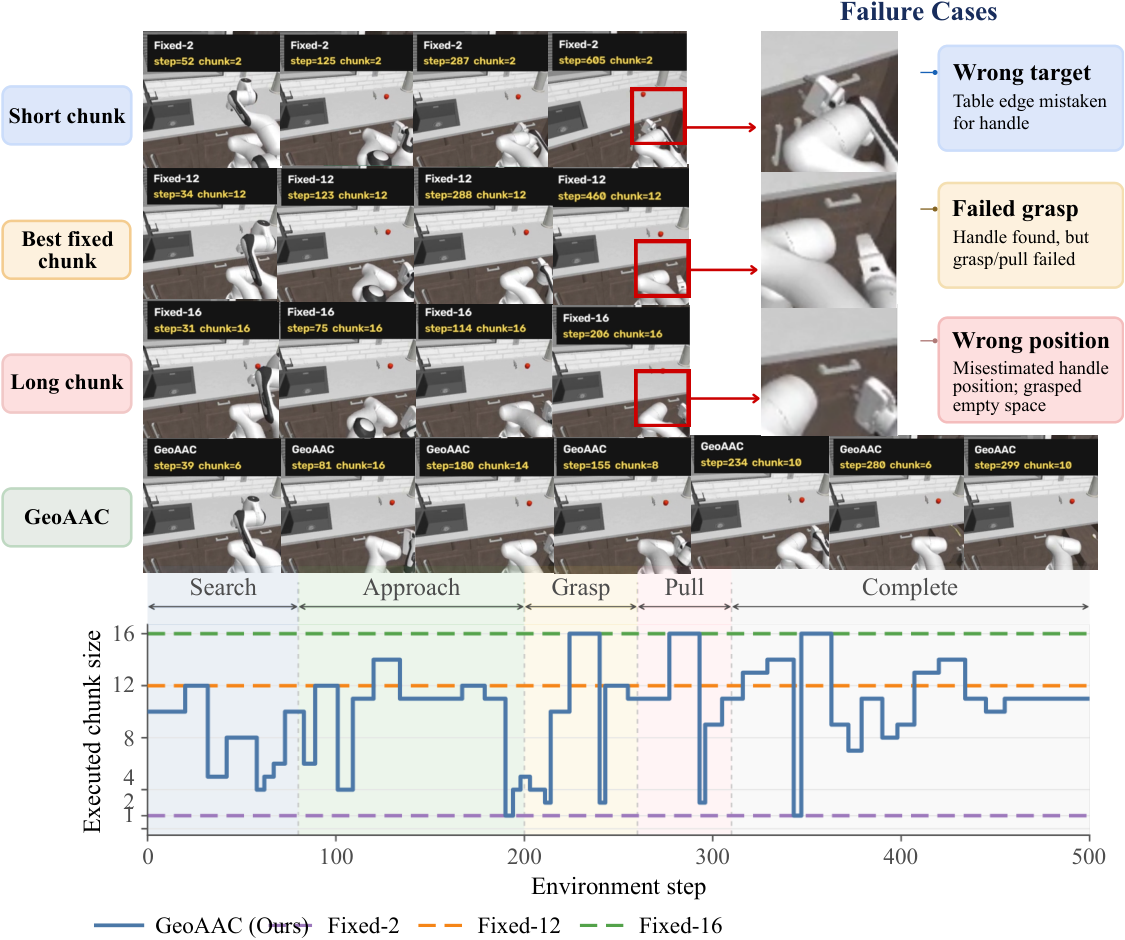
Simulation first
GR00T N1.5 on LIBERO (40 tasks, 50 rollouts each): GeoAAC 95.5% average success, versus 94.7% for the best fixed horizon they report (8). Object 99.0%, Long 89.2%.
π0.5 on LIBERO: 98.0% versus 97.1% for fixed-5. Long 96.4% versus 93.2%.
RoboCasa365 (18 tasks, GR00T N1.5): 75.1%, 8.7 points above the best fixed baseline, and above two other adaptive methods (multi-sample uncertainty, self-attention).
LIBERO-Pro position shifts, π0.5: 36.2% average, 5.3 points above fixed-horizon.
Align and place get shorter average horizons (~7.8–7.9). Transport, push/pull, and turn run longer (~9.2–10.5). That matches the story: look more often when the pose has to be right.
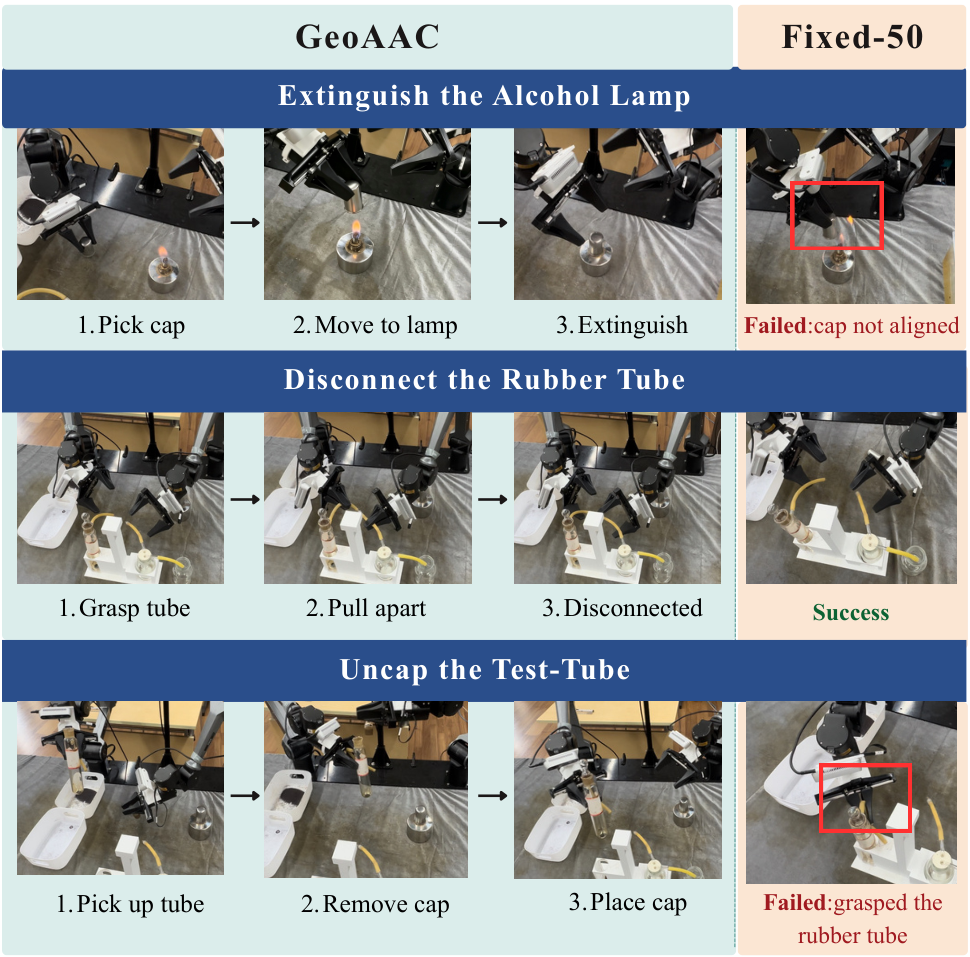
Real dual arms
Two PiperX arms, three RealSense D435i cameras, a Qwen3-VL-2B backbone with a Flow Matching expert, prediction horizon H=50, 50 Hz control. 50 demos per task, 30 eval trials each.
| Task | Fixed-50 | GeoAAC |
|---|---|---|
| Extinguish alcohol lamp | 16.7% | 36.7% |
| Disconnect rubber tube | 76.7% | 100.0% |
| Uncap test tube | 66.7% | 86.7% |
| Average | 53.3% | 74.4% |
Same weights. Only the execution boundary changes. Fixed-50 misses the cap alignment and grabs the wrong object on uncap. GeoAAC replans during those pinches.
A Human’s Take
I have been waiting for someone to stop treating chunk length as a hyperparameter you pick once for the whole kitchen. Reading the denoise instead of training a second head is the kind of cheap trick that survives contact with a real lab. 21 points on the same checkpoint is the number. If your VLA already “knows” the task and still drops the cap, maybe it did not need more data. Maybe it needed to look up sooner.