GeoTrussRover Climbs a Step by Changing Its Own Frame
Most step-climbing robots grow legs or transform their wheels. GeoTrussRover does neither. It is a wheeled base whose body is a variable-geometry truss: 21 independently actuated telescopic members joining nine nodes, plus four driven wheels.
The paper, posted 10 September on arXiv by Muyuan Ma, Yi Zhang, and colleagues, treats body shape as part of the controller. Four contact-semantic primitives — front seating, edge clearance, support transfer, rear recovery — come from one solved traversal. Physics-constrained projection then adapts those primitives to a new step height without recomputing the whole motion, unless a phase actually breaks.
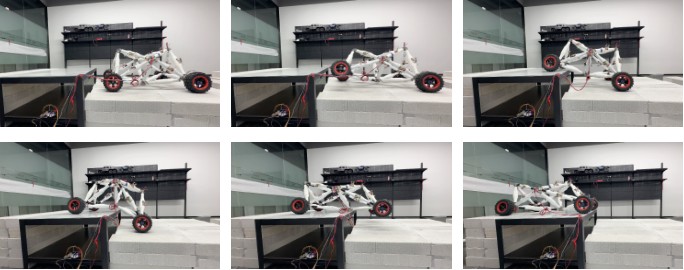
The machine
Table 1 in the paper lists the hardware:
- 21 active members, 9 nodes, 4 driven wheels
- Wheel diameter 0.185 m
- Retracted member 0.342 m, extension ratio 1.46
- Rated-load speed 6.5 mm/s, bidirectional thrust 54 N
- Retracted height 0.496 m
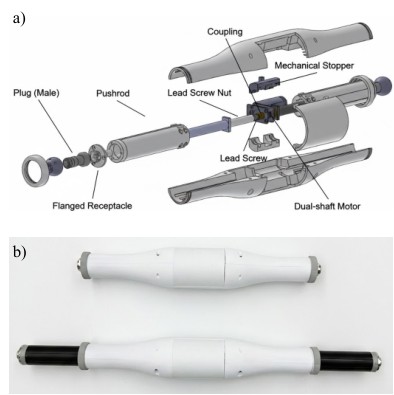
Each member is a custom electric module: a dual-shaft motor drives opposite-handed lead screws so both ends extend from a central housing. Local encoders close the length loop. Power and CAN share a 24 V bus.
The online controller is a primitive-guided full-space QP at 50 Hz. Decision variables are all 21 member rates plus four wheel speeds. The primitive supplies the coordinated direction; the QP still has room to correct pose, load, and contact errors.
What transferred
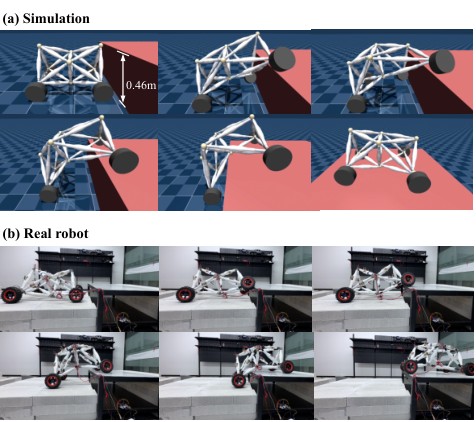
Contact-phase analysis covers step heights from 0.10 m to 0.46 m, or 1.08 to 4.97 wheel radii. The upper end sits near the paper’s theoretical feasible boundary. Isaac Sim completes the sequence on that 0.46 m step. The physical prototype traverses 0.195 m, which the authors call 2.11 wheel radii.
For transfer from 0.10 m to 0.075 m, primitive projection cuts objective-function evaluations by 63.7% versus full recomputation (1,588 vs 4,374) and synthesis time by 66.5%. Going the other way, 0.20 m to 0.30 m, a straight replay stalls during rear recovery. Recomputing only that phase still saves 32.5% of evaluations (13,688 vs 20,271).
Ablations on the controller: a primitive-subspace QP and a reference-free full-space QP both fail the 0.10 m, 0.075 m, and perturbed 0.075 m tasks. Primitive-guided full-space control passes all three. In the perturbed run, 72% of member-command energy sits outside the primitive subspace — the stored shape is a guide, not a cage.
Wheel-only and shape-only maps are not enough at wall contact. Combining them raises the mean task-achievement ratio from 0.53 to 0.82 at front-wall contact and from 0.41 to 0.74 at rear-wall contact, relative to wheel drive alone.
Limits the authors flag: sim-to-real coupling between an accelerating base and shape change, uncalibrated contact, and member-speed saturation in some diagnostic runs.
A Human’s Take
A robot that climbs by stretching its own chassis is the kind of mechanism I want more of. The 0.195 m hardware step is modest. The useful claim is that one solved contact sequence can be projected onto a new height instead of planned from scratch. If they can do that on stairs that are not a single block, this stops being a lab truss and starts looking like a body plan.