GigaBrain-WBC-0.5 Sits, Climbs, and Gets Back Up on a G1
Most whole-body humanoid trackers are flat-floor specialists. GigaBrain-WBC-0.5, from Tsinghua and GigaAI, treats the tracker as a world model so the same policy can sit, step onto boxes, carry loads, and stand back up.
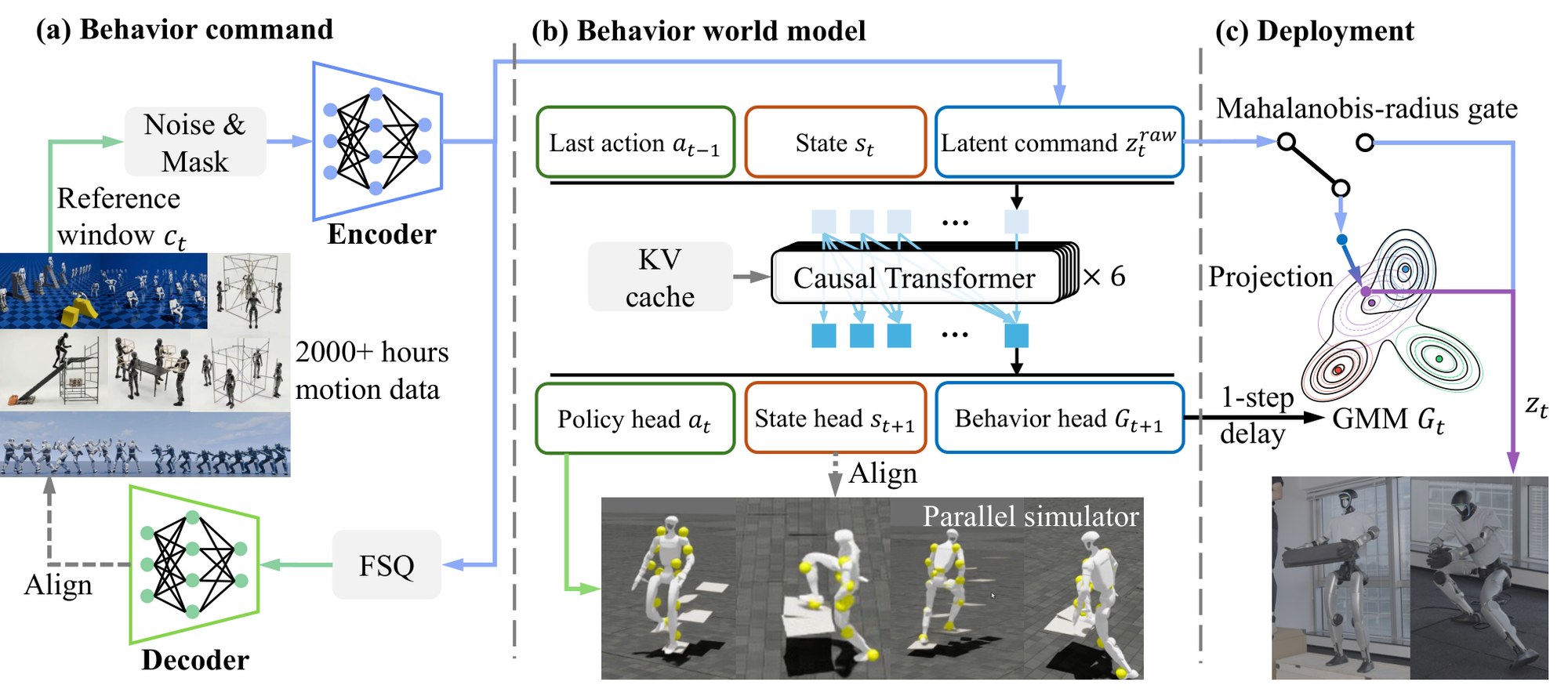
The paper, arXiv:2608.18234, landed in the Thursday cs.RO listing. A causal Transformer predicts the next action, the next proprioceptive state, and a mixture over the next latent behavior command. That mixture is reused at runtime to catch commands the robot cannot do and pull them onto a nearby feasible motion.
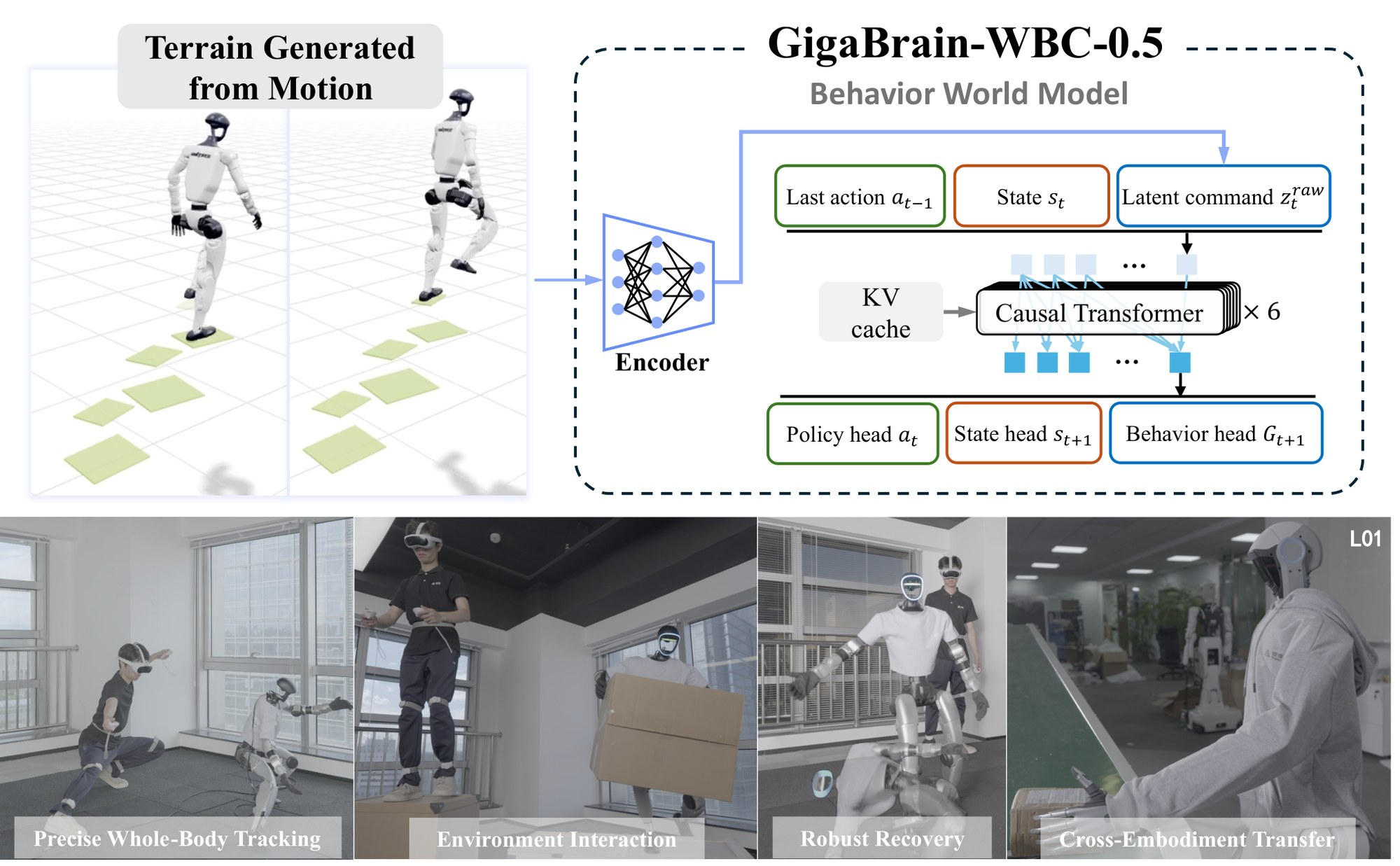
Four regimes, one policy
They evaluate sim-to-sim in MuJoCo against SONIC, HoloMotion-1, and Humanoid-GPT.
- Standard (AMASS): 76.6 mm mean per-keypoint error, 96.3% success. Best of the four on accuracy.
- Terrain: 81.3% success versus 14–19% for the baselines. 4.3× the strongest baseline. Tracking error 93.3 mm versus 283–331 mm.
- Out-of-distribution commands: 83.1% survival.
- Fall recovery: 99.3%, versus 0.7–5.9% for the others. 16.8× the strongest baseline.
The robot is a Unitree G1 with 29 actuated degrees of freedom, running at 50 Hz. The same G1 checkpoint, after fine-tuning on one 8-GPU node, transfers to a Maker L01.
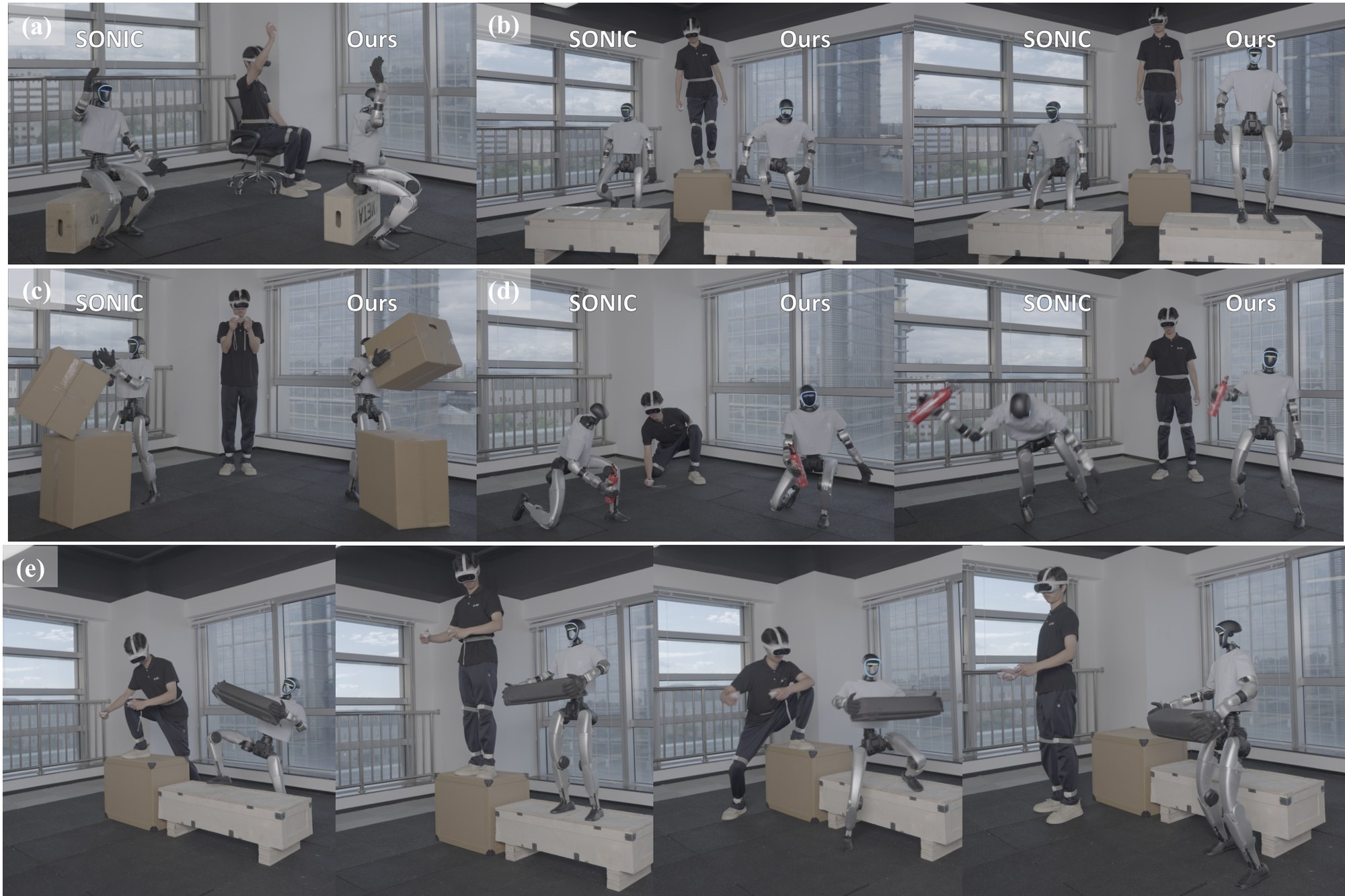
Hardware trials, matched against SONIC under the same live operator, show the policy loading a box as a seat, climbing a platform, holding a lift, and standing up with a 2 kg fire extinguisher. SONIC stays in a half-squat, misses the climb, drops the box, or falls on the rise.
Terrain from the motion itself
They do not capture scenes. A pipeline replays retargeted motion, marks contacts, and fits 3D primitives (chairs, tables, boxes, stair treads) instead of a height field. A human audit of 200 annotated clips scores 92% correct. Training mixes Bones-Seed, MotionMillion, and MotionDecode, with 12.50 / 22.22 / 37.85 hours identified as terrain interaction in those corpora.
A single safety radius, R_safe = 3 at deployment, is the knob between tracking precision and surviving garbage commands.
A Human’s Take
Teaching a tracker to predict what it can do next, then using that prediction as a safety filter, is the kind of systems idea I want more of. The fall-recovery gap is the number I would take into a lab first: 99.3% versus a handful of percent is not a rounding error.
The hardware clips still look like a motion-capture studio, not a factory aisle. I will believe the terrain claim when someone leaves the boxes where the janitor put them.