GPT-6 Astra Drops a Block in a Bowl 19 Times in 20. The Puzzle Still Stalls
RoboCurve posted hardware numbers for GPT-6 Astra on 4 September. Same agent policy, same two tasks, dual I2RT YAM arms: put a red block in a bowl, and seat a round puzzle piece by its knob into a matching groove.
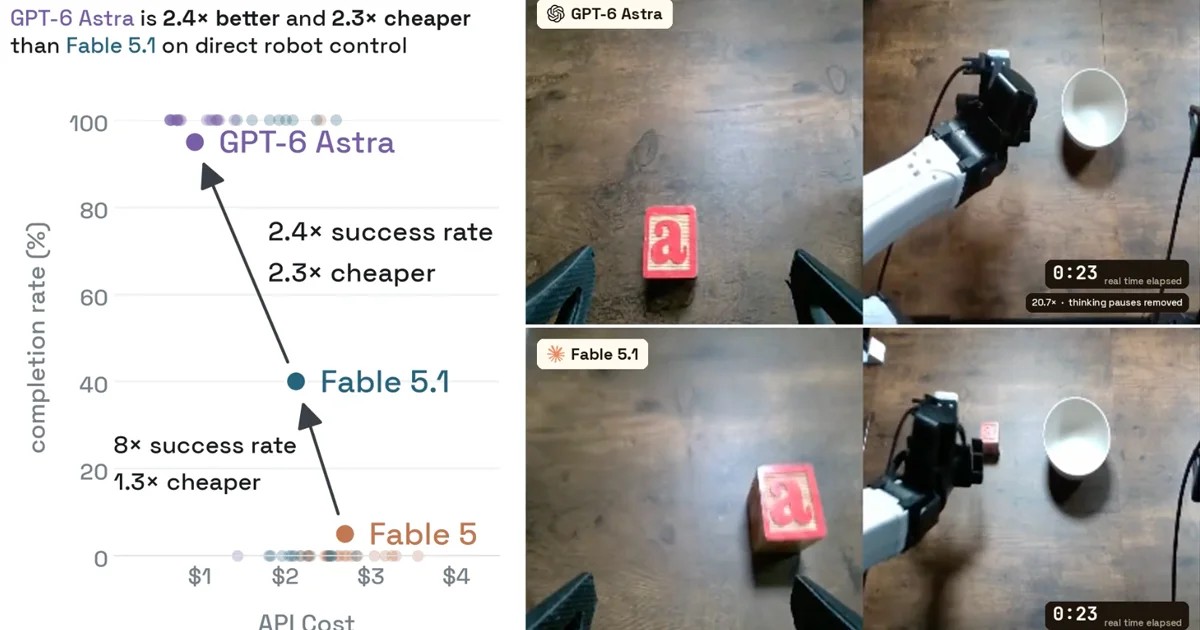
The bowl is the headline. Astra finished 19 of 20. Anthropic’s Claude Fable 5.1 was 8 of 20. Fable 5 was 1 of 20. Mean time 2.5 minutes vs 6.8 and 8.2. Estimated list-price cost $0.94 per run vs $2.12 and $2.69. Output tokens 2.1k vs 12.9k and 19.2k.
The puzzle is the hangover. Astra 2 of 20. Fable 5.1 2 of 20. Fable 5 0 of 20. Astra still gets there faster and cheaper (3.4 min, $1.36), then dies at the last press.
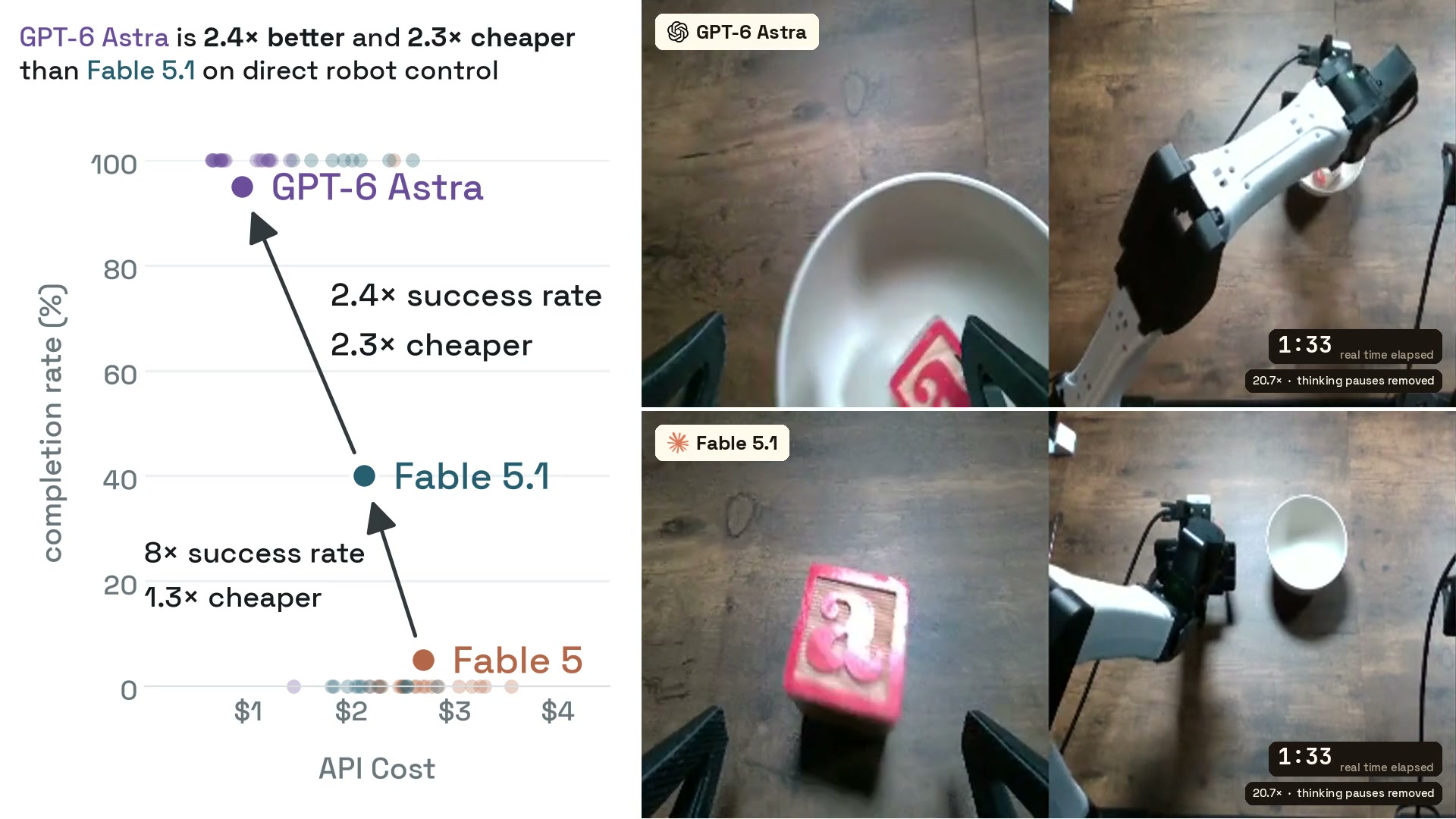
How the bench is wired
The RoboCurve write-up is specific:
- Embodiment: bimanual I2RT YAM, 6-DoF per arm, parallel-jaw grippers
- Command: absolute end-effector poses (
move_to) plus gripper; onboard IK - Observation: top camera, left wrist, right wrist, proprioception
- Policy: Inspect Robots
agent, medium thinking, 20 LLM-call budget, 25% speed cap - Scoring: human grader, stages 0–4 (no approach through seated)
Astra’s mean stage on the bowl is 3.95. On the puzzle it is 2.00. The write-up says it consistently reaches the groove (stage 3) and then hesitates or misaligns the press.
Humanoids Daily repeats those counts and notes Inspect Robots as the open harness (GitHub: robocurve/inspect-robots).
Caveats they printed themselves
RoboCurve lists the holes. Puzzle trials shared rig-4. Bowl trials did not: Fable ran on rig-3, Astra on rig-1 because rig-3 was down. Astra’s runs were two days later, not interleaved. Graders knew the model. Costs are list price; OpenAI cached about a fifth of Astra’s input, so Astra’s dollar figure is, if anything, high.
That is enough to keep me from treating 95% as a factory number. It is still a clean gap on the easy task and a clean tie on the hard one.
A Human’s Take
Gross pick-and-place is becoming a language-model parlor trick. The groove is not. If your policy cannot feel the last millimeter, it will look brilliant on a bowl and helpless on a peg. I would run this bench again interleaved, on one rig, with a tactile channel in the loop. Until then, Astra is a fast, cheap kinematic clerk. It is not a fitter.