Graph-MambaNav Puts the Coffee Machine Last in Line
Graph-MambaNav is an object-goal navigator that treats scan order as the policy. If you are looking for a coffee machine, the toaster and the mug should not be processed in a random pile. The paper is arXiv:2608.13723, accepted at IEEE RA-L and slated to transfer to ICRA 2027.
Most object graphs are permutation-invariant. Every node talks, then attention decides who mattered. Graph-Mamba showed that who goes last in a state-space scan gets the richest context. This paper makes that order target-aware.
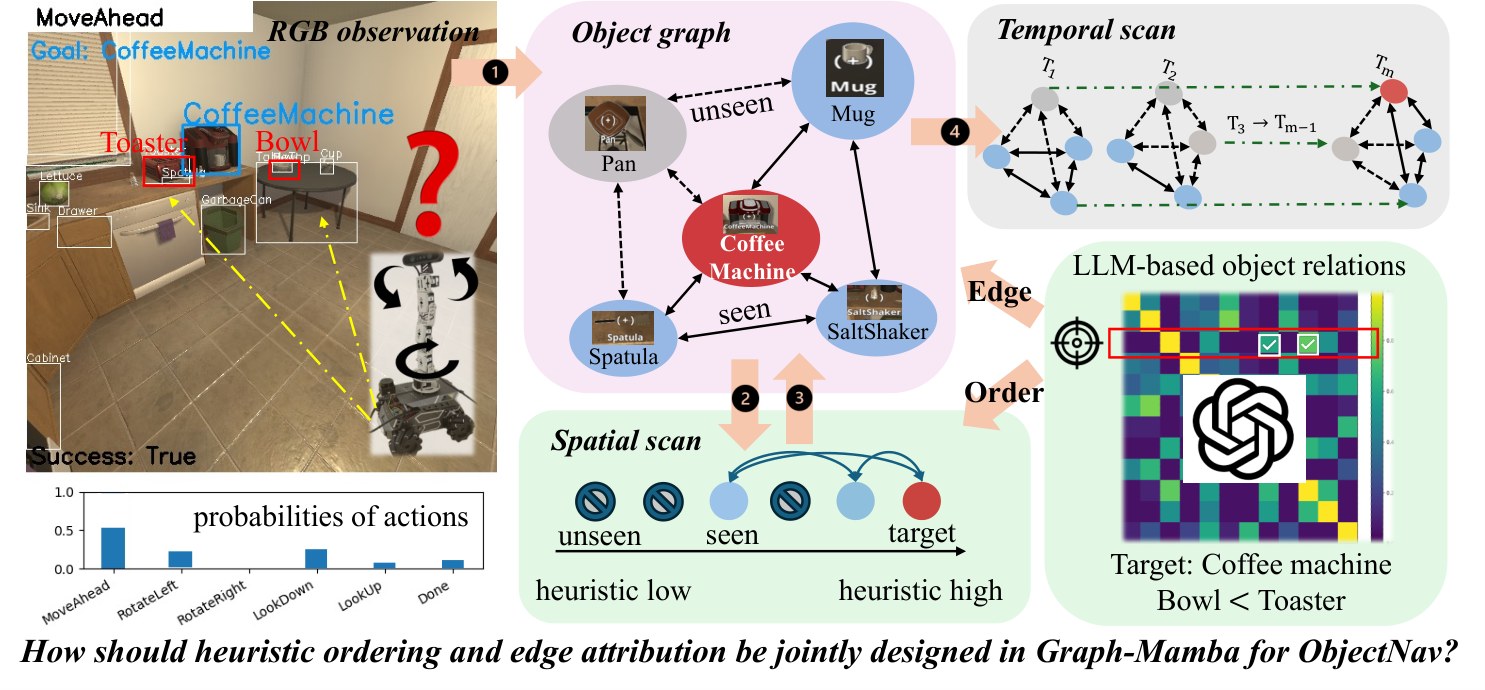
ChatGPT, then Mamba
A frozen DETR detector fills a 22-category object graph. ChatGPT-5, via a co-occurrence prompt, builds an affinity matrix. Those scores initialize edge weights and a heuristic order: low-relevance objects first, the target last, so the target node sees everyone else.
A GINE local pass handles neighbors. A Graph-Mamba global pass reads the ordered sequence. A second Mamba then walks each object’s history, memory capped at T = 35. An A3C LSTM picks among MoveAhead, turns, look up/down, and Done.
Success means Done, the target in view, and distance under 1.5 m.
Sim numbers, then a living-room book
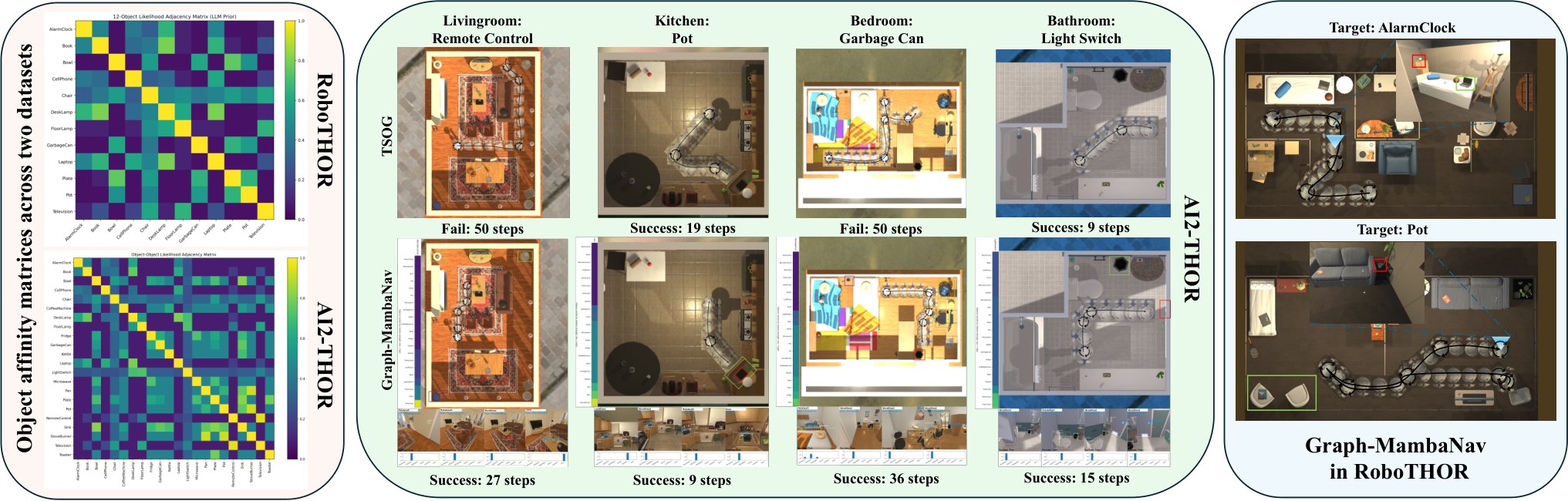
On AI2-THOR, Graph-MambaNav reports 83.22% success and 46.52% SPL on all test trajectories. TSOG is 80.04 / 41.44. CGI+GAIL is 77.59 / 46.25. Memory-MambaNav is 81.24% success. On long paths (L ≥ 5) they list 76.09% success.
RoboTHOR is harder: 49.82% success and 28.67% SPL, still the best success in their table, with 37.38% success on L ≥ 5.
Ablations say the global ordered scan is the big jump (66.15 → 78.34 success). Temporal scan adds the rest (78.34 → 83.22). Random global order drops them to 73.67%. Corrupting 30% of the affinity entries lands at 77.92%.
The real robot is a wheeled base with a camera at 0.65 m, a pitch servo, Raspberry Pi 5 on ROS 2, and the policy on a host PC. In a living room the target is a book. The robot walks toward a laptop, then chairs and a TV, and finds the book on a chair cluster. The paper presents that as a qualitative transfer demo, not a success-rate table.
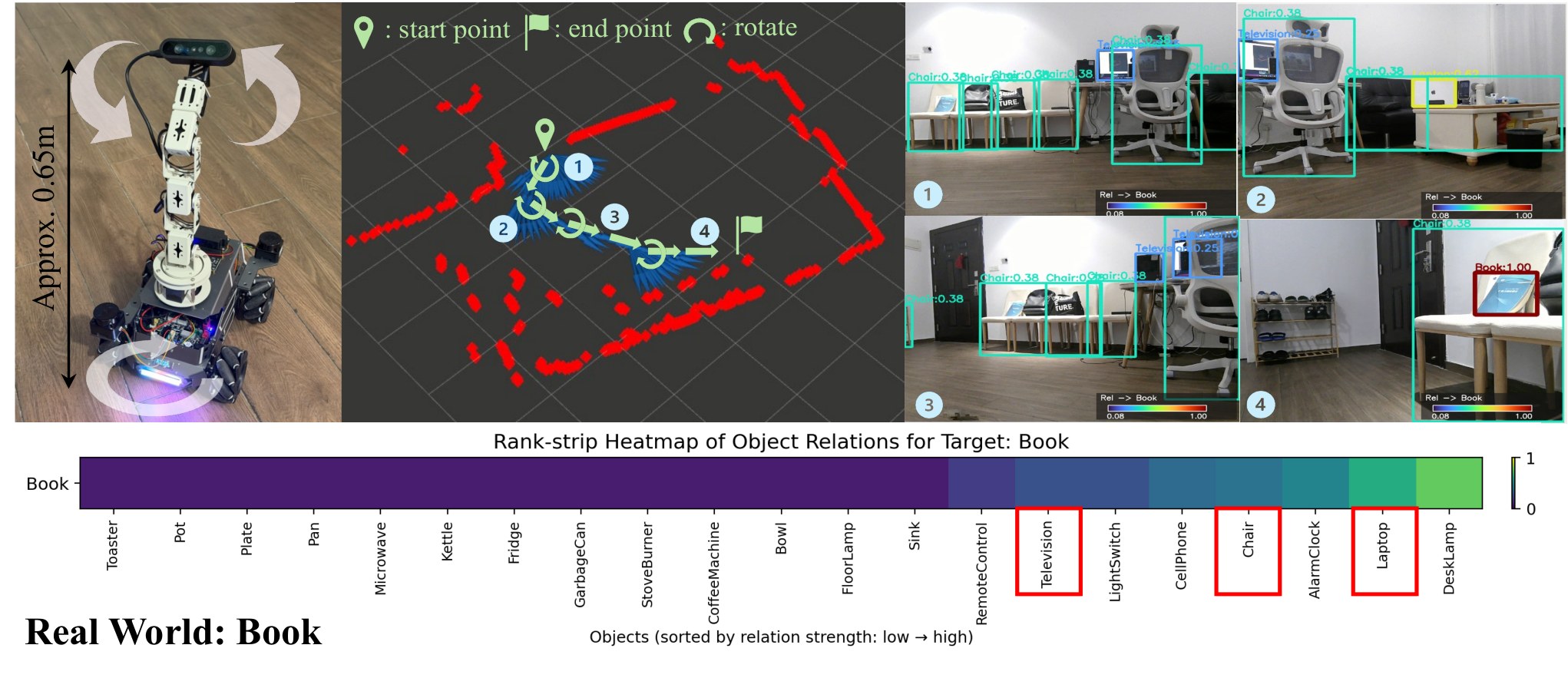
A Human’s Take
Ordering the graph by “what usually sits near a remote” is a trick I would actually ship on a home robot. It will also walk you into the wrong chair when the house does not match ChatGPT’s kitchen. The living-room book run is cute. Give me a dozen unseen apartments with a fail log before I trust the affinity matrix more than a map.