CSIRO Evolves Soft Fingers as Graphs, Then Prints the Pareto Set
CSIRO Robotics published a way to grow soft gripper fingers as graphs, score them in nonlinear FEM, and keep a diverse Pareto set instead of one “best” finger.
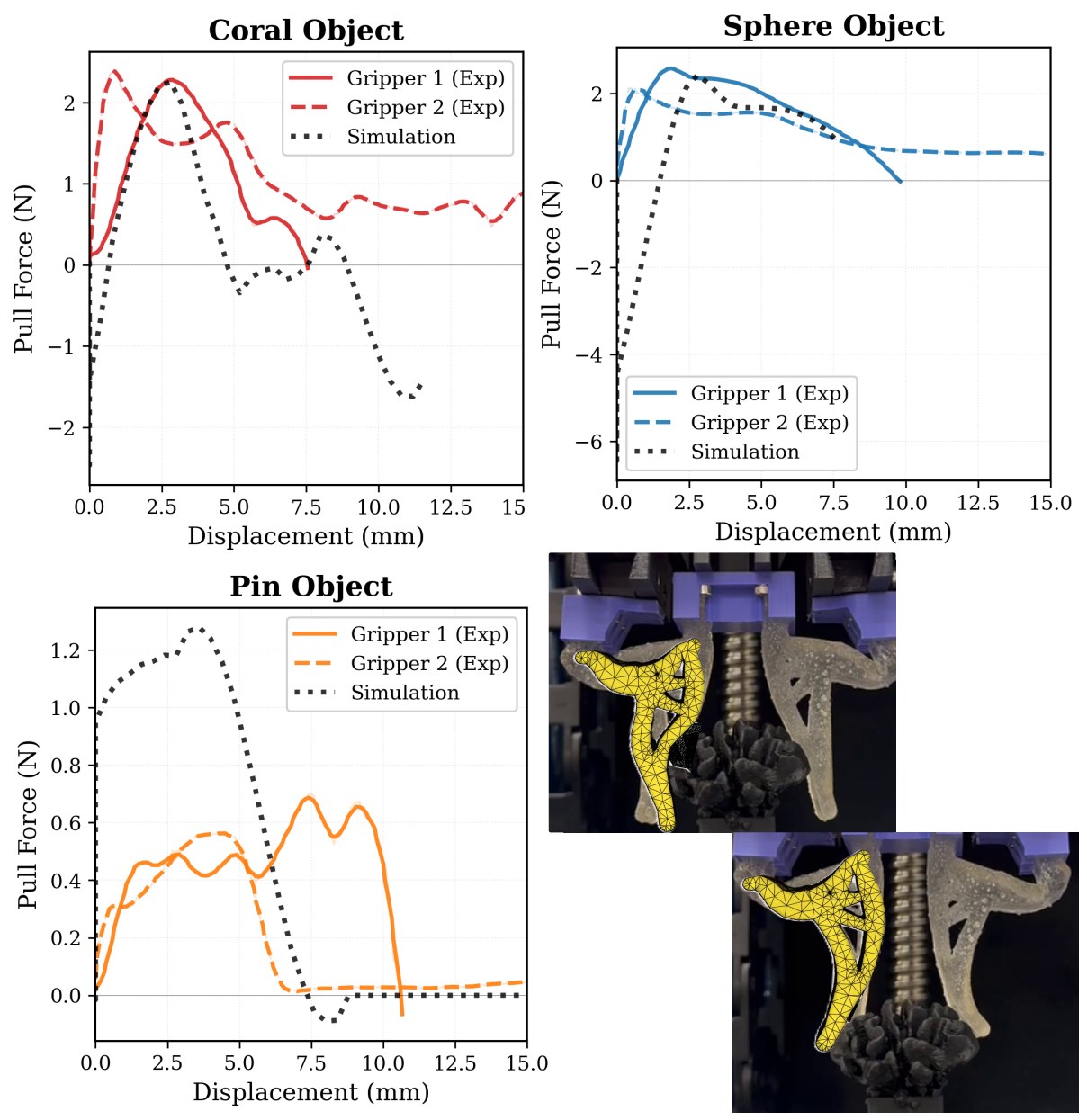
André Farinha, Ge Shi, Harry Bowman, Brendan Tidd, David Howard, and Josh Pinskier posted arXiv 2609.20087 on 17 September 2026. The hardware check is small and specific: two designs from the four-objective front, printed in Formlabs Elastic 50A, on a parallel gripper driven by a Dynamixel XM430-W210.
Graphs, not voxels
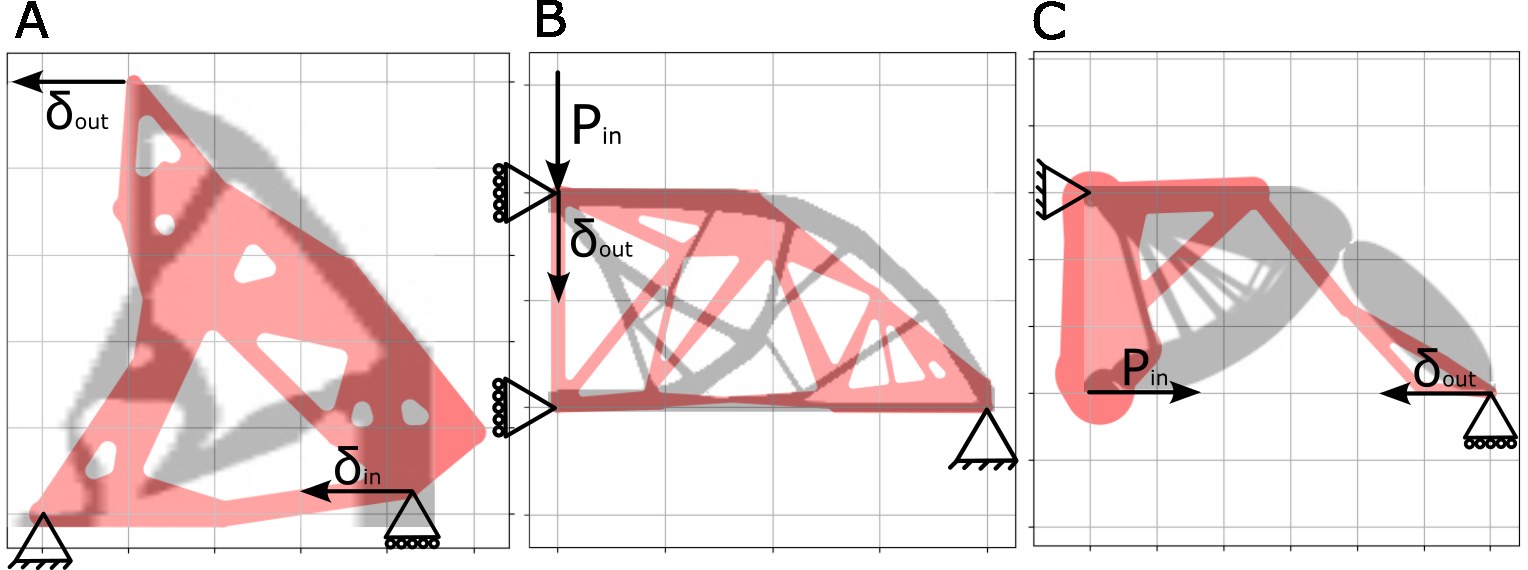
Each design is a set of 2D nodes. Edges appear when a weighted distance falls under a threshold; each edge becomes a beam of set thickness. That geometry goes into a Neo-Hookean FEM with Incremental Potential Contact, implicit Newmark time, and about 5,000 tetrahedra per design.
The search is Pareto Dominated Novelty Search: a multi-objective twist on Dominated Novelty Search. Population N = 300, 200 generations, a 10-D behavior descriptor.
Four grasp cases sit on an ALOHA-style parallel finger: large rigid, large soft, small soft, small rigid. Soft objects use one-third the gripper’s Young’s modulus. Pinch versus power is object size and contact height, not a second controller.
What the front looks like
The four-objective run kept 89 non-dominated designs. The first two principal components of objective space hold 81.3% of the variance. PC1 (57.8%) splits the small-rigid case from the rest: soft fingers that live on contact area struggle to load a tiny hard object.
Specialists look different. Large-object winners grow longer moment arms. Small-object winners shorten the arm for tip travel. Soft-small designs grow hooks; large-rigid designs grow thin, compliant contact strips.
Single-objective optima win their training case and fall off when the object moves ±10 mm. Four-objective samples stay competitive off-diagonal and, on two unseen shapes (a concave column and a coral), the best individuals often come from the random Pareto subset, not the specialist elites.
The print test used a Zemic H3-C3-25KG-3B load cell on pull-out. The paper calls the match qualitative: deformation and contact line up with sim, and pull-force magnitude is in the same band. It is not a 50-object warehouse trial.
A Human’s Take
I like a gripper paper that prints two fingers and pulls a coral instead of stopping at a heatmap. The useful claim is narrower than “general-purpose”: train on four contacts, and the mixed front transfers better than a greedy specialist. That is a design-process result. I still want a third printed finger on a fruit that was never in the FEM.