GTA-2 Builds Robot Skills From Axes, Not End-to-End Actions
End-to-end VLAs hide the plan. Code-as-Policies dumps a whole program in one shot. GTA-2 (Grounded Task Axes v2), from Carnegie Mellon’s Robotics Institute and Bosch Research, splits the difference: four vision-language agents write an inspectable skill, then a UR5e runs it.
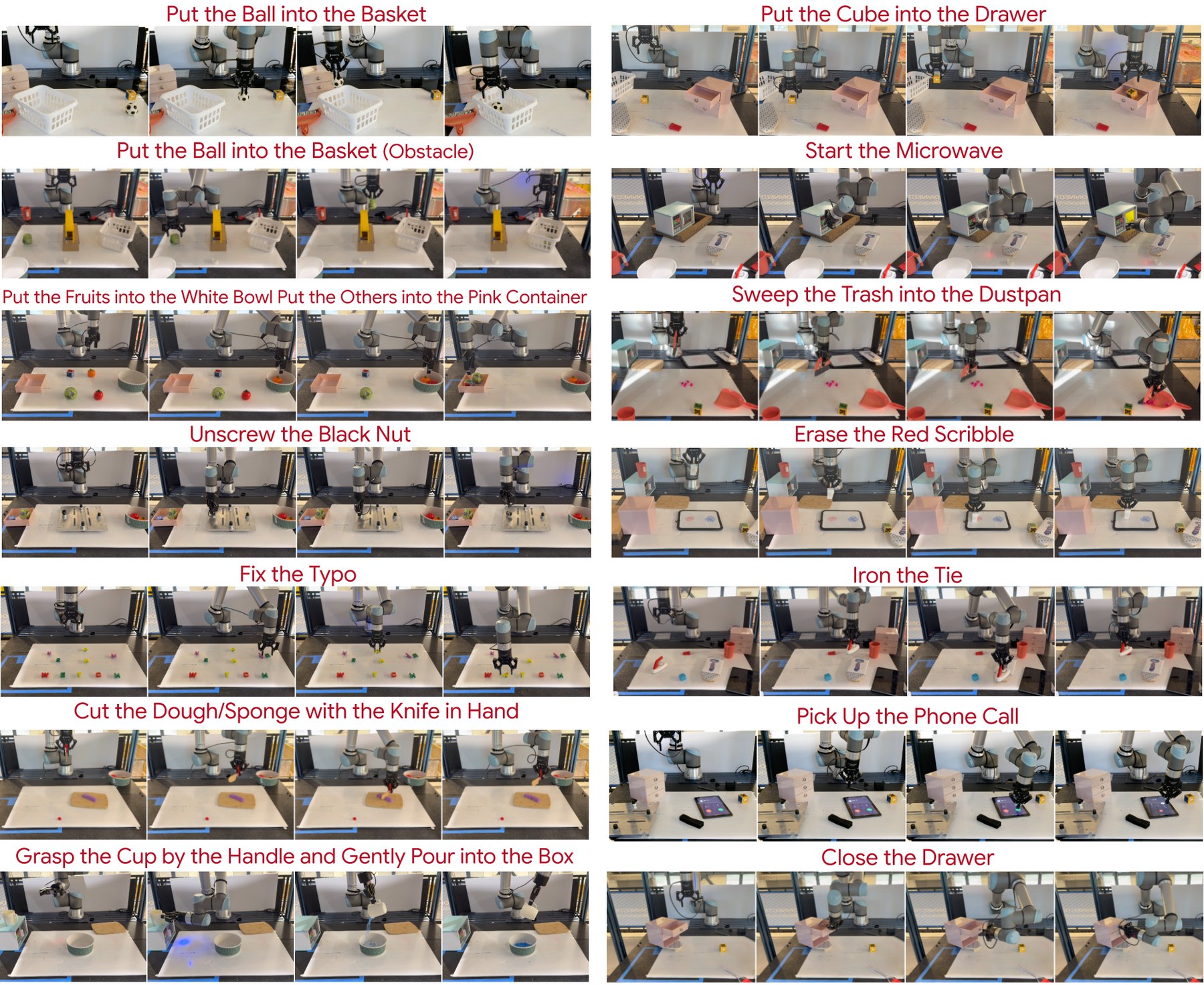
The paper (arXiv:2609.09808, submitted September 9, 2026) reports 73.9% average zero-shot success on 14 real manipulation tasks, 31.4 points above the strongest baseline. After targeted human feedback on a failed stage, that average rises to 90.7%. No task demos, no policy training, no fine-tuning.
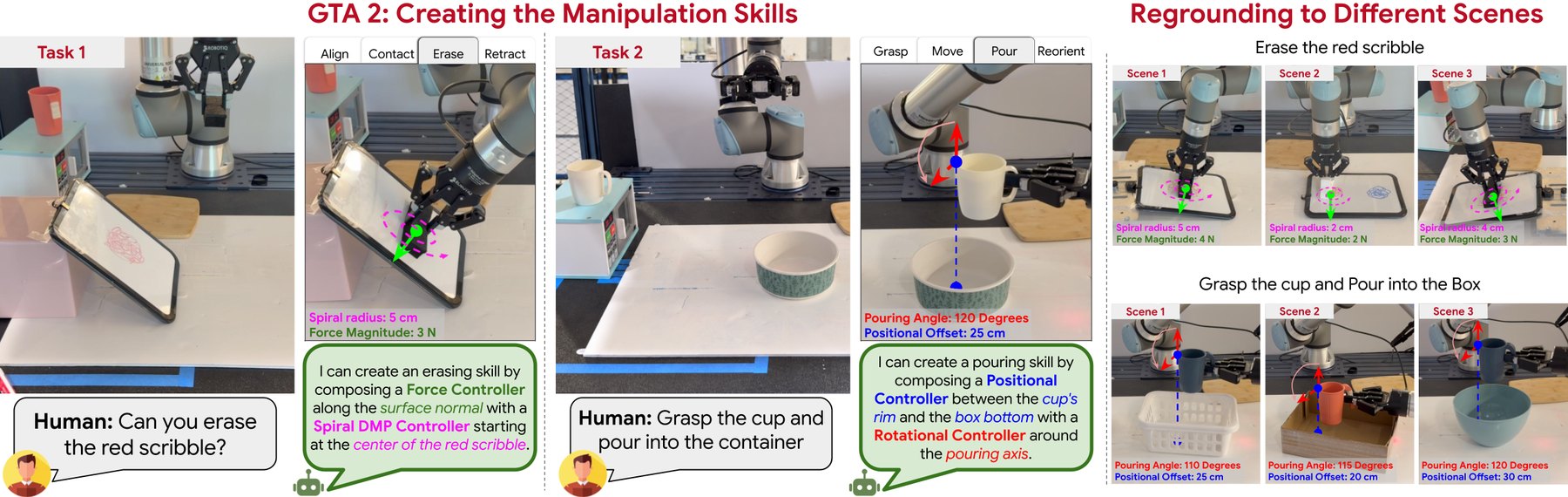
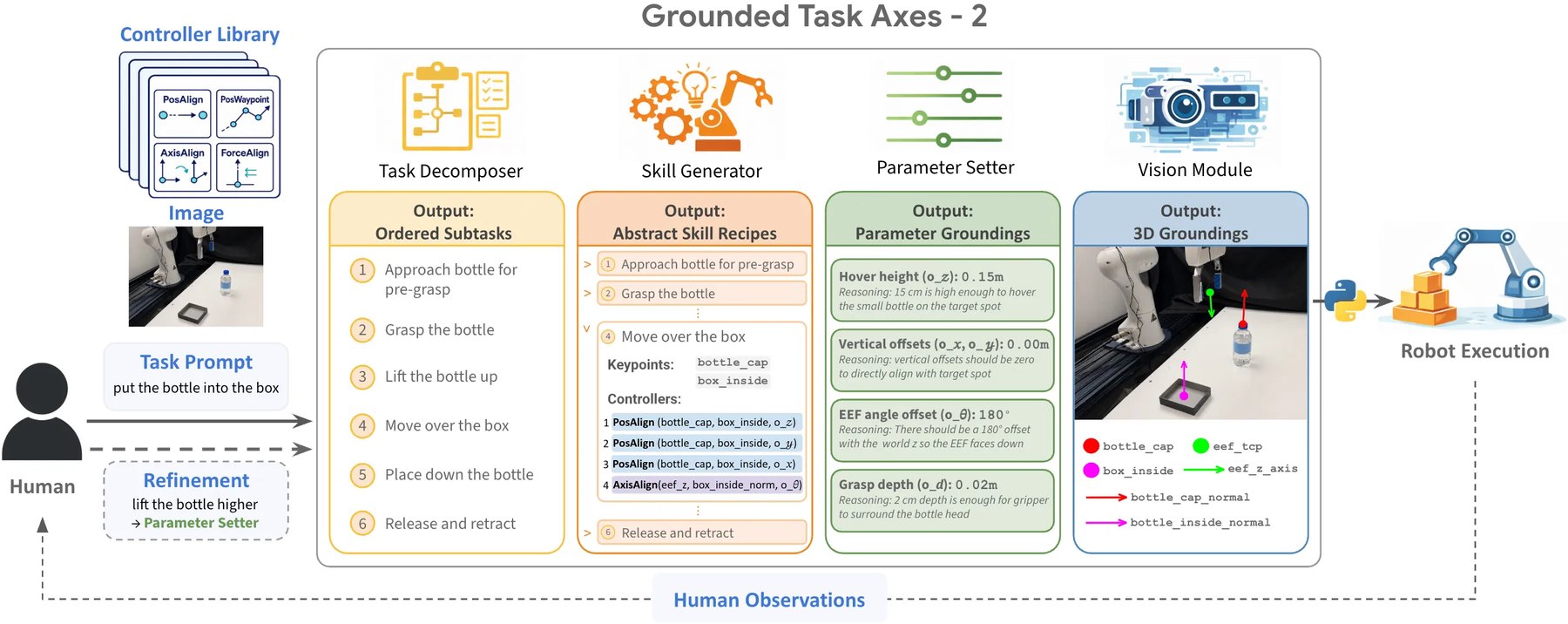
Four agents, one controller library
Hardware is a UR5e, a Robotiq 2F-85 gripper, and a calibrated ZED 2i. All four agents use Gemini 3.1 Pro, differing only in prompts and structured outputs:
- Task Decomposer — ordered subtasks from the instruction.
- Skill Generator — keypoints, axes, and controller recipes per subtask.
- Parameter Setter — numbers: offsets, forces, angles.
- Vision Module — metric 3D features from RGB-D.
Controllers include position and axis alignment, waypoints, constant force, gripper state, and a learned spiral DMP. Lower-priority commands sit in the null space of higher ones. If the pour height is wrong, you poke the Parameter Setter and keep the rest.
Numbers against π0.5 and two code baselines
Each generalization cell is 20 physical trials. Zero-shot GTA-2 averages 73.9%. CaP-Primitive (Code-as-Policies with Cartesian motion, gripper, and contact force) is the best baseline at 42.5%. π0.5 (DROID-finetuned, run on a Franka for that baseline) and CaP-TAC (same task-axis library, one generated script) trail further. CaP-TAC does beat primitives on pouring, cutting, and sweeping, where contact geometry matters.
Plan generation is a separate study: 15 runs per task, 210 total. Zero-shot execution succeeds in 154/210 (73.3%). One feedback round reaches 181/210 (86.2%), two rounds 208/210 (99.0%), all 210 within three. First-round edits mostly hit the Skill Generator; later edits shift to vision grounding.
The authors are clear about the box they built. Features are grounded once, not tracked online. Slip or a moved object needs a new cycle. The controller library has to already express the objective. Tests are one tabletop arm.
A Human’s Take
I smiled at “fix the typo” rearranging letters into TEACH. That is a system that followed the words, not a hidden demo script. The useful part is the edit loop: you do not regenerate a 400-line policy because the spiral radius was 2 cm too small. I still want to see this on a second arm and a moving object. Until the vision module updates while the cup is pouring, it is a very smart first take, not a shift worker.