GUARD Watches Whether a Diffusion VLA Is Actually Looking at the Scene
Diffusion vision-language-action policies can look fluent while barely using the pixels and words that define the task. GUARD (Grounding Uncertainty and Ablation-Based Risk Detection for Diffusion-Based VLAs), posted to arXiv as 2608.04510, is a test-time monitor for that failure mode: it measures how much the action head depends on multimodal evidence, without retraining the policy.
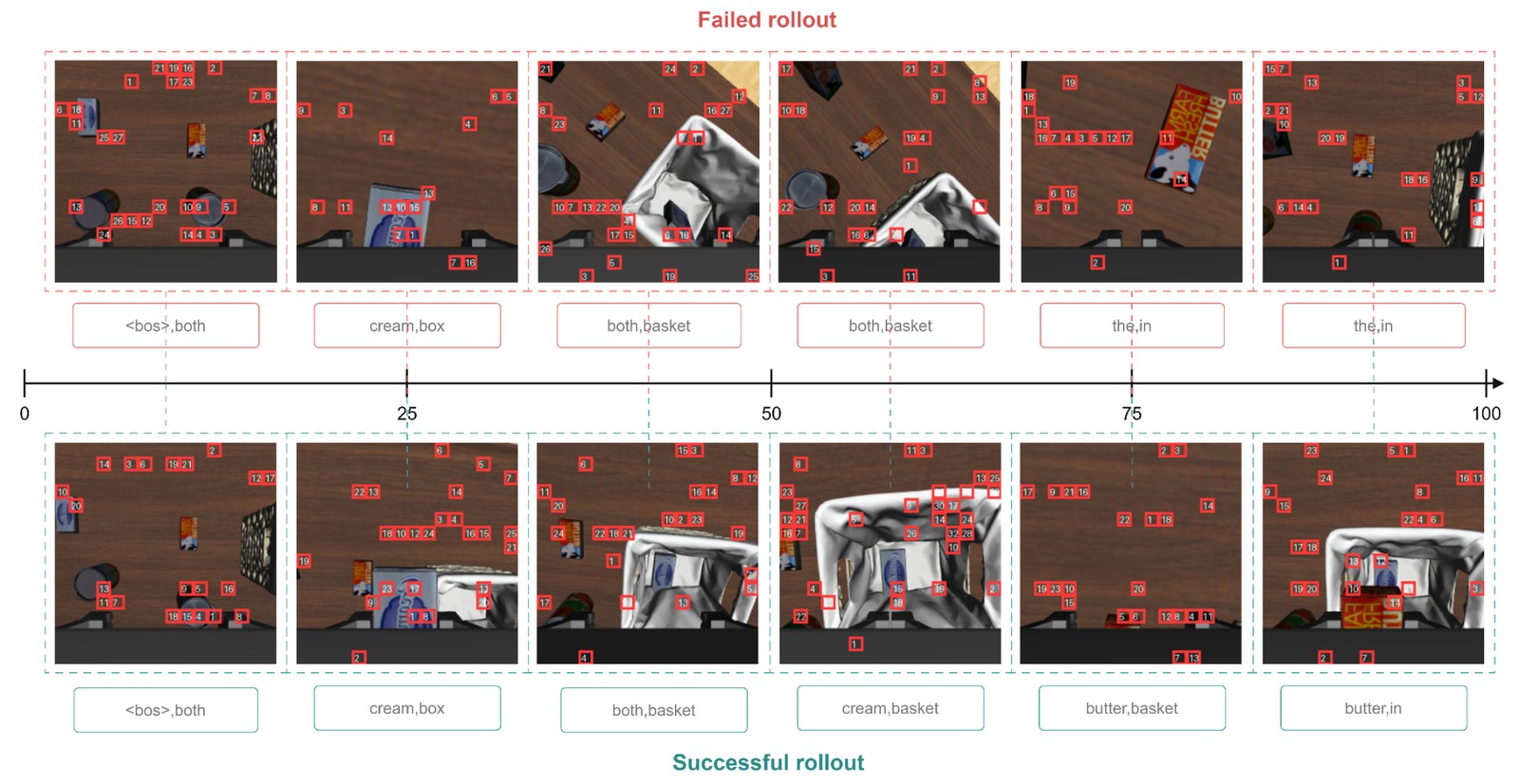
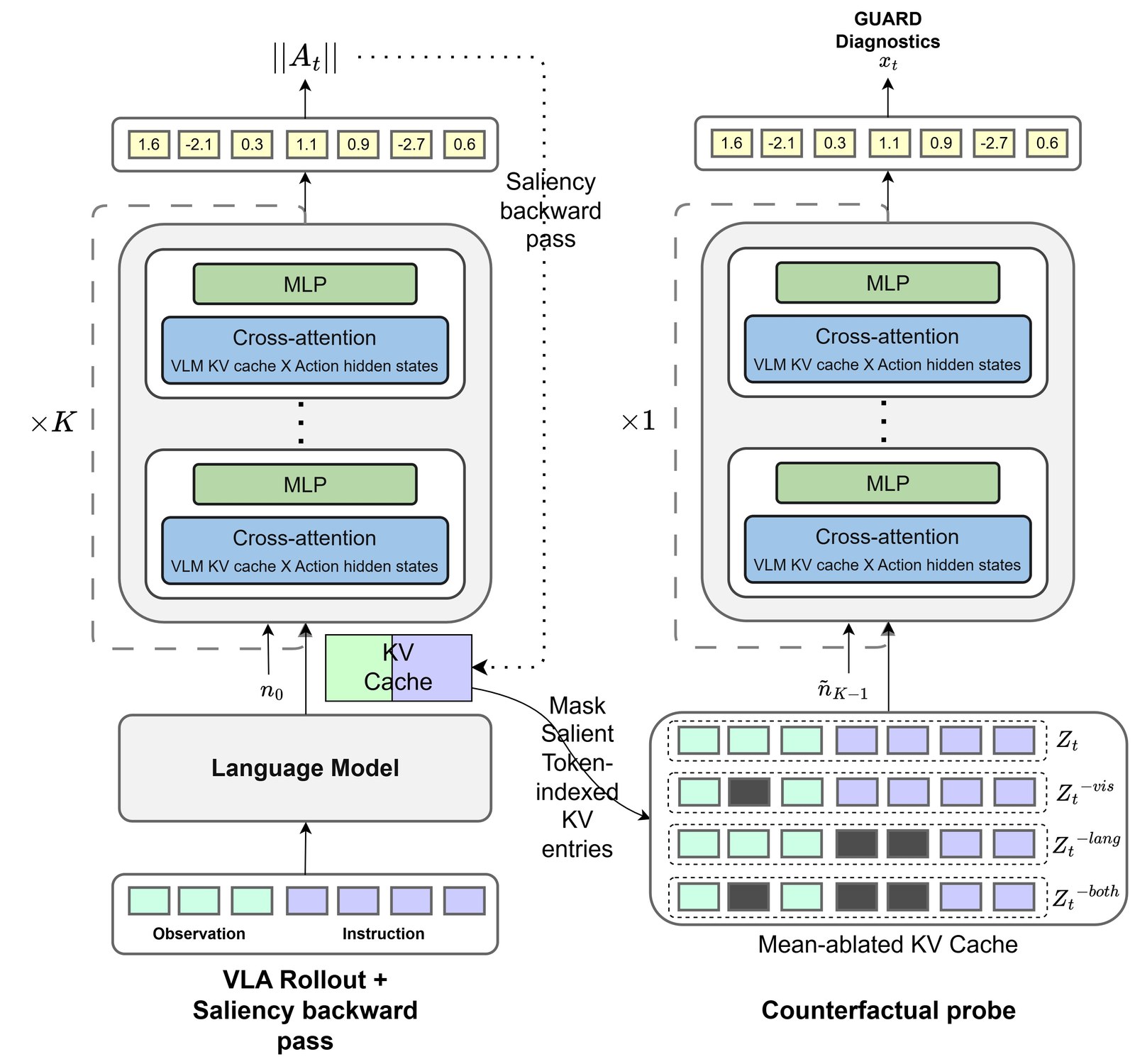
How GUARD works
From the paper abstract and body:
- Estimate the influence of token-indexed entries in the final vision-language model key-value (KV) cache.
- Build counterfactual caches by ablating the most salient KV entries.
- Compare denoising responses under ablated vs original conditioning.
- Form a diagnostic stream — sensitivity, attention entropy, modality bias, grounding efficiency — calibrated online and fed to a lightweight temporal classifier.
The point is practical: if ablating the evidence that should ground the task barely changes the action denoiser, the policy is free-running on priors. That is a failure signal you can read at runtime.
What they measured
Authors evaluate under task-held-out splits across five policy–benchmark settings, covering policies Pi0, SmolVLA, and Alpamayo-1.5 on LIBERO, SimplerEnv, MetaWorld, and PhysicalAI-AV.
Headline results from the abstract:
- Best ROC-AUC on four of five unseen-task settings; second on the remaining one
- Average unseen-task ROC-AUC improved by 5.73 percentage points over the strongest competing runtime monitor
- Seen-task average stays within 0.19 points of the best competing monitor
So the claim is transferable failure detection across policies, tasks, embodiments, and domains — not a one-benchmark party trick.
A Human’s Take
I care less about another VLA leaderboard tick and more about whether the robot knows it is winging it. GUARD’s KV ablation idea is the right class of tool: probe the action head’s dependence on evidence at test time. The receipt I want next is open code on a physical arm with sticky-note and lighting attacks in the same loop. Until then, treat the ROC-AUC gains as sim-monitor progress — useful, not a safety certificate.