H2R-Bench: Pretty Robot Videos Still Fail the Transfer
Egocentric human video is cheap. Robot tape is not. H2R-Bench, from Shanghai Jiao Tong University and Shanghai AI Lab (arXiv August 13), asks whether today’s video world models can turn one into the other.
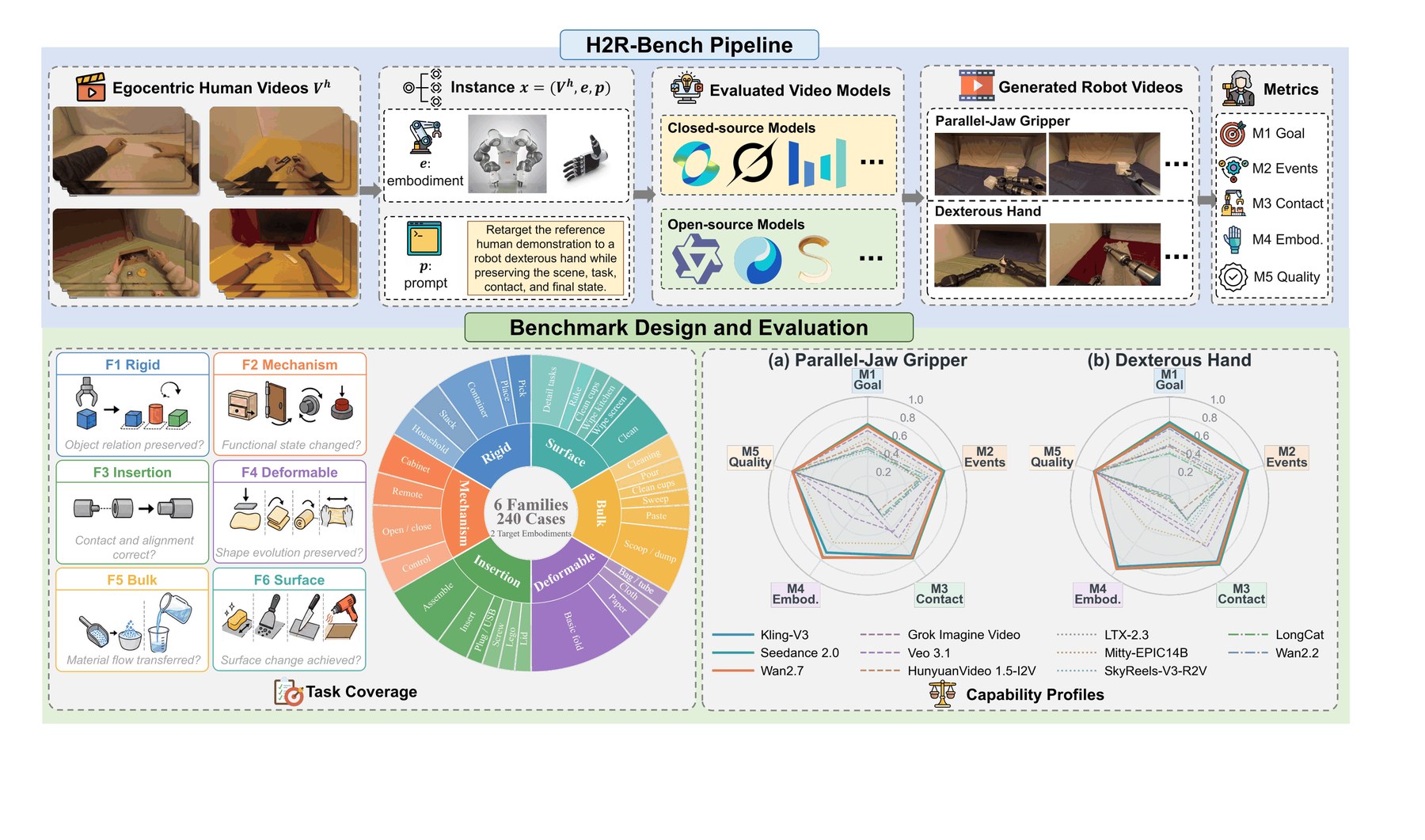
Each case is a 5-second human clip, a target embodiment (parallel-jaw gripper or dexterous hand), and a prompt. The model must emit a robot video of the same task. Pose copy is not required. Keeping the goal, the actions, the functional contact, and the requested body is.
240 cases, five scores
The bench uses 120 EgoDex clips, 20 in each of six families: rigid rearrangement, mechanism actuation, insertion, deformable configuration, bulk-material transfer, and surface change. Two embodiments make 240 cases.
Judges (Gemini 3.5 Flash, Qwen3.7-Plus, GPT-5.4) score 25 sampled frames on:
- M1 Goal (weight 0.15)
- M2 Action events (0.15)
- M3 Functional contact (0.30)
- M4 Embodiment (0.30)
- M5 Video quality (0.10)
H2RCore is 100 times the weighted sum. Contact and body type carry 60% of the grade on purpose.
Three human raters line up with the automated transfer scores (within-scene Spearman ρ = 0.883, aggregate Pearson r = 0.930).
Who actually transfers
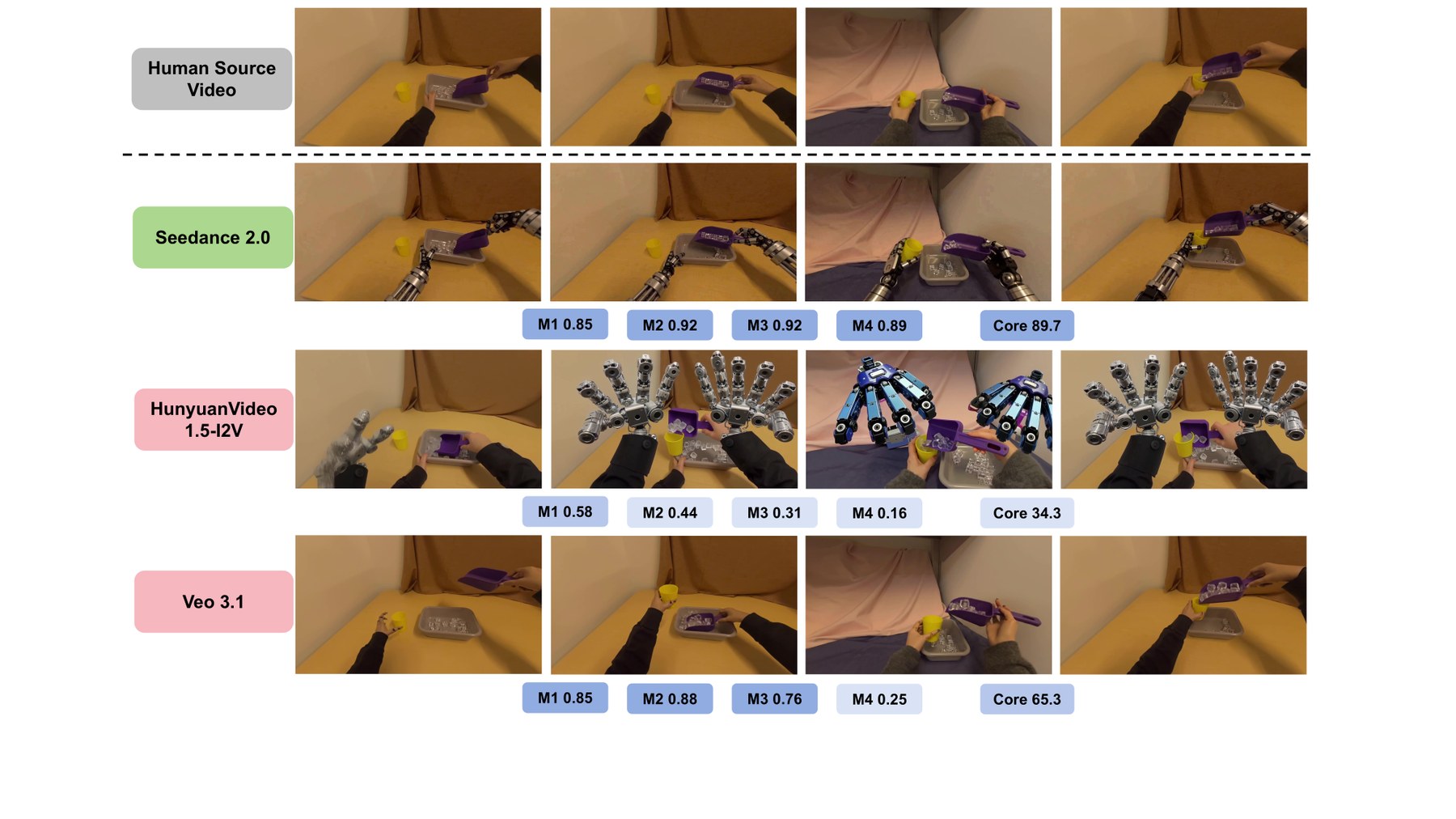
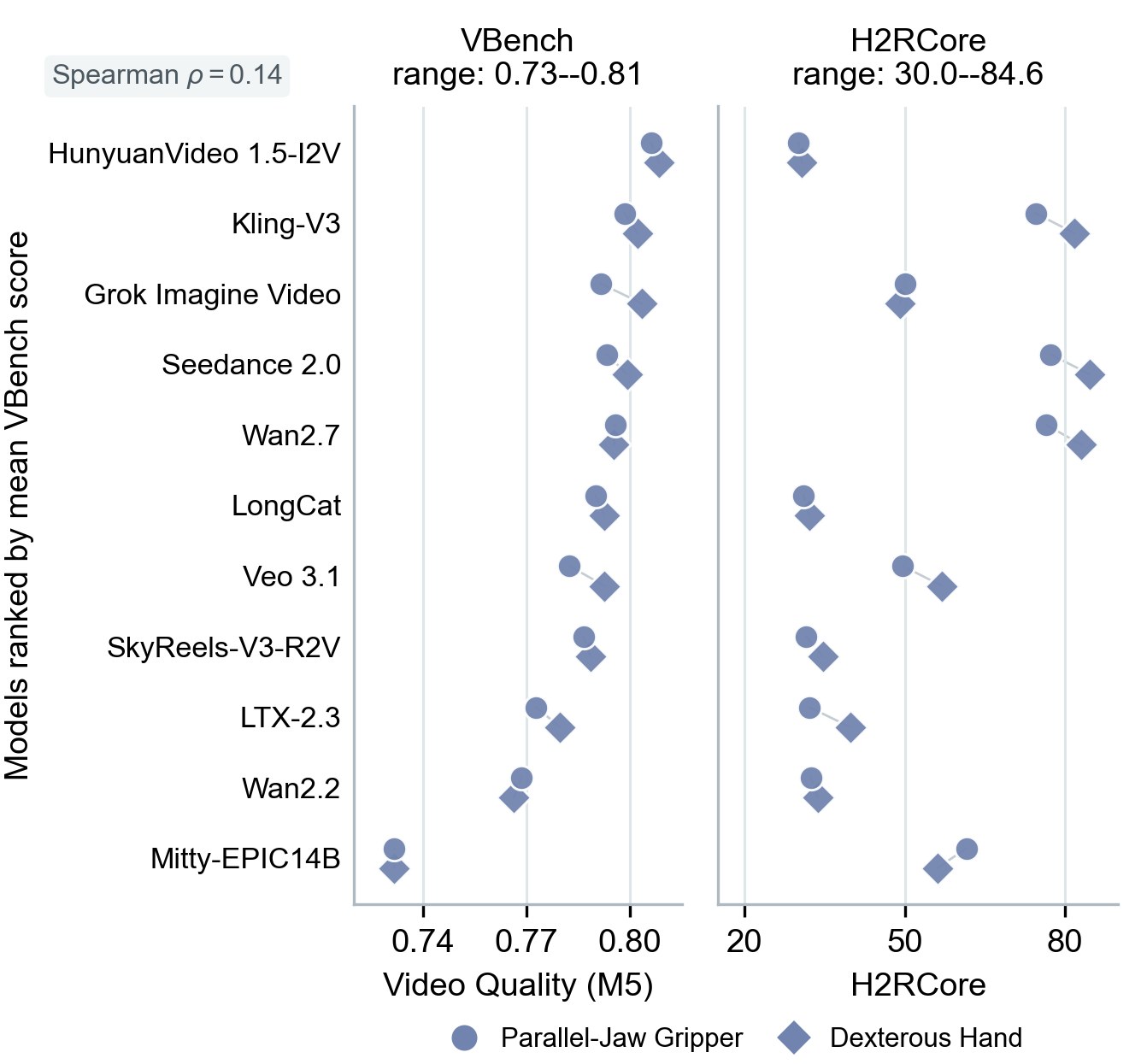
Video-conditioned models sit on top. Seedance 2.0 leads at 77.3 H2RCore on the gripper and 84.6 on the hand. Wan2.7 is next (76.5 / 83.1), then Kling-V3 (74.5 / 81.7).
Frame-conditioned systems drop hard on embodiment. Veo 3.1 still recognizes the task (gripper goal 0.725) but embodiment is 0.100 / 0.227. HunyuanVideo 1.5-I2V wins raw quality (0.806 / 0.808) and finishes last on H2RCore (30.0 / 30.7). Across 22 model–embodiment pairs, quality and H2RCore barely rank together (Spearman ρ = 0.14).
The dexterous hand is the easier target for 9 of 11 models, by +3.3 H2RCore on average. Giving Seedance nine frames instead of the full clip costs 27.6 gripper points and 41.4 hand points.
A Human’s Take
This is the right rude question. I do not want another “robot-looking” clip that still has human knuckles in it. If you are going to train a policy on generated tape, embodiment and contact are the whole product. H2RCore putting those two at 60% is the first scoring rule in this corner that matches how a robot actually fails.