HAF Splits a Generalist VLA So a Humanoid Can Walk and Work
A team from Peking University, the Beijing Innovation Center of Humanoid Robotics, Nankai University, and Xi’an Jiaotong University posted HAF on August 17. The pitch is blunt: off-the-shelf vision-language-action models are not ready to run a humanoid that has to walk, set its waist, and use both arms at the same time.
HAF is a two-part adapter. HAF-VLA generates the motion. HAF-Steer tweaks it later without retraining the big backbone.
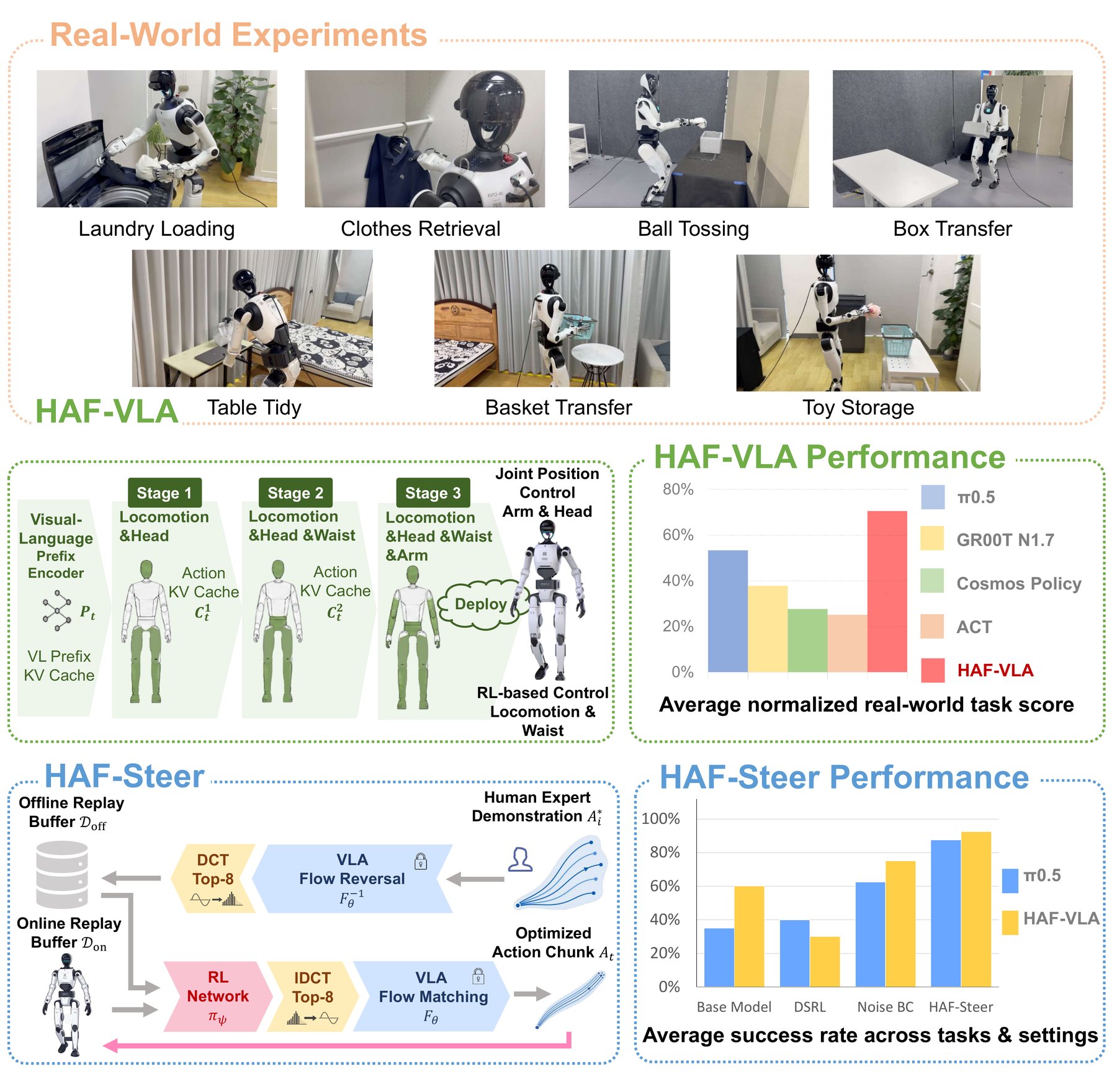
Three stages instead of one noisy whole-body chunk
HAF-VLA sits on a pretrained flow-matching VLA. Instead of denoising the entire body in one shot, it expands the action space in order:
- Locomotion + head
- Add the waist
- Add manipulation
Clean actions from earlier stages go into a KV cache so later stages still know what the feet already committed to. The authors say one-shot generation is how you get incoherent whole-body motion.
They evaluated seven real humanoid loco-manipulation tasks. On the project page’s main table, HAF-VLA averages 70.5% success. The listed baselines are π0.5 at 53.3%, GR00T N1.7 at 38.1%, Cosmos at 27.6%, and ACT at 25.2%.
Out-of-distribution checks are small but specific. With an unseen chair on the Laundry Loading path, HAF-VLA scores 40.0% versus 26.7% for π0.5. With a 20 cm backward start shift on Clothes Retrieval, it scores 43.3% versus 36.7%.
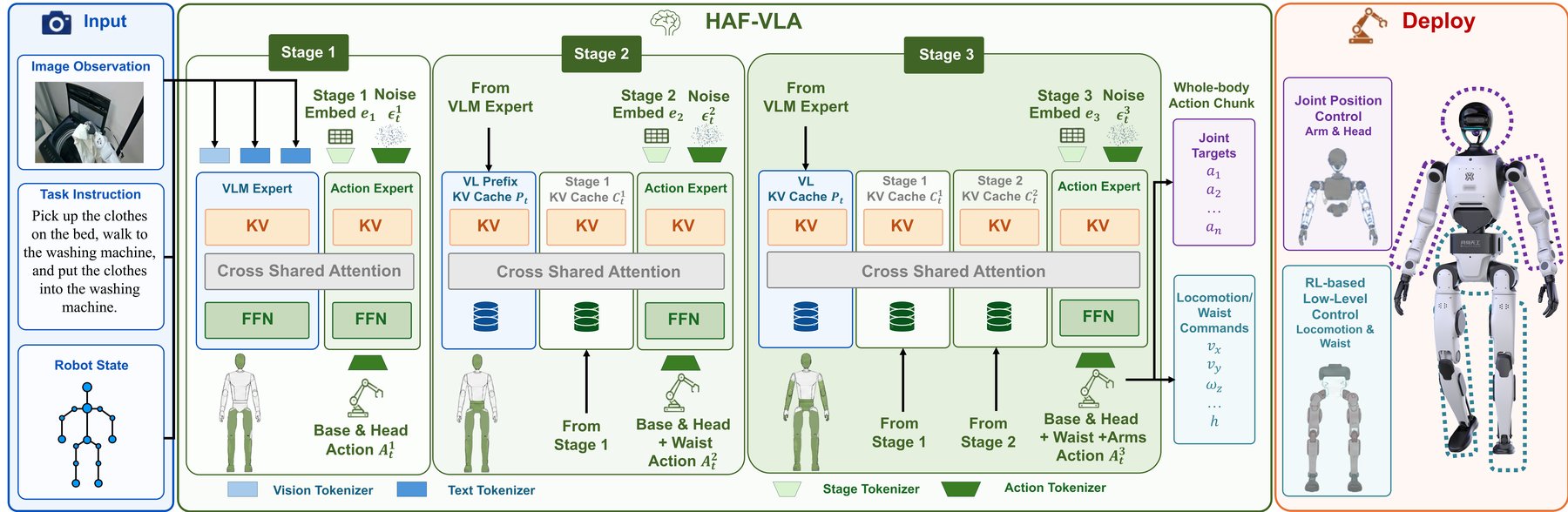
Steer the noise, leave the VLA frozen
HAF-Steer is the part I would actually deploy if I already paid for a large VLA. The generator stays frozen. Expert action chunks are reversed through the flow, squashed with DCT, and used to train a regularized SAC policy in that compact noise space.
The authors’ reason is practical. Offline behavior cloning is often mediocre on the real robot, and online RL on the full backbone is expensive and unsafe. They report extra gains on Toy Storage and Basket Transfer after offline-to-online adaptation. The project page notes that some DSRL training was stopped when exploration got unsafe.

A Human’s Take
Whole-body VLA papers keep trying to emit legs, waist, and hands as one pretty trajectory. That is a bad habit. Feet have to be right before the arms get clever.
I like that they kept the backbone frozen and only trained in a compressed noise subspace. That is how you refine a factory policy without gambling the whole model on a bad episode. The success table is the right kind of receipt. Now I want hours, not ten-trial averages.