HALOMI Teaches G1 Loco-Manipulation From Human Demos Alone
Most humanoid learning still assumes you own a robot and a skilled teleoperator. HALOMI (Humanoid Active-Perception Loco-Manipulation Interface) flips that: learn long-horizon loco-manipulation from robot-free human demonstrations, then run them on a Unitree G1 with a custom 3-DoF active neck.
The interface
Authors from Shanghai Jiao Tong University and collaborators describe a data kit that pairs bimanual UMI-style handheld grippers (Agilex Pika Sense) with a helmet-mounted RealSense and VIVE tracking. Demonstrators produce synchronized ego-view RGB, wrist-view RGB, and head-hand trajectories at 30 Hz — no robot in the loop during collection.
On the robot side, matching Pika grippers sit on the G1 arms, and a servo-driven neck aims the head camera with yaw/pitch/roll roughly aligned to the optical center. A high-level VLA (π0.5 fine-tuned on processed human data) predicts relative head-hand action chunks; a manifold-constrained whole-body controller tracks those world-frame targets by planning in a BFM-Zero latent behavior space rather than raw joint commands.
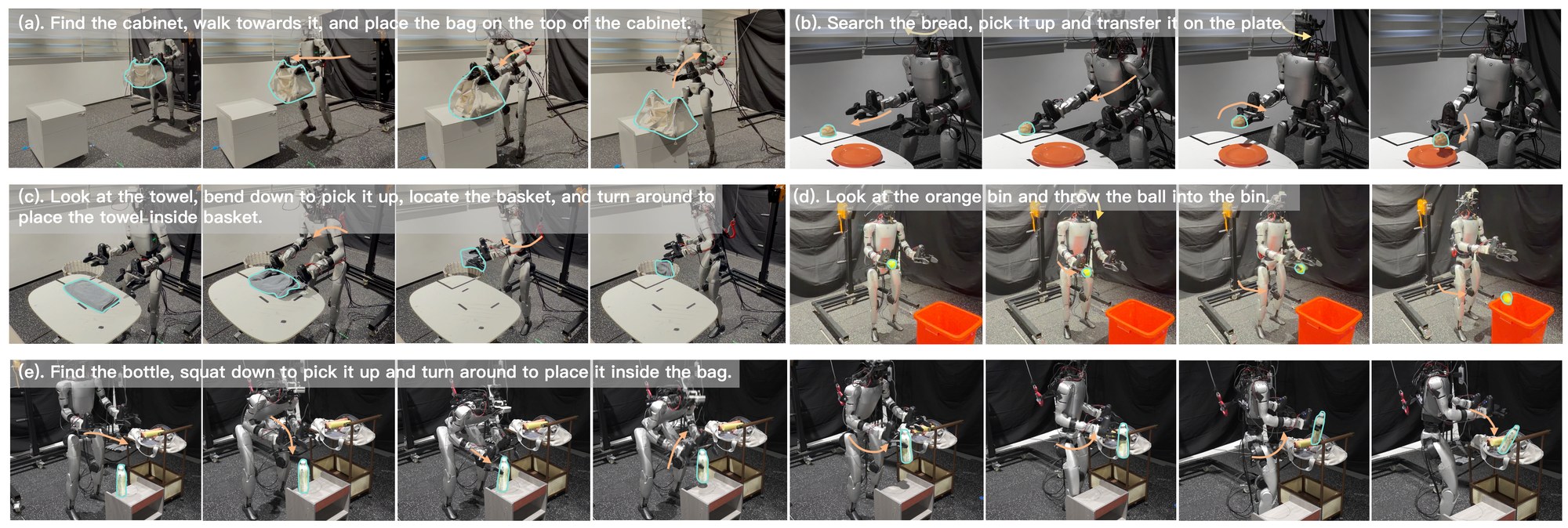
Results worth quoting
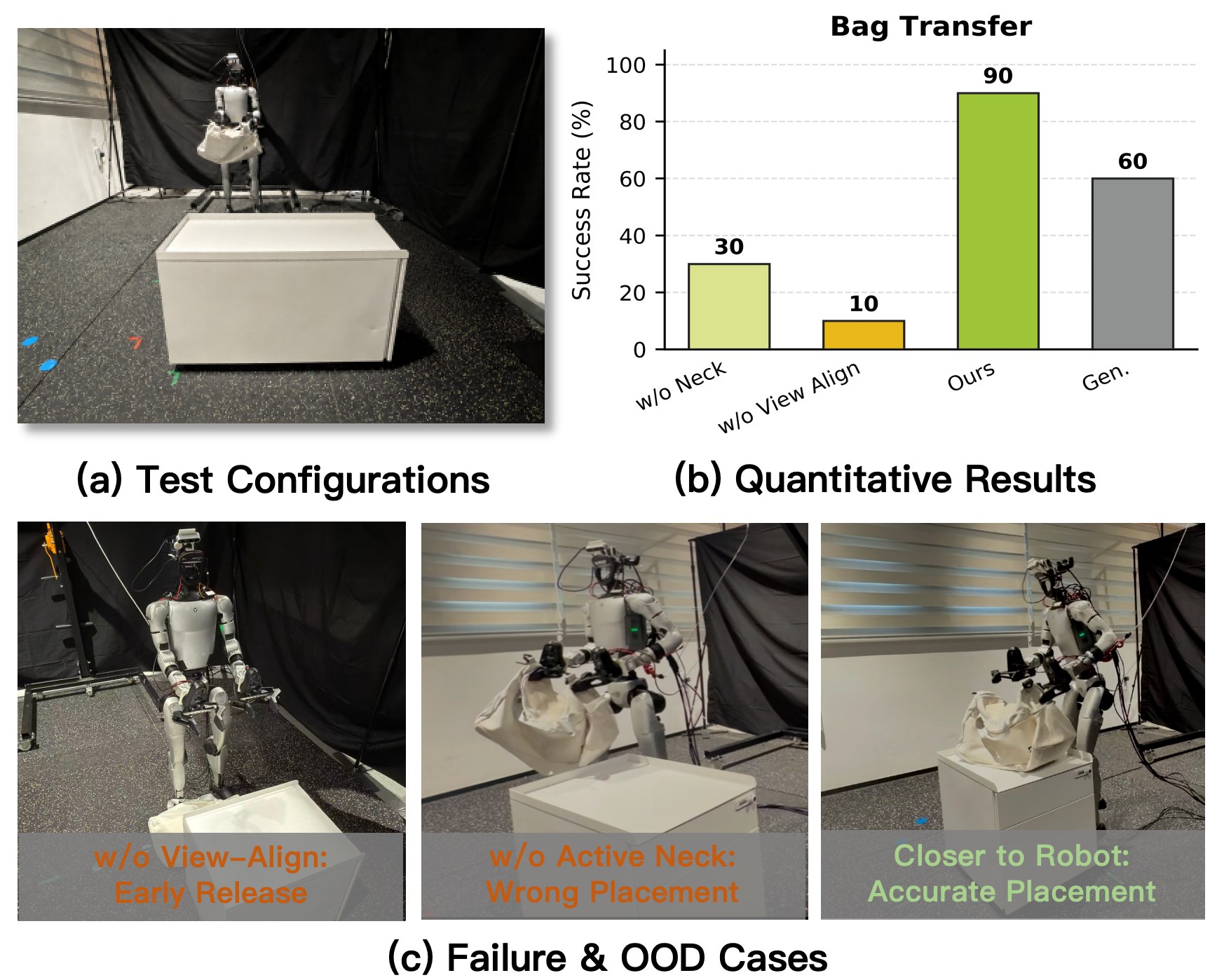
Across three quantitative tasks with ~95–102 human demos each and 20 rollouts per setting, success rates land at 90% (bag transfer to cabinet), 85% (pick bread and place), and 80% (towel to basket) — about 85% average as stated in the abstract. Qualitative demos add dynamic tossing and deep-squat grasps.
Ablations are sharp:
- Drop ego-view alignment on bag transfer: 90% → 10%
- Disable active neck on bag transfer: 90% → 30%; on towel task: 80% → 10%
- Controller-aware trajectory adaptation trims tracking error ~6–8% and lifts bread task 75% → 85%
OOD tests hold partial generalization (e.g. 60% on novel towel appearance; 60% on unseen cabinet placements) but collapse when bread-to-plate relative layout leaves the demonstration distribution.
Project site: halomi-humanoid.github.io. Paper: arXiv:2606.18772 (submitted June 17, 2026).
A Human’s Take
Active perception is the sleeper feature here. Teaching a humanoid from people who naturally look where they reach is how long-horizon home and warehouse tasks should be collected — if the alignment stack holds up outside the authors’ lab. The neck hardware is a reminder that stock G1 heads still leave something on the table for hand-eye work.