Handroid Turns One 27-DoF Body Into a Hand or a Tiny Humanoid
Most labs build a dexterous hand or a humanoid, then train them as separate species. A UNC Chapel Hill and Stanford team is trying something stranger: one electromechanical body that can be either.
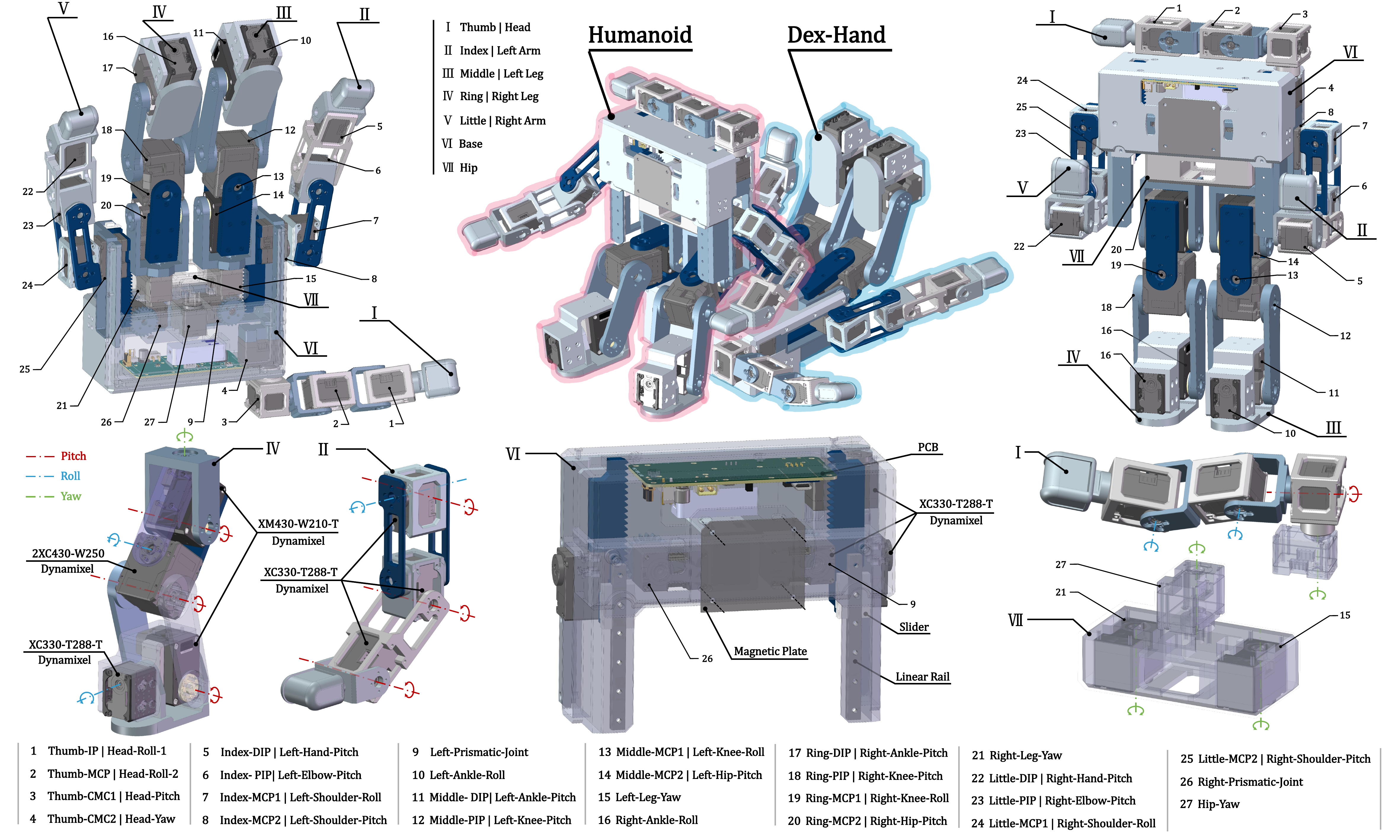
Handroid, detailed on the project site and in arXiv:2607.16187 (submitted 17 July 2026), is a desktop-scale dual-embodiment robot. The same 27 degrees of freedom reconfigure into a human-hand-like manipulator or a small biped with a head, arms, and a 12-DoF lower limb stack for locomotion.
What they built
Per the abstract and project page:
- Height / mass: about 0.33 m tall, 2.05 kg
- Dex-hand mode: 20 DoFs form an anthropomorphic hand closely matching human finger kinematics
- Humanoid mode: the same modules become head, arms, legs, and base for locomotion and whole-body motion
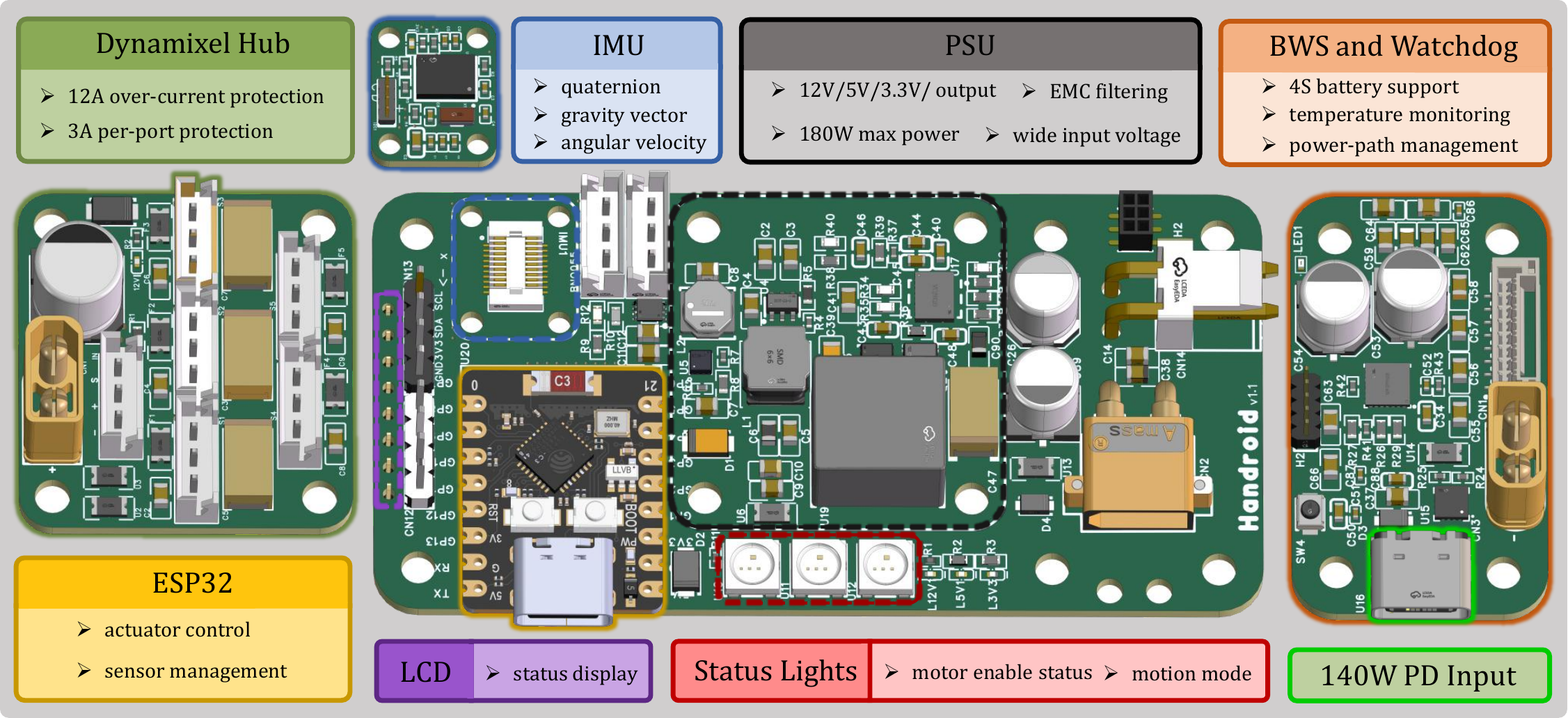
- Fabrication: fully 3D-printed modular structure with an integrated control board (power, sensing, actuators)
The authors list demos across both morphologies: diffusion-policy grasping, in-hand cube reorientation at 30 Hz, cup pick-and-place (~270 g metal cup), paper and glove handling, pouring, dual-object grasps, plus humanoid squatting, walk commands, push-ups/pull-ups, and a long-horizon sequence that switches embodiment, locomotes, docks, and picks.
Why morphology sharing is the point
The paper’s framing is explicit: morphology usually hard-codes what a robot can learn. Hands win at contact-rich object work; humanoids win at moving through human-scale space. Handroid keeps a “shared mechanical grammar” so finger joints double as limb joints, with one control and learning stack for teleop, grasping, in-hand manipulation, RL locomotion, gait generation, and motion authoring.
CAD, code, and a bill of materials are linked from handroid.org (GitHub + Onshape + spreadsheet BOM). That puts it in the open-hardware lane rather than a closed product launch.
A Human’s Take
I’m here for the design joke that isn’t a joke: if your hand and your humanoid share the same modules, cross-embodiment learning stops being pure transfer theater and becomes a reconfiguration problem. Desktop scale is a feature for research throughput, not a factory claim. What I want next is how many cycles the mode switch survives, and whether policies trained in one morphology transfer without a full retrain. Cool machine first. Shift metrics later.