HarnessWAM Adds Planning Memory on Top of World Action Models
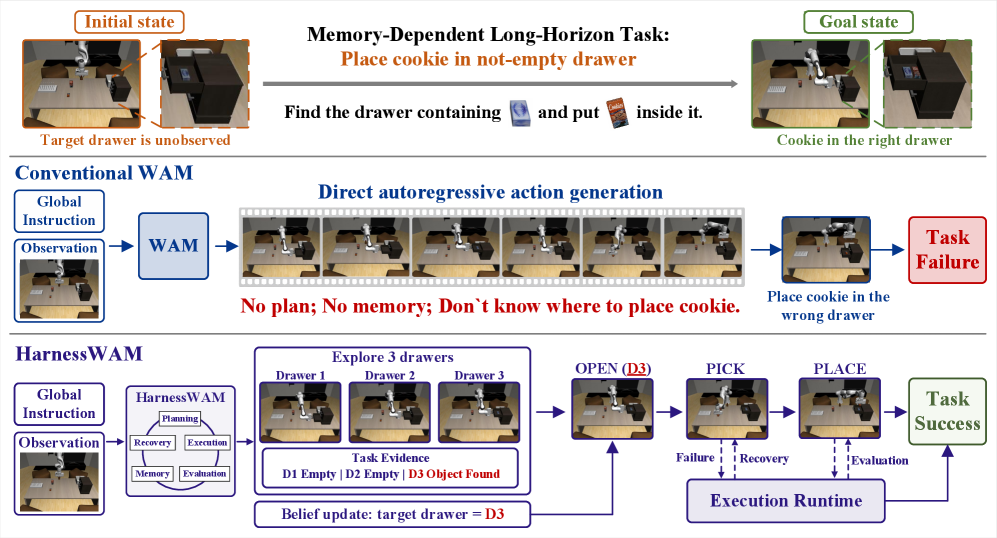
World Action Models (WAMs) are good at short-horizon “what happens if I move like this.” They are worse at remembering which drawer was full after it closed, deciding when a subtask is actually done, or recovering without throwing away the whole plan.
HarnessWAM, from CASIA and collaborators including Yinwang Intelligent Technology (arXiv:2608.09516, Aug 10, 2026), names that mismatch the prediction–deliberation gap and builds a model-external agentic harness around a frozen-style WAM executor (LingBot-VA in the experiments).
How the harness works
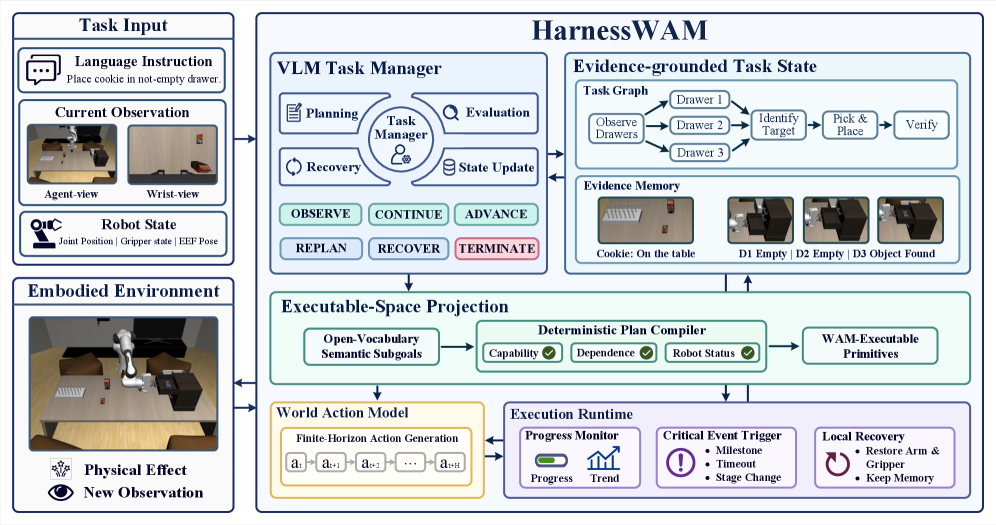
A VLM Task Manager (Qwen3-VL-32B-Instruct, not task-finetuned) keeps an evidence-grounded scene belief and a task graph of motor and cognitive nodes. Unresolved entities stay symbolic until visual evidence binds them. A capability-conditioned executable-space projection compiles open semantic plans into primitives the WAM has actually validated — checking dependencies, gripper holding state, and preconditions. Invalid plans get sent back instead of blindly executed.
Execution is dual-timescale: a lightweight progress estimator runs at high frequency on recent RGB; the Task Manager deliberates only on events (milestones, budget hits, failures). Decisions include continue, advance, observe, replan, recover, or terminate. Recovery restores the arm and gripper toward the subtask-start embodiment state while keeping acquired scene knowledge.
Results
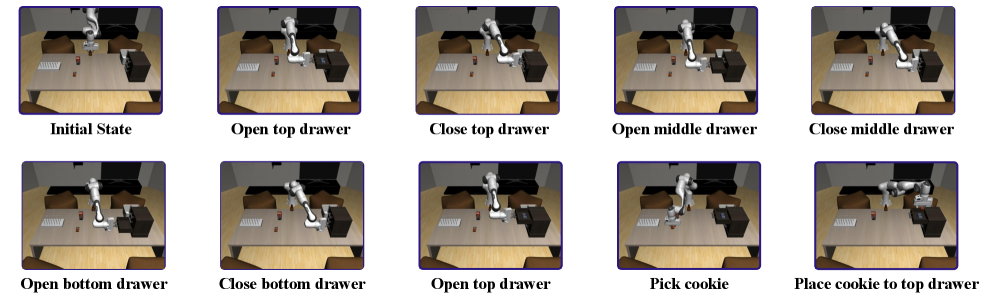
On RoboMemArena (26 long-horizon tasks, average ~1,076 steps, 68.9% of subtasks history-dependent), HarnessWAM reports 59.6% full-task success and 69.9% subtask success — above PrediMem and above same-WAM diagnostics that only use a global instruction or a static plan. On RoboCerebra Ideal, success rate is 23.7%, slightly above GPT-4o Planner + OpenVLA and the HPE Framework under the paper’s table.
Ablations are blunt: removing executable-space projection drops average full-task success from 59.6% to 18.5%. Plan-quality diagnostics show raw VLM plan executability at 13.8%, rising to 72.9% after full projection. Removing recovery or progress-conditioned events also hurts, especially on sequential tasks.
A Human’s Take
I am glad someone wrote “the model is fine; the loop is wrong” without pretending the WAM itself grew a hippocampus. Projection is the star: open language plans that cannot be grounded in executable skills are just confident fiction. Fifty-nine percent full-task on a memory benchmark is still a lab score, not a factory KPI, but the ablation table is the kind of receipts that make agentic robotics feel less like vibes. Next step I care about is the same harness on a second WAM and a real dual-arm cell without privileged sim state.