HIL-UMI Fine-Tunes a VLA Without Rolling the Robot
Most VLA post-training still means running the policy on a real arm and grabbing the joystick when it stalls. HIL-UMI moves that loop onto a handheld Universal Manipulation Interface gripper. The human demonstrates. The current policy predicts on the same camera stream and never executes. Where the two disagree, the system keeps the clip.
The paper is arXiv:2609.20659, submitted 17 September. Project page: hil-umi.github.io. Authors span Xi’an Jiaotong, Peking University, PrimeBot, and JD Technology.
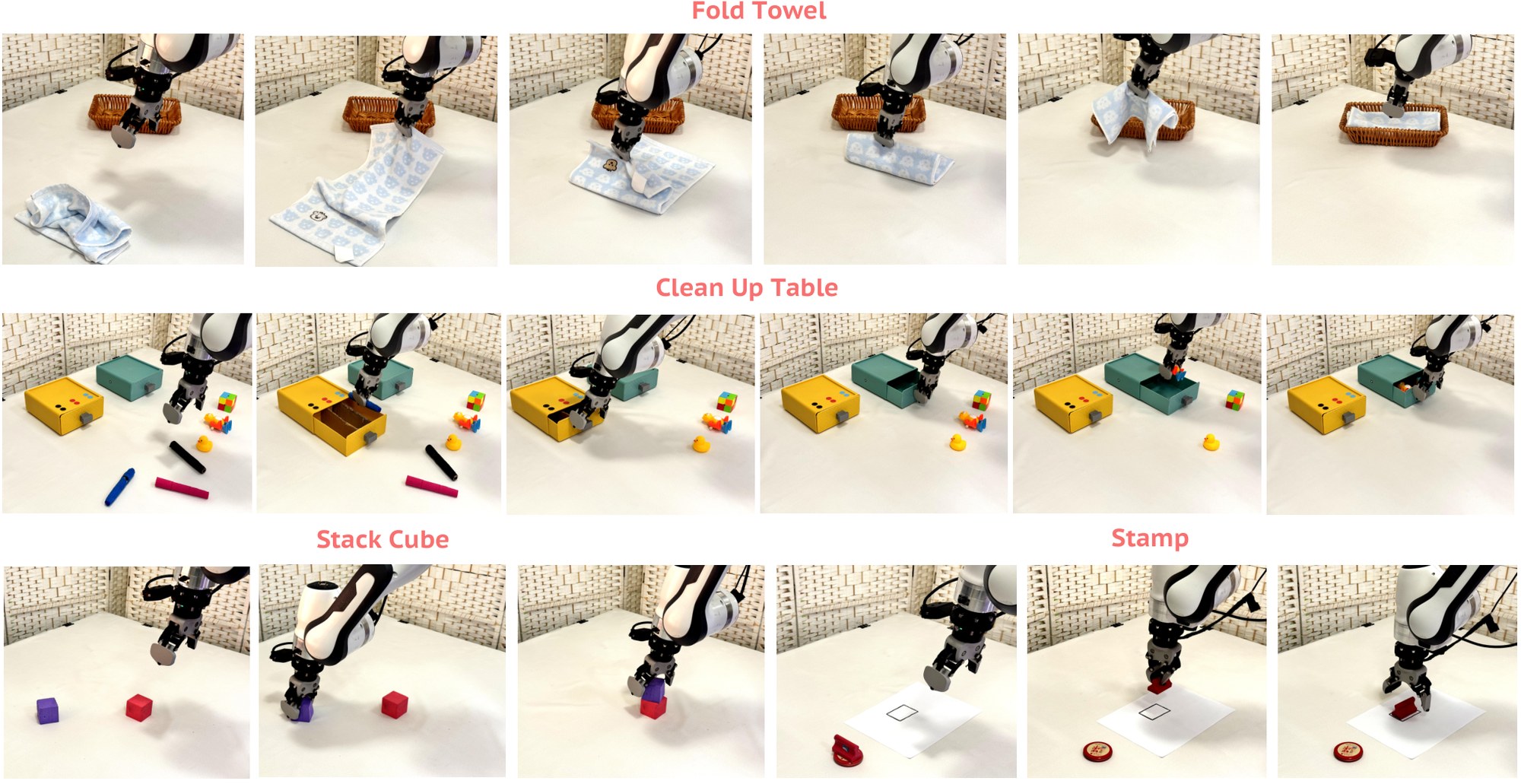
Four tasks, one Franka
All scoring is on a Franka arm. Each checkpoint gets 10 trials with object starts varied in a 30 cm × 60 cm workspace. The metric is Task Progress Score (TPS), 0–100, with partial credit.
- Fold Towel: flatten, two folds, into a basket (+25 each)
- Clean Up Table: pens into color slots, toys into a second drawer, open/close both drawers
- Stack Cube: purple cube onto red
- Stamp: stamp body inside a box 1 cm larger than the stamp on each side
They adapt open-source π₀.₅. Long-horizon tasks start from 50 UMI demos and add 12,000 frames per round. Stack Cube and Stamp start from 80 demos and 2,500 frames. SFT is the same budget with ordinary UMI recordings.
A separate Energy Score on N = 10 policy samples flags out-of-distribution states. An advantage model, queried every K = 50 steps, labels how much a clip actually helps. Mixed training uses α = 0.5 new vs base data. Detector latency: 112 ms (policy) and 93 ms (advantage).
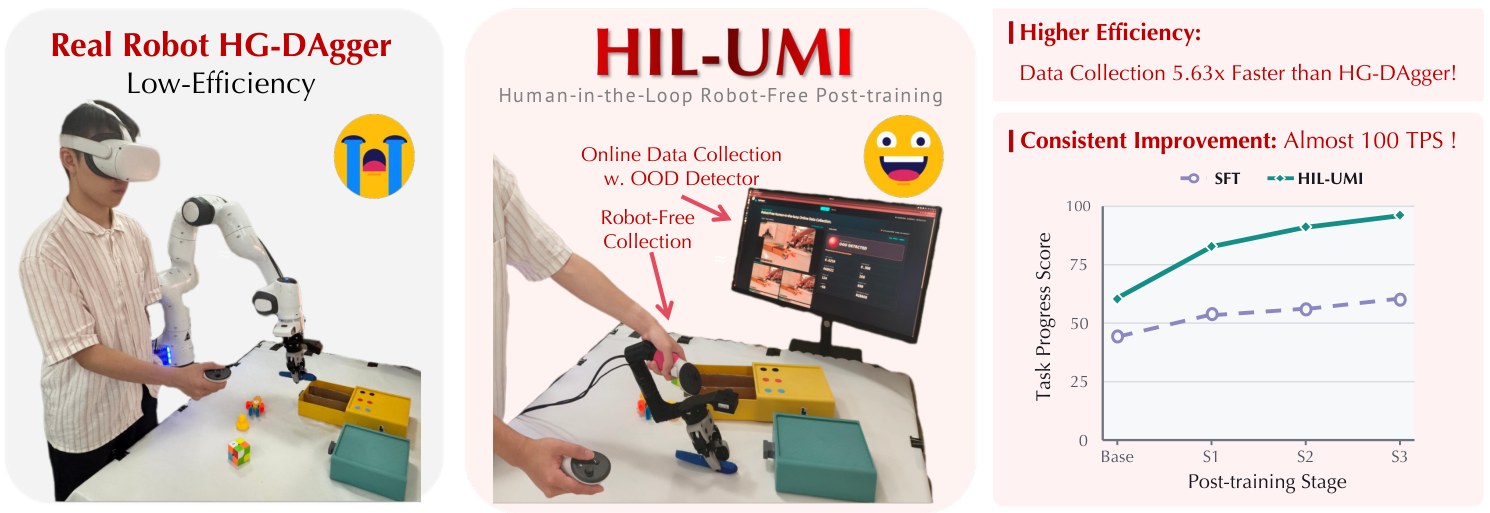
Faster than teaching on the arm
On Clean Up Table, HIL-UMI finishes about five TPS points above real-robot HG-DAgger at the same stage budget. Collection time is the headline: HG-DAgger takes 412.99 ms/frame. HIL-UMI takes 73.40 ms/frame on that task — the paper’s 5.63×. Per-task handheld times still beat SFT’s simpler recording on progress, even though HIL-UMI is slower per kept frame than plain SFT (for example 91.92 vs 69.43 ms on Fold Towel).
A threshold ablation on Stack Cube, with (τP, τA) = (1.2, 0.2), goes 84 → 86 → 90 → 100 TPS across base and three rounds. Looser or tighter gates stall below that.
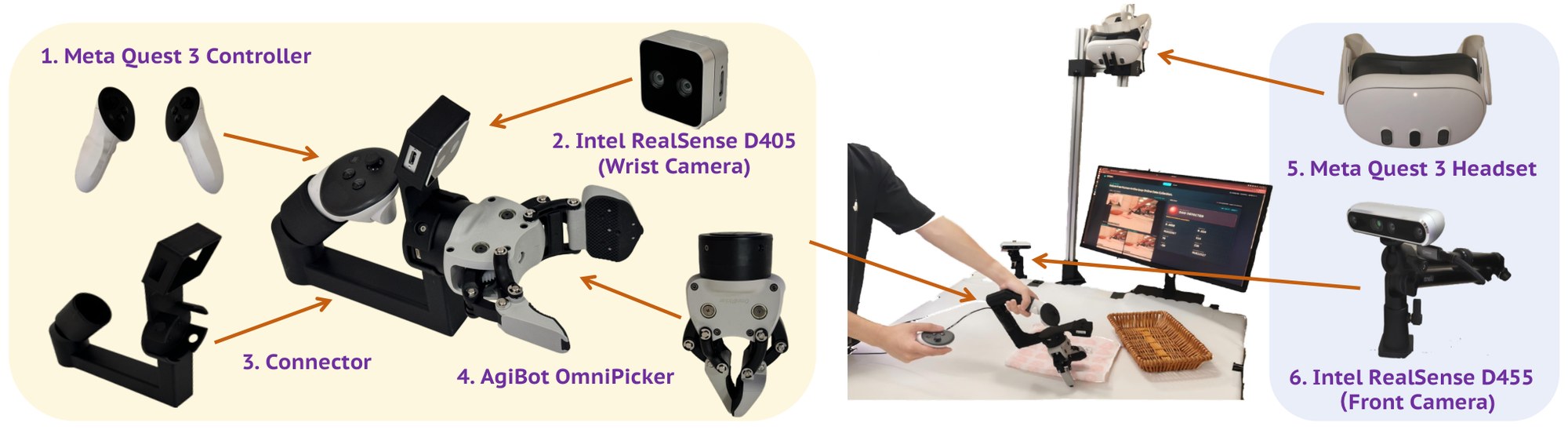
The gripper stack in Figure 2 is a Meta Quest 3 controller, an Intel RealSense D405 wrist camera, an AgiBot OmniPicker, a Quest 3 headset, and a D455 front camera.
A Human’s Take
Taking the policy off the robot during data collection is the part I want copied. Five-point TPS over HG-DAgger is modest. 5.63× less time per frame is not. The catch is the same as every UMI paper: the gripper is not the Franka, and the paper still evaluates on one arm in one cell. If distributed operators can actually feed π₀.₅ this way, the next chart I want is TPS versus number of cities, not versus number of rounds on one table.