HINT Only Rethinks the Goal When the Manipulation Pattern Changes
HINT (Human-Intent Inception), posted 2 September (arXiv:2609.02653), is a wrapper around existing vision-language-action policies. The complaint is familiar: dense video plus a sparse sentence, and the policy follows whatever is visually convenient instead of what you asked.
The fix is also familiar if you watch a person pack a lunch. They do not re-parse “put the fruit in the blue basket” every frame. They pick a target at a pattern change, then track it.
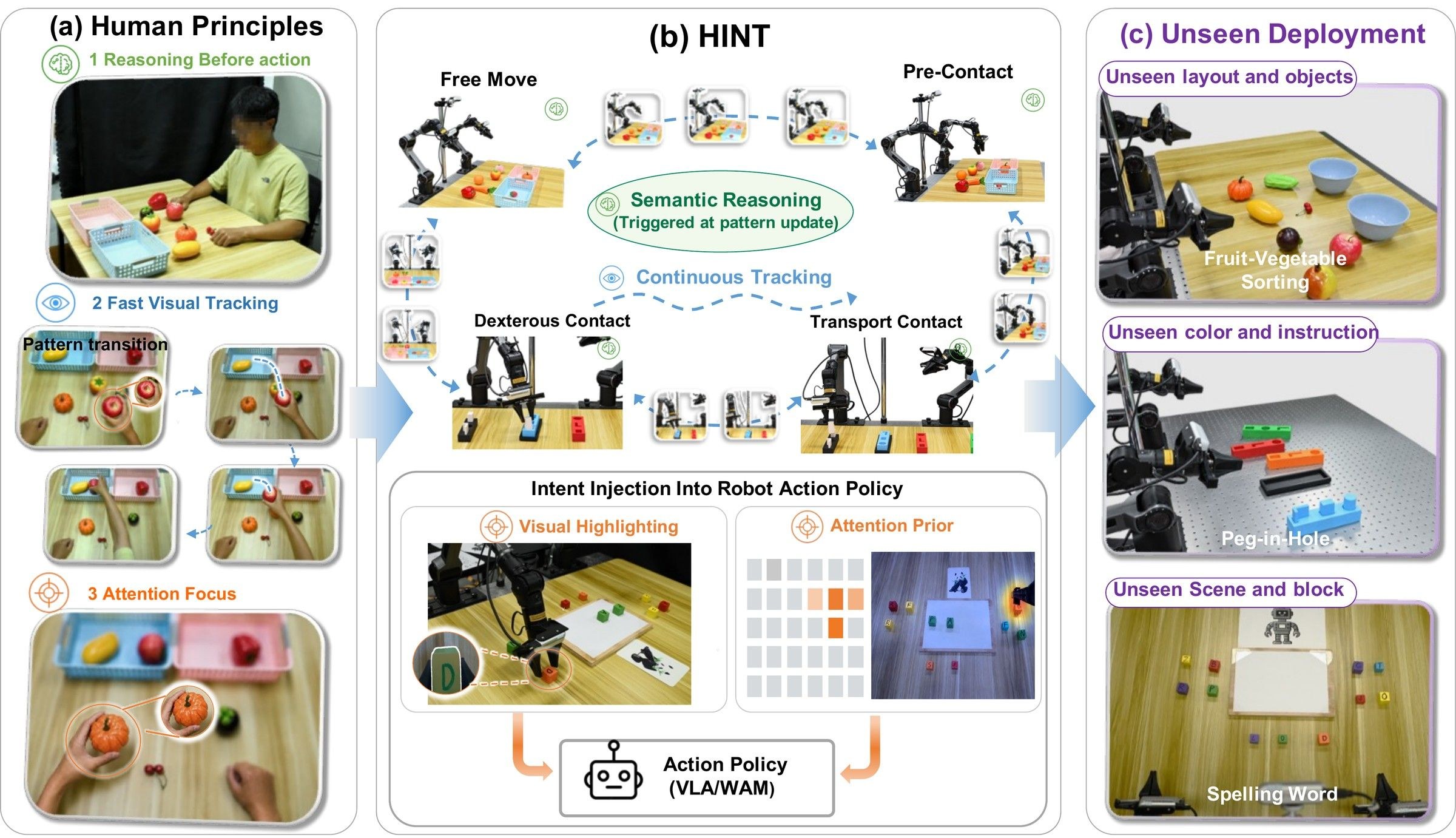
Plug-in, no new policy weights
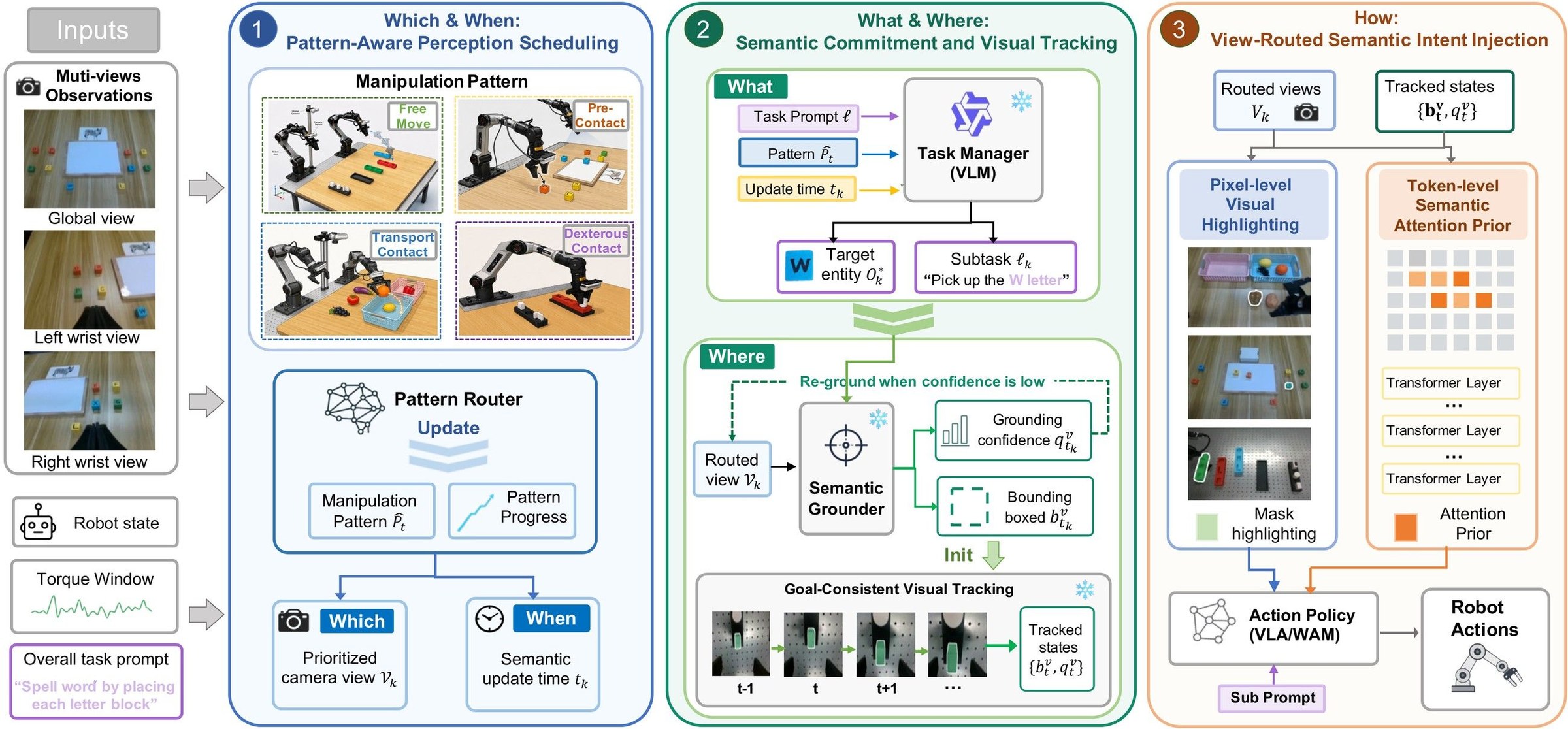
Hardware is dual-arm PiPER robots with one global camera and two wrists. HINT sits on Wall-OSS-0.5 and π0.5. The project page is explicit: no extra trainable parameters in the action backbone.
A pattern router decides which view matters and when to spend a semantic update. At those transitions HINT grounds the current subtask and target, then tracks it. Intent reaches the policy two ways: pixel highlighting on the routed view, and a token-level attention prior. Other camera views stay untouched.
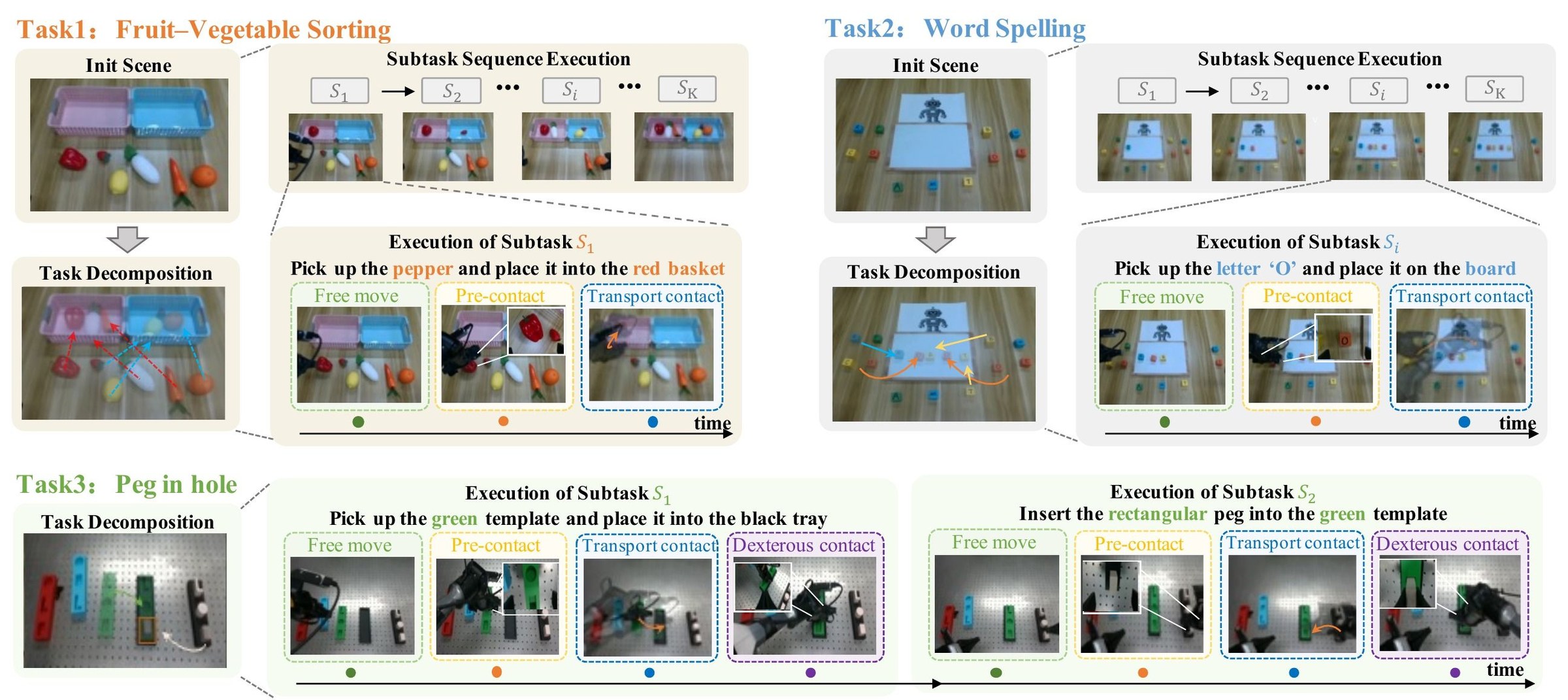
Three long-horizon tasks: fruit–vegetable sorting, word spelling with letter blocks, and peg-in-hole (pick a colored template, park it, insert the matching peg).
In-distribution, π0.5 + HINT vs bare π0.5 on the project page:
| Task | Full-task success | Intention score |
|---|---|---|
| Fruit–vegetable sorting | 10.0% → 60.0% | 52.2% → 91.2% |
| Word spelling | 13.3% → 86.7% | 44.7% → 97.9% |
| Peg-in-hole | 5.0% → 40.0% | 35.0% → 100.0% |
Out-of-distribution (unseen objects, layouts, colors, instructions; same motor primitives), full-task success on all three tasks goes from 0% for π0.5 to 30% with HINT. Intention scores still climb a lot (for example spelling 40.9% → 95.5%). The robot often knows what it should grab and still cannot finish the episode.
A Human’s Take
I am so here for “do not re-reason every frame.” That is how people actually move, and it is also how you keep a 50 Hz arm from waiting on a VLM. The spelling jump is the one I would show a skeptic. The OOD full-task numbers are the one I would show a product manager: intent can be right and the episode still dies. HINT is a better pointer, not a better hand.