hint² Steers a Short-Horizon Policy With Two World Models
Language-conditioned policies are bad at “do A, then B, and never tilt the box.” hint², from Moritz Zoellner, Anastasios Manganaris, Ahmed H. Qureshi, and Rohan Paleja at Purdue, leaves the policy alone and steers it at inference time with two world models and a temporal-logic spec.
The mismatch is simple. Modern diffusion policies emit a short action chunk and replan. Linear temporal logic is scored on the whole future. hint² splits the job.
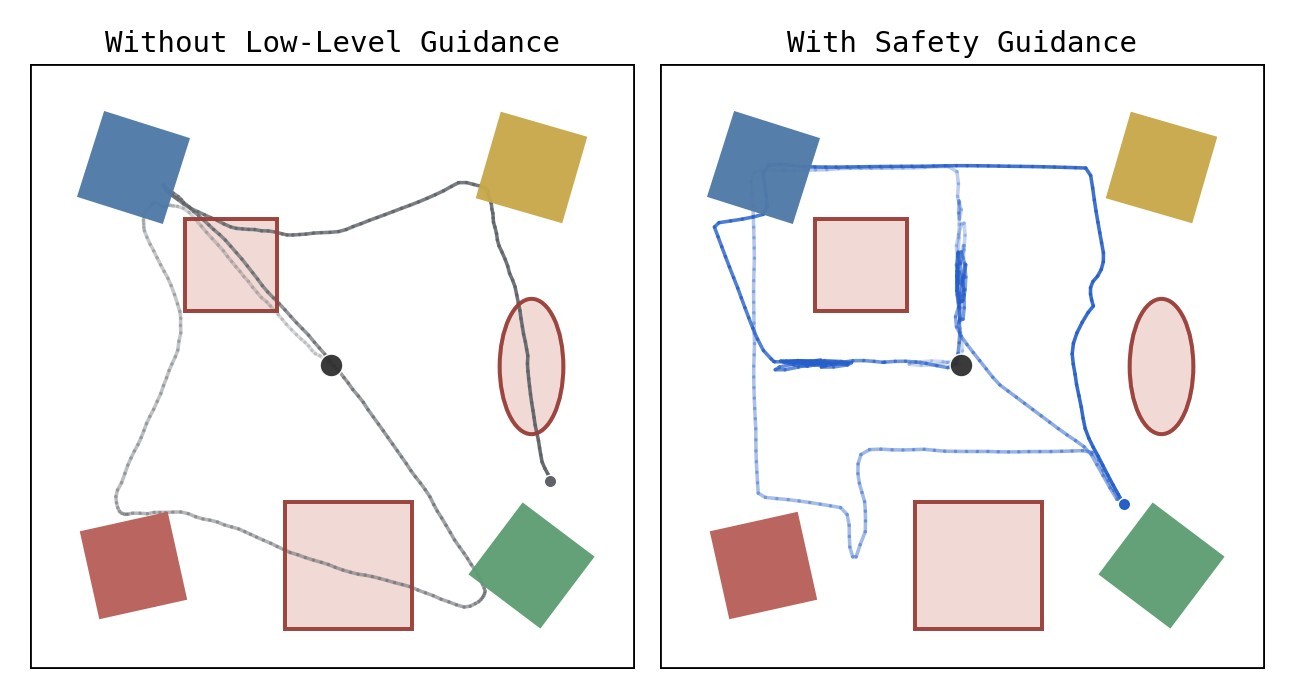
High-level progress, low-level safety
The high-level model predicts the next distinct atomic-proposition labels an action chunk will cause, then walks the LTL automaton. That is how you get “eventually close the drawer, then flip the switch” without rolling a pixel world model for 30 seconds.
The low-level model predicts nearby states so signal temporal logic robustness can push the chunk away from a painted-off region or a bad gripper angle.
The policy itself stays an unconditioned diffusion policy. Guidance is a gradient on the chunk, not a new training set.
What they actually ran
On a 2D colored-squares toy, hint² holds 100% LTL satisfaction as the automaton distance grows. Full-trajectory baselines LTLDoG and TeLoGraF, trained on the same single-target demos, fall off. hint² only ever samples 8-step chunks.
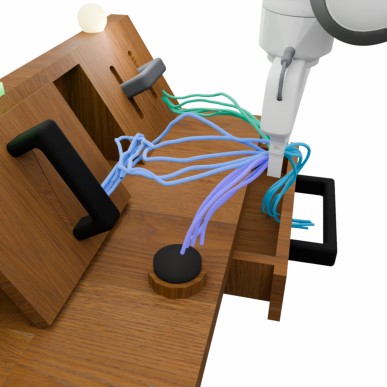
In CALVIN, they train on six hours of play data. For single-behavior selection (formulas like “eventually button on”), hint² averages 91% and beats DynaGuide and ITPS. On longer specs (unordered, branched, cyclic, plus “keep the gripper open” or “hold 20 degrees”), the paper reports near-perfect success. FLOWER, a strong language VLA on the same suite, handles primitives and then stalls on long instructions unless an LLM planner is bolted on.
Cheez-Its on a UR5e
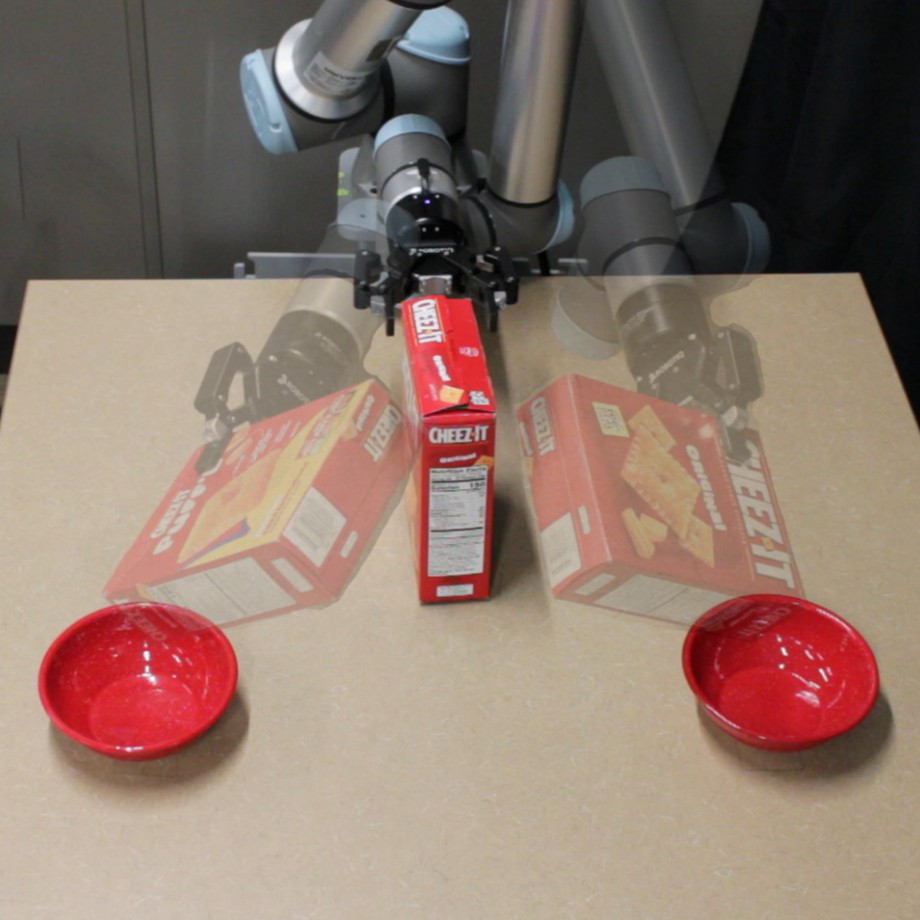
The real setup is a UR5e and 130 demos of grab-pour-place with a Cheez-Its box. High-level labels are box_grabbed, pour_left, pour_right. hint² completes mode selection, keep-upright-until-near-bowl, avoid-region, and cyclic left/right pours. A short-horizon STL sampler (STL-GPC) helps a bit on mode pick and can lose to the base policy on safety, because one robustness number is trying to pick a bowl and keep the box upright at the same time.
The authors say the high-level abstraction is exact for stutter-invariant LTL relative to the MDP. Broader formulas and learned discrete features are future work. Videos live at the anonymous project page.
A Human’s Take
This is the right split. Use the automaton for “what comes next” and the short dynamics model for “don’t dump the crackers.” I do not want another VLA retrained every time the safety rule changes. I do want to see those CALVIN numbers on a second lab’s play dataset before I treat 91% as a product feature.