Penn Jerboa Hops at 8.85 Leg-Lengths per Second on Hip Torque Alone
The Penn Jerboa has one motor per hip, springy passive legs, and a 2-DoF tail that used to do the energetic heavy lifting. Shane Rozen-Levy, Griffon McMahon, and Daniel Koditschek flipped that (arXiv:2608.10387, August 11). Pitch is still stabilized with a PD-plus-feedforward hip law. The reaction torque from that law is now the thing that puts energy back into the bounce.
Steal energy from the attitude loop
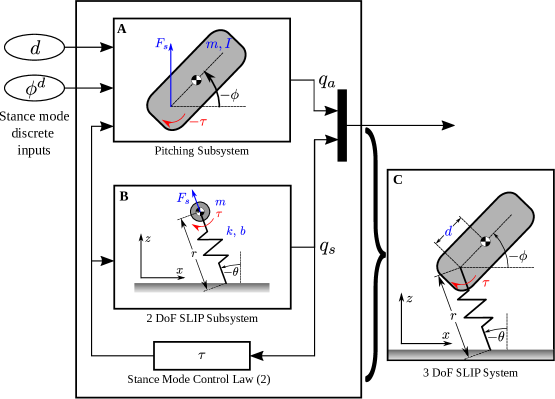
Jerboa’s tail used to drive the shank spring, SLIP-style. Here the tail, if it is used at all, is a low-power shape shifter. The hip controller moves the mass-center location so the pitch-stabilizing torque grows, which dumps work into the translational gait. A discrete stepping policy then splits that energy between forward speed and apex height.
They analyze the 3-DoF pitch-unlocked SLIP with hybrid averaging, get closed-form fixed points, and prove that asymmetric stepping is required in this hip-energized regime. Symmetric steps would let angular energy run away while the radial spring dies. That is Theorem 2 in the paper, not a slogan.
Hardware that actually hops
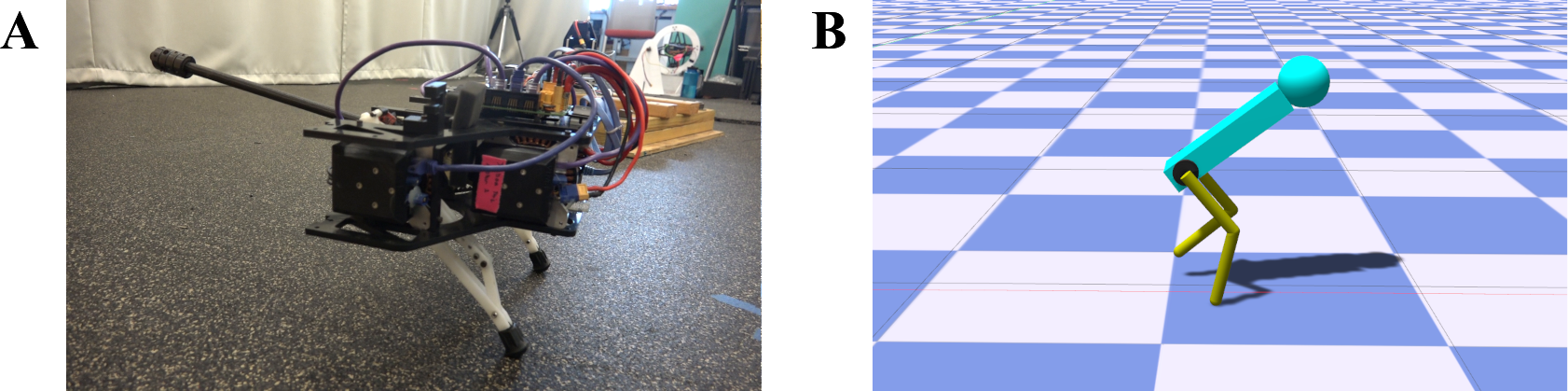
Simulation covers a generic 5-link planar biped and a careful Jerboa model. Hardware is the boom-constrained sagittal Jerboa. Stable speeds: 1.02 m/s to 1.77 m/s, or 5.10 to 8.85 leg-lengths per second. Earlier tail-energized hopping on the same machine (Shamsah et al., 2018) was 0.2–1.0 m/s. The authors flag the comparison as suggestive: Cassie and Atlas are spatial robots; Jerboa is on a boom; Atlas is hydraulic.
Analytic fixed points match sim within about 6–14% and hardware within about 12–16%, per the paper’s tables. Ground-reaction plots in the paper look VPP-like even though the controller does not target a virtual pivot.
A Human’s Take
I have a soft spot for machines that do a lot with one hip motor. Recruiting the pitch loop as a free energy pump is a clever piece of underactuated accounting, and 8.85 leg-lengths per second on that little tailed hopper is a fun number. Boom-constrained hopping is not a warehouse shift. It is still the first hardware hip-energized monoped demo they say is in the literature, and the math is doing real work instead of decorating the appendix.