HiTac-WAM Predicts Touch Before the Grasp, Then Checks It Live
Vision can look like a good grasp while the fingertips have already missed. HiTac-WAM, from the Institute of Automation at the Chinese Academy of Sciences, ImprintX Robotics, and BAAI, is a world-action model that forecasts contact, 3D deformation, and slip risk for each candidate action chunk before it runs. arXiv posted it August 20.
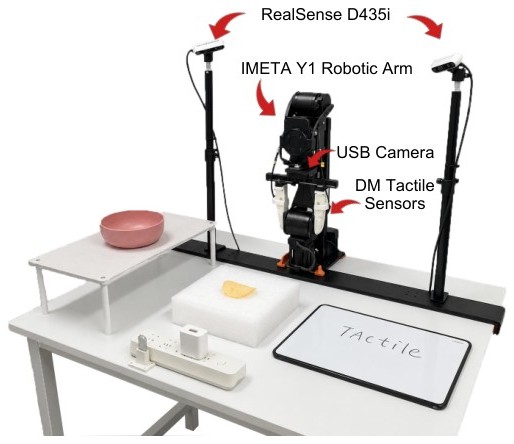
On a real IMETA-Y1 arm with bilateral DM-Tac W2 sensors, that forecast-and-check loop moved average success from 31.1% to 72.2% across three contact-rich tasks.
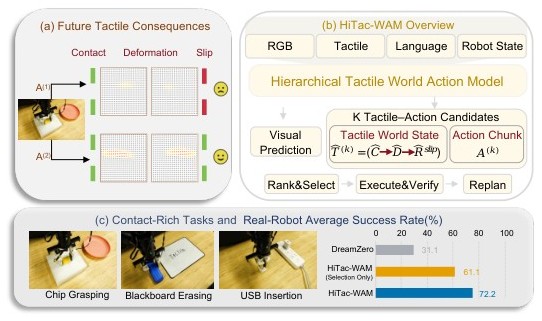
Hierarchy, not another tactile image
Most tactile-aware world models dump future touch into an image or a latent. HiTac-WAM splits the forecast into three physically ordered heads:
- Contact state (are we touching?)
- 3D deformation field (how is the skin moving?)
- Slip risk (are we about to lose it?)
Deformation is gated on contact. Slip is gated on contact plus deformation. Stop-gradient keeps the downstream losses from rewriting the upstream heads. A directed attention mask lets tactile queries see the predicted video and action, but not the other way around, so the vision-action backbone does not get to cheat on touch.
They train per task for 10,000 steps on 8 H100s, batch 64, from 200 episodes per task split 160 / 20 / 20. Streams run at 30 Hz. Tactile history uses offsets −12, −6, −2, 0; they predict 24 future tactile steps.
Mean contact F1 is 0.921. Onset and release timing errors average 2.1 and 2.3 frames (~60–87 ms). Under matched budgets, the hierarchy cuts 3D displacement L2 error 17.6% versus a deformation-only predictor and lifts slip AUPRC 60.4% versus slip-only. Slip events are only 1.39% of frames, so they treat that head as a ranker, not a calibrated alarm.
Does the forecast change the action?
DreamZero (one sampled chunk, no tactile path) averages 31.1%. Ranking four candidates with the hierarchical forecast hits 61.1%. Ranking on visual task progress alone, same budget, is 35.6%, and the confidence intervals do not overlap. Adding online verification, where a mismatch against the retained forecast for three consecutive steps aborts and replans, reaches 72.2%.
Task-wise, full system, 30 trials each: chip grasping 76.7%, blackboard erasing 90.0%, USB insertion 50.0%. USB is still the dog. Success rules are strict: chip must sit 3 s, erase must clear >80%, USB must seat and light the LED.
Post-hoc, verification fired in 18 of 90 full-system trials; 16 lined up with real anomalies and 12 of those recovered.
A Human’s Take
Predicting slip before you commit the chunk is the right argument. The USB number tells you the method is not magic: a connector still jams. I want this on a five-finger hand, not just a parallel jaw, and I want the slip head calibrated so it can stop a drop instead of only reranking a batch of four. Until then, 72% versus 31% on the same three chores is a real delta.