HiWET Tracks Humanoid Hands in the World Frame
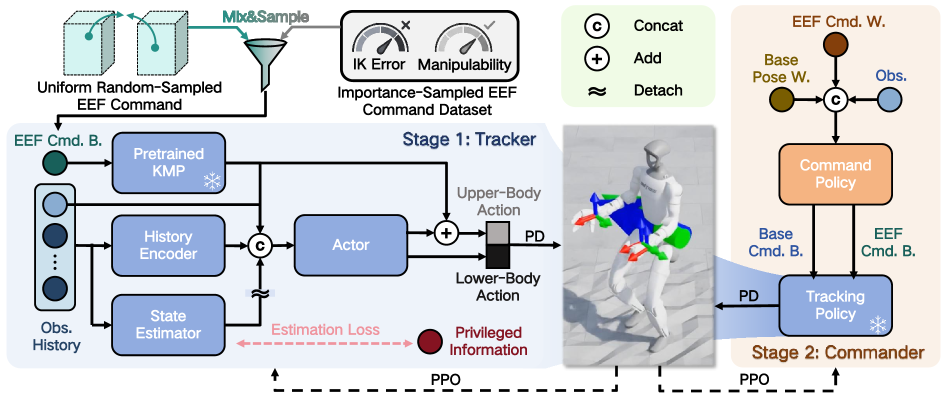
Most humanoid loco-manipulation stacks command the arms in a body-centric frame. That works until the base walks, drifts, and the hand target in the room is no longer where the controller thinks it is. HiWET (Hierarchical World-Frame End-Effector Tracking) reformulates the job as world-frame end-effector tracking with a two-level RL hierarchy.
Authors from Shanghai Jiao Tong University and collaborators posted arXiv:2602.06341 (February 6, 2026). Experiments run on a 29-DoF Unitree G1.
Hierarchy: commander + tracker
- High-level world-frame command policy — takes absolute world end-effector targets and base pose; outputs base velocity, body height, base-relative hand poses, and a waist regularization weight α.
- Low-level whole-body tracking policy — high-frequency joint targets; upper body uses residual actions around a frozen Kinematic Manifold Prior (KMP); lower body uses absolute joint targets for gait.
Training is two-stage in Isaac Lab: train the tracker first, freeze it, then train the commander. A spatial curriculum expands world-frame target range only after local tracking error drops.
Numbers that matter
Low-level tracking (Table I in the paper): full HiWET reports 12.4 ± 2.4 mm end-effector position error in simulation, better than ablations without KMP (25.2 mm), without state estimation (23.0 mm), or without importance sampling (16.1 mm). Linear velocity tracking also improves versus the HOMIE baseline cited in the paper.
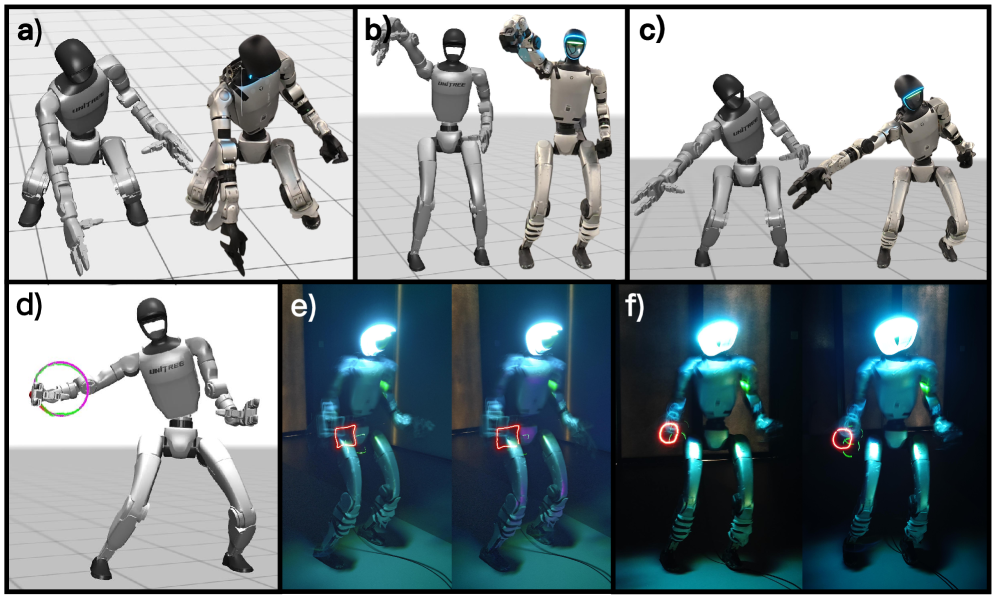
Long-horizon world-frame geometric trajectories (star, heart, circle, spiral, rectangle) within ±5 m of the start are scored successful if average EE error stays under 20 mm. Ablations without KMP or state estimation show clear distortions and oscillations on heart/star paths.
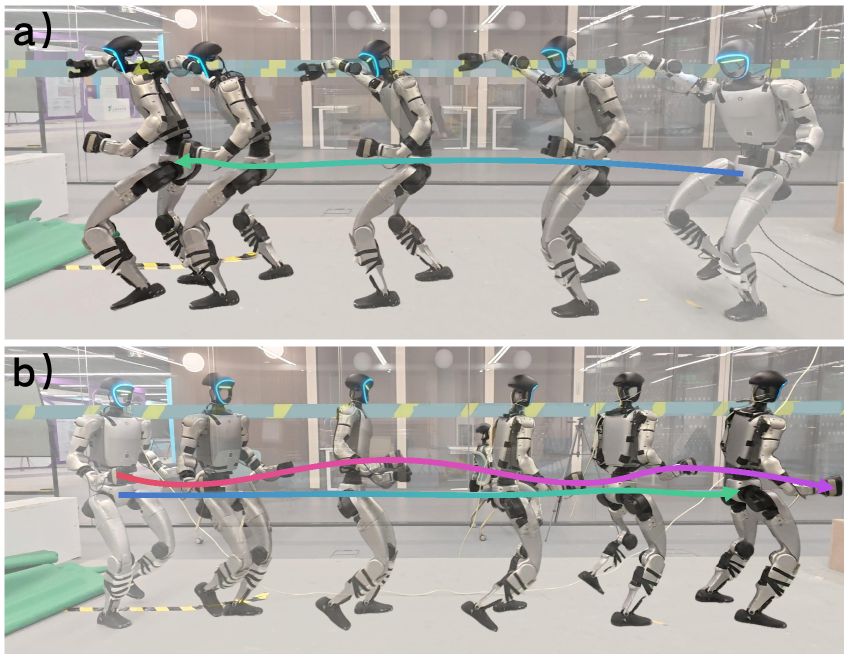
Real-world zero-shot transfer of the low-level policy: walking while reaching high or tracing a circular hand path. With LiDAR/IMU localization (Livox Mid-360 + Fast-LIO2), circle/square world-frame tasks report 12 mm / 15 mm RMSE for full HiWET (Table II), worse when α is fixed or KMP/estimator removed.
Limits the authors list
World-frame precision is capped by LiDAR localization; evaluated trajectories are relatively small; high-level experiments emphasize single-arm tracking; contact-rich grasping is left for future work.
A Human’s Take
Body-frame EE tracking is fine for a table-fixed arm on a robot that barely moves. The moment the base walks a shift, world-frame drift eats your grasp. HiWET’s explicit base-transport + height + residual KMP stack is the control diagram I want next to every “loco-manipulation” claim.