HODAgent Lets a G1 Take a New Order Mid-Stride
Most service demos assume the goal is frozen before the robot moves. HODAgent, posted to arXiv on Aug. 18, is built for the opposite: a new request while the body is already walking.
The authors, corresponding at chenj81@xiaopeng.com, call it a System-2 embodied agent. In 164 interactive simulation cases it reaches 84.8% and 91.5% Joint Success under two Qwen backbones, beating a shared-protocol ReAct baseline by 9.8 and 18.9 points. On a physical Unitree G1, pass rates are 92% atomic, 72% composite, and 63.3% for complete tasks.
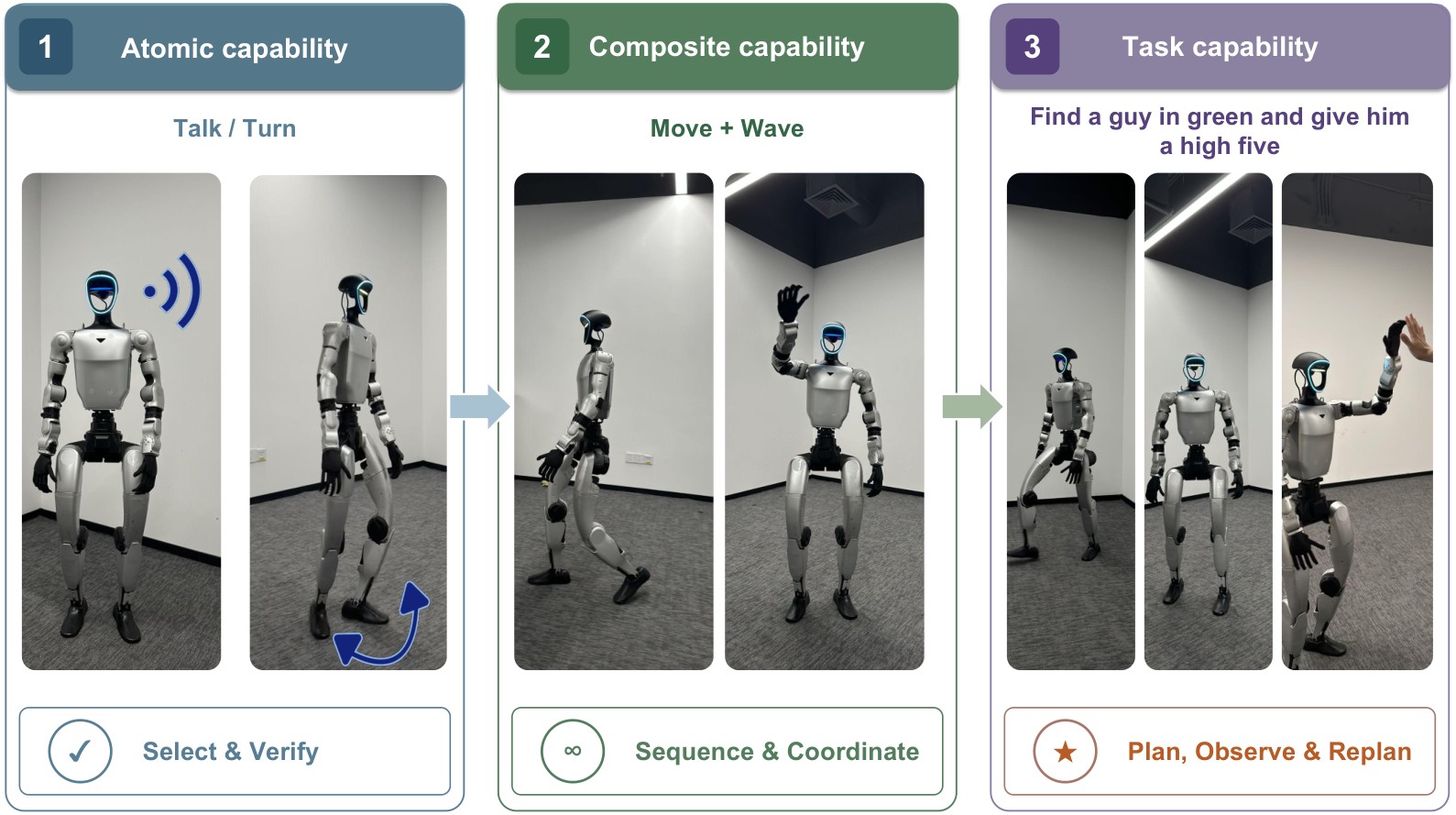
What “on demand” means here
The paper’s example: a user asks for directions, then changes the destination while the robot is navigating. The agent has to keep the valid progress, drop the rest of the old plan, and check the new outcome before it says it is done.
Four modules share one episode: Env-Interactor, Planner, Executor, and hierarchical Memory. Interaction stays live during motion. Planning fires at decision points. Execution can overlap the next plan near the end of a trajectory.
They keep System-2 above reusable skills (System-1) and hardware control (System-0). The same high-level contract talks to Isaac Sim and to the G1 through a GR00T/SONIC stack. The paper also lists XPeng IRON as a physical platform the shared mechanisms are designed to cover. Privileged sim tricks such as teleport resets are not offered on the real robot.
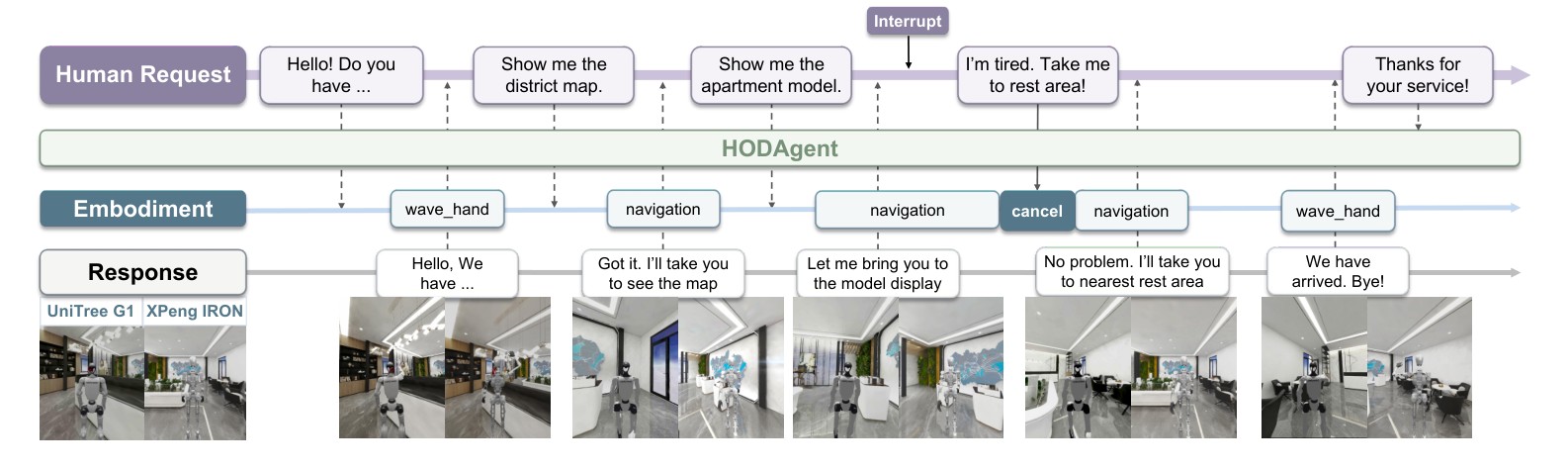
How they scored it
Simulation uses a frozen workflow and a User Agent with four personas (novice-guided, time-limited, neutral-cooperative, evidence-cautious) across 22 indoor scenes from SAGE-3D. 15 of the 164 cases interrupt during navigation. Joint Success requires both a rule-based Task PASS and a Service Judge PASS on the same episode, so fluent talk cannot cover a missed walk.
On the G1 they escalate:
- Atomic: talk, walk, turn, wave, halt-and-stand (46/50 combined)
- Composite: speak while moving, move-then-wave, take a correction during motion (36/50)
- Tasks: find a person in a specified color and high-five (5/10); walk up, wave, say hello (8/10); bypass an obstacle then greet (6/10)
A command receipt is not counted as success. Audio, video, and robot state have to show the outcome.
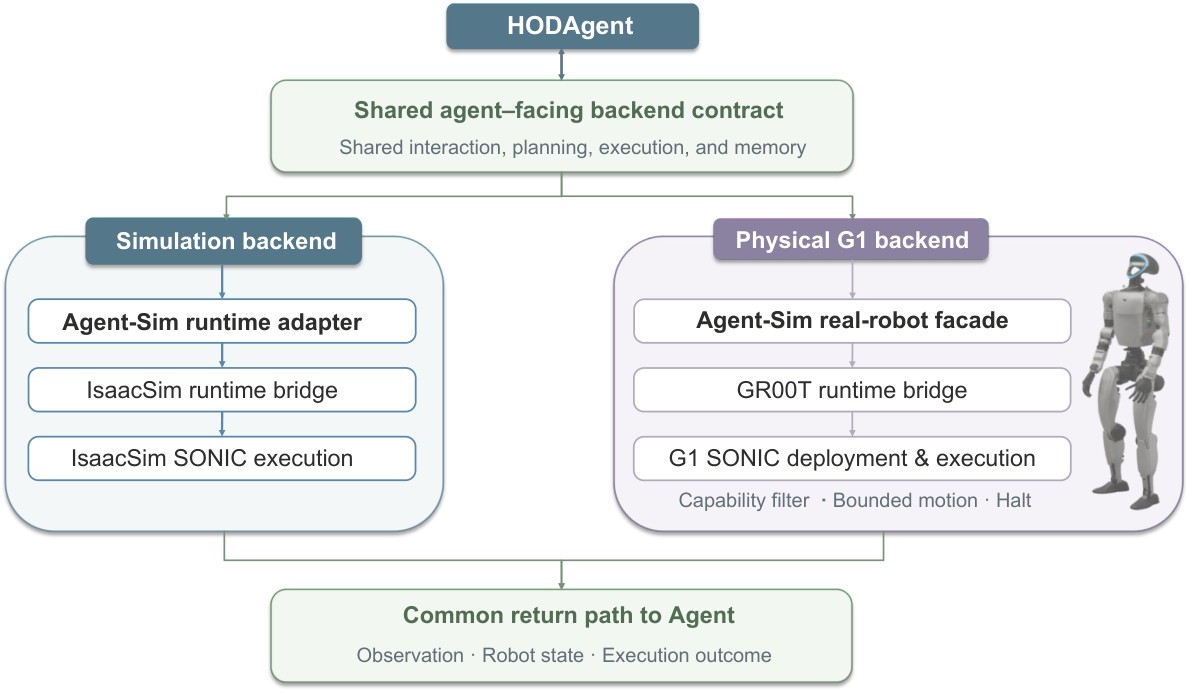
The authors are explicit about what this is not: no new low-level policy, no general VLA, no hard real-time full-duplex guarantee, and no claimed sim-to-real transfer of the service tasks themselves.
A Human’s Take
The useful idea is temporal: keep listening while the legs are busy, and do not declare victory from a tool return. The G1 numbers falling from 92% to 63% as the task gets longer is the honest slope.
I want the interruption cases on hardware, not just “move then wave.” If a guest changes the destination in a real lobby, that is the product. Until then, this is a clean System-2 wrapper with receipts, which is still rarer than it should be.