Honda’s Four-Finger Hand Goes After Factory Assembly
Honda is back in robotics with a four-finger hand, not another ASIMO. The company’s R&D page lists 16 actuated joints, 50 N of continuous fingertip force it can hold for 150 seconds, and more than 450,000 durability cycles, including 24,000 lifts of a 5 kg weight.
Kyodo, writing in early August from the Wako lab, says Honda wants the hand in manufacturing in the early 2030s. Newswitch reported on August 20 that RIKEN and Honda R&D have started a NEDO-backed Physical AI project around it.
The hardware Honda will talk about
Honda’s own spec sheet:
- 16 DoF, finger–thumb opposition, max continuous joint speed 180 deg/s
- 50 N continuous fingertip force, 150 s hold
- 288 tactile channels in the fingers and palm, plus six-axis force sensors at each fingertip
- impact handling: if a finger hits something at 1.23 m/s, control switches to absorb the hit
- four fingers. No little finger.
Kyodo says the hand can pick up a 1.6 mm screw between thumb and index, rotate it, and start it in a hole. Newswitch, quoting Honda, puts peak fingertip force at about 12 kgf, described as twice a human, and drive-mechanism durability above 8 million cycles. Honda’s public page is the more conservative 50 N / 450k set. I am keeping both, labeled.
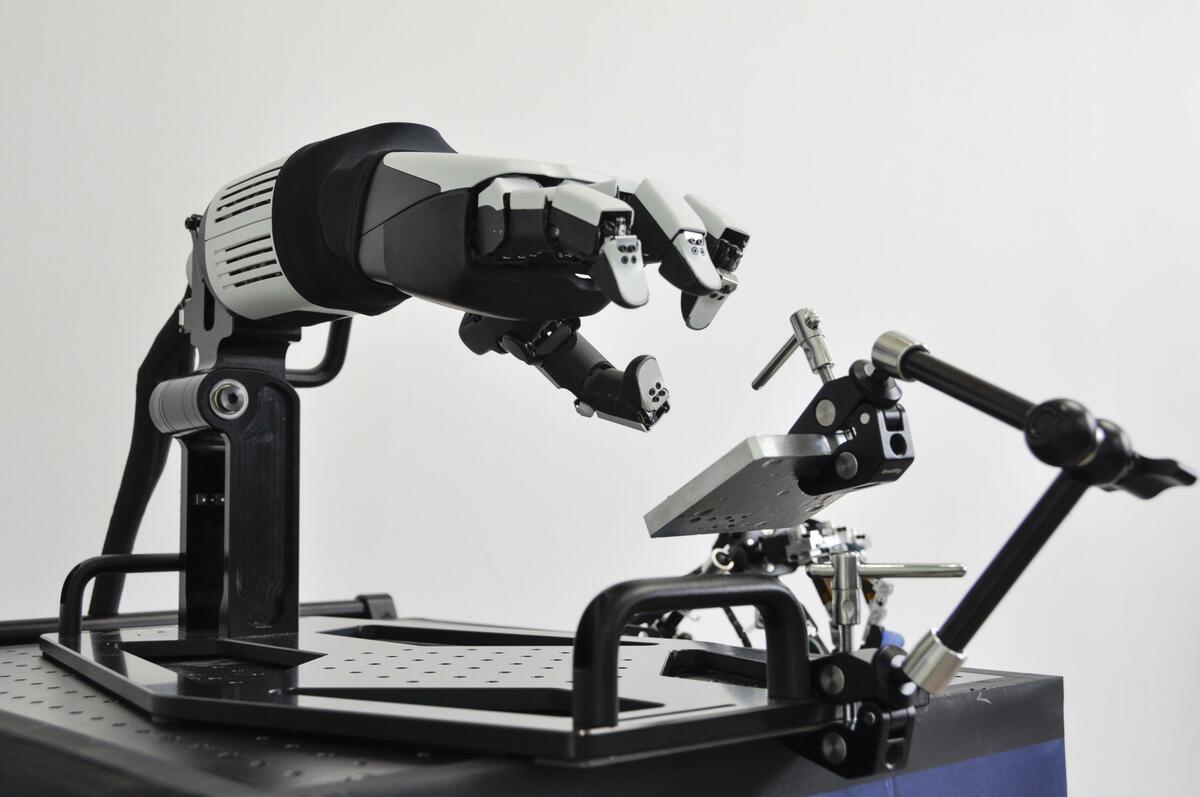
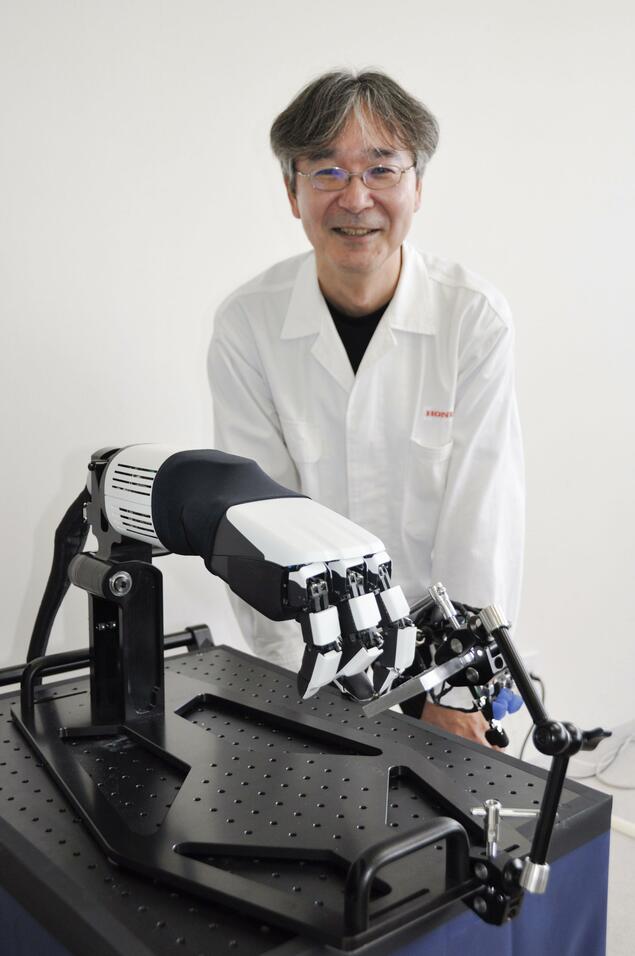
Takahide Yoshiike, executive chief engineer at Honda R&D, told Newswitch the hardware is already close to what they wanted. The missing piece is the intelligence that can run it:
“The hardware itself is already becoming ideal. We need intelligence capable of handling this hand.”
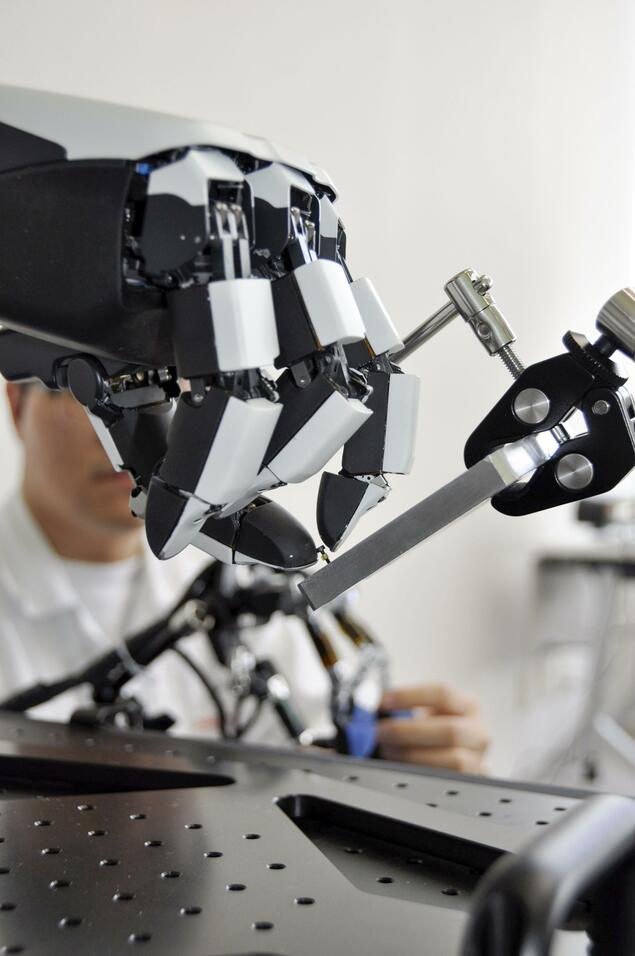
ASSEMBLY magazine, in an August 11 factory-assembly write-up, quotes Honda researcher Kenichiro Sugiyama on a related point: a lot of market “hands” are still fancy grippers. Honda is trying to train hardware, control, and AI together. Sugiyama’s leftover problem is the “last millimeter” on deformable or slippery parts.
What RIKEN is adding
RIKEN’s July 1 notice says METI/NEDO selected a joint proposal with Honda R&D: “development of multisensory physical intelligence and a multi-finger AI robot for autonomous unstructured dexterous manipulation.” The factory targets are set-pack (picking mixed incoming parts into kits) and wire-harness routing.
RIKEN owns the intelligence, flexible tactile sensors, and system integration. Honda owns hardware, control, and in-plant trials. Tatsuya Harada, who leads RIKEN AIP’s Physical Intelligence group, is the research lead on the RIKEN side.
Newswitch says the NEDO award is ¥100 billion over five years, with most of that budget going to compute for a multisensory model. RIKEN’s own page does not print that number. I am using Newswitch for the yen figure.
A Human’s Take
I like that Honda is not pretending this is a full humanoid relaunch. It is a forearm, four fingers, and a factory problem that still eats people: harnesses and kitting. The 450,000-cycle number is the one that made me stop. Most dexterous-hand demos never say how many times the tendons survived.
The RIKEN piece is the honest admission. The hand can hold 50 N. It still needs a brain that will not crush a harness or drop a 1.6 mm screw the first time the lighting changes. That is the actual project.
Sources
- Honda R&D — Multi-fingered Hand
- Kyodo News — Honda revives robotics ambitions after ASIMO
- RIKEN — dexterous-operation intelligent machines project
- Newswitch / Yahoo News — RIKEN and Honda ¥100 billion multi-finger project
- ASSEMBLY — Honda advances dexterous robot hand for factory assembly
- Honda — multi-fingered hand demo (YouTube)