HumanCLAW Asks: Can VLMs Act Through a Body?
Vision-language models can describe a room. HumanCLAW asks whether they can act through a body inside a closed loop — decide what the body should do next, every half-second, after seeing the consequences of the last choice.
Authors from Meta, Nanyang Technological University, University of Washington, Brown, and Northwestern released the framework and benchmark as arXiv:2607.27180 (submitted July 29, 2026), with a project site at human-claw.github.io.
Decoupling decision from motor failure
When a robot fails a task, it is hard to tell whether the VLM chose poorly or the motor controller fell over. HumanCLAW factors motor tracking and balance failures out of the score. At each 0.5 s step, a frozen off-the-shelf VLM proposes an atomic skill; a verifier can reject unsafe proposals; a skill-conditioned motion generator produces a full-body motion chunk; a half-physics simulator applies gravity, collisions, and object reactions and feeds the next egocentric view back into the VLM.
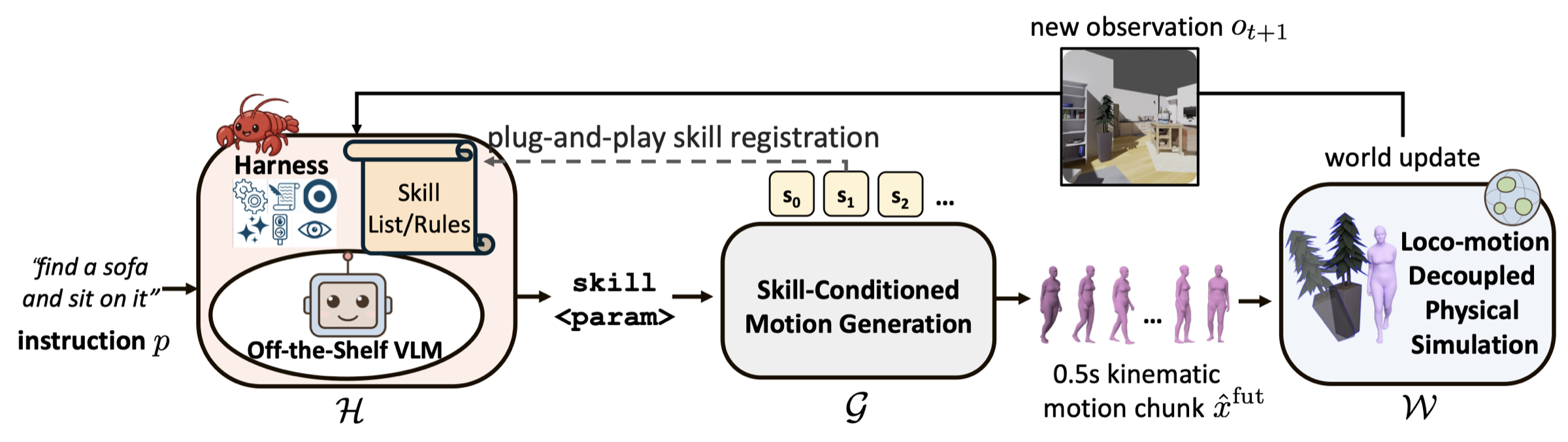
The benchmark
HumanCLAW-Bench runs a progressive find → navigate → interact task: find a target object, walk within 20 cm, then sit with pelvis contact. Scenes come from HSSD: 41 validation houses, 1,218 episodes, six target categories (chair, bed, couch, potted plant, toilet, TV). Success metrics include FindSR, NavSR, and InteractSR, plus collision and motion-jerk scores.
What the leaderboard says
Nine state-of-the-art VLMs were tested frozen. None solves the suite. Headline numbers from the project page:
- Best high-level success: Gemini-3.1 at 64.9%
- Best full sit success among findings: only 16.8% of episodes (and four of nine models sit in at most 0.2%)
- Of episodes where the agent finds the target, 68% still fail navigation — mostly egocentric self-localization errors
- Collisions concentrate on unwatched body parts: legs/feet 28–45% of steps, arms/hands 20–35%, head under 7%
Authors summarize the shared deficit as missing embodied self-awareness: models reason about the scene but lose track of where their own body is, whether they arrived, or whether they hit an obstacle.
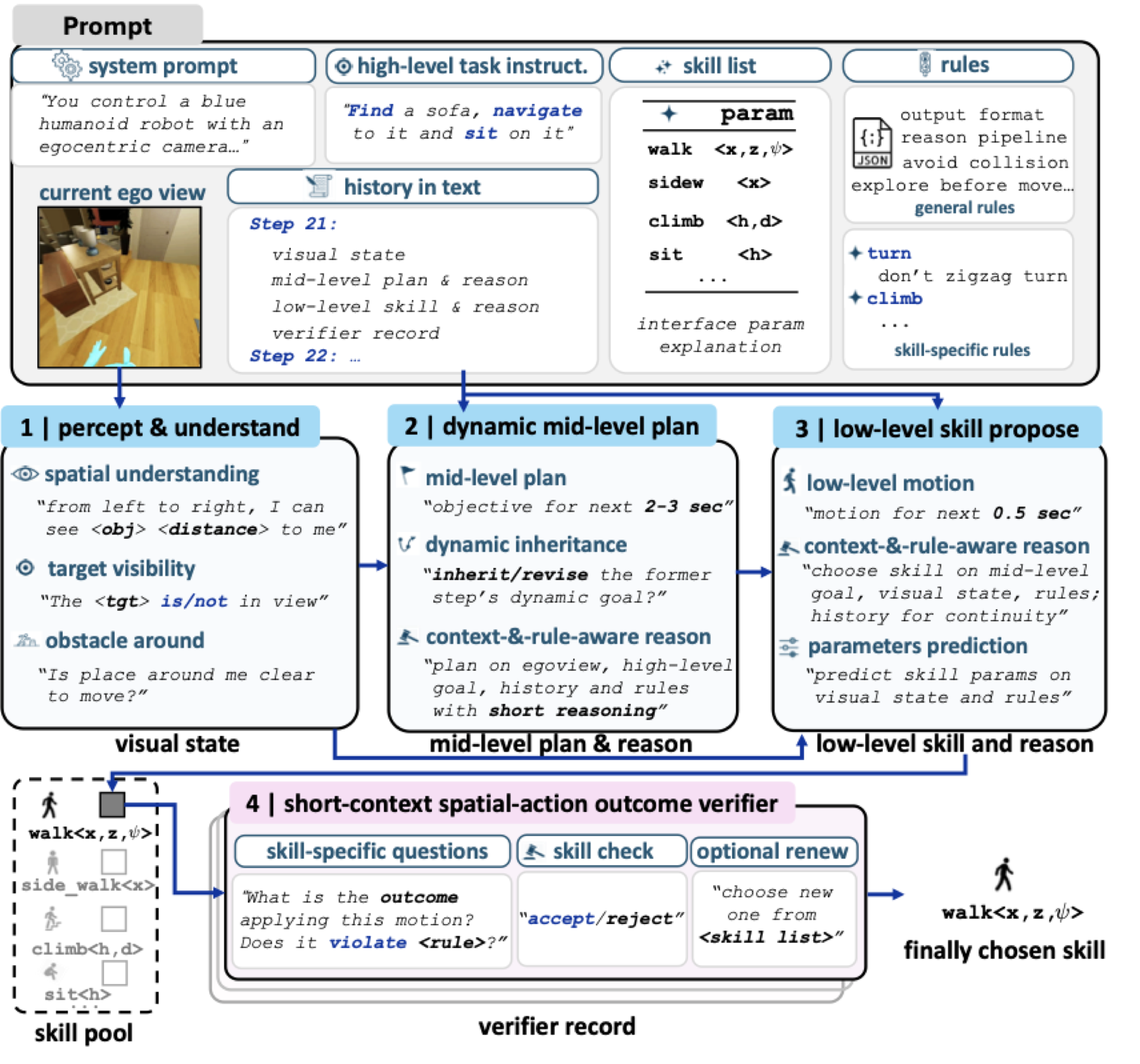
Code is listed at github.com/Human-CLAW/HumanCLAW.
A Human’s Take
This is a useful cold shower. Leaderboard VLMs that ace chat and captioning still behave like ghosts in a body — fluent about furniture, clumsy about feet. If you are wiring a foundation model into a humanoid stack, HumanCLAW-Bench is a sharper stress test than another pick-and-place success rate in a clean lab.