UT Austin Walks a G1 Through Holes Tighter Than NIST Specs
Humanoids do not get stuck on flat ground. They get stuck in holes. Carlos Gonzalez and Luis Sentis at UT Austin posted a whole-body planner (arXiv:2608.10220, August 10) that treats the robot as reachable rigid volumes instead of a particle on a spline. On a simulated Unitree G1 it threads openings with confinement ratio Cr < 1.5, tighter than the NIST emergency-response mobility tests they compare against.
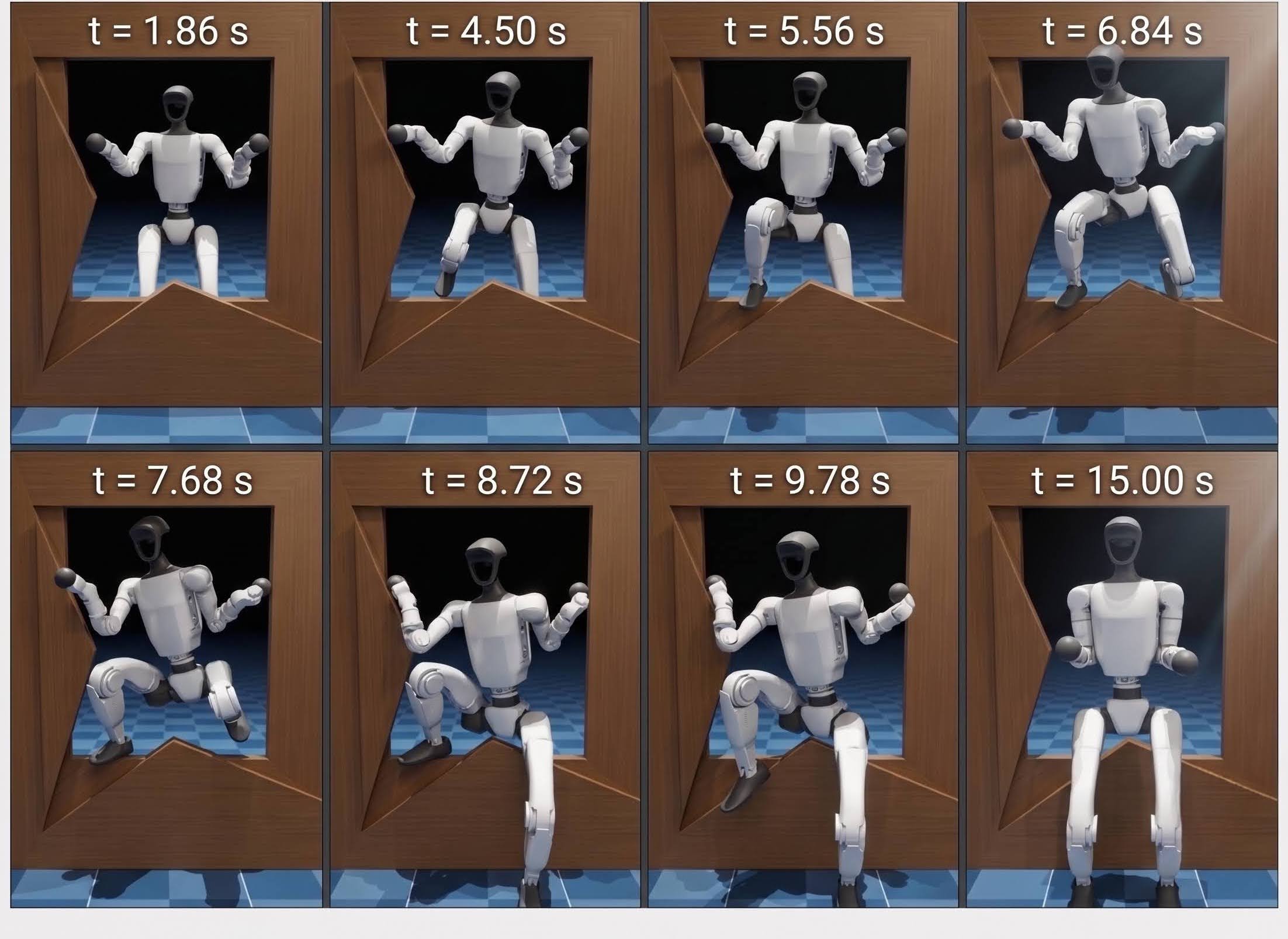
Three stages, then a residual policy
Stage 1 plans collision-free Bézier paths for torso, feet, and palms inside IRIS convex regions, with a convex stand-in for rigid-link reach. Stage 2 adds differentiable collision between capsules and spheres so those paths stop intersecting the robot itself. Stage 3 transcribes the guides into a full-order trajectory optimization with hard collision inequalities and a two-pass warm start (dynamics first, then collisions). A residual RL policy then tracks the plan in MuJoCo under mass, friction, and push noise.
The G1 here is 27 DoF. Plans run 12–18 seconds with palm and foot contacts. Supplementary video is on the authors’ project page.
Benchmarks that actually pinch
Three testbeds: unobstructed hole, obstructed (non-convex) hole, and tilted stairs. Nominal stance confinement: Cr = 1.4, 1.5, and 2.0. Ten random start poses per contact sequence.
Full pipeline success (mean solve time):
- Tilted stairs: 10/10 (174 s)
- Unobstructed hole, step over / step on: 10/10 (125 s / 180 s)
- Obstructed hole, left / right step: 7/10 (191 s) and 6/10 (332 s)
Spline guides that ignore knees went 0/10 on both hole tasks. Linear frame interpolation also 0/10 on holes. Skipping Stage 2 (no volume-aware self-collision guides) dropped obstructed-hole left-step success to 1/10. The learned tracker hit >95% traversal under the paper’s domain randomization after 2×10⁸ env steps.
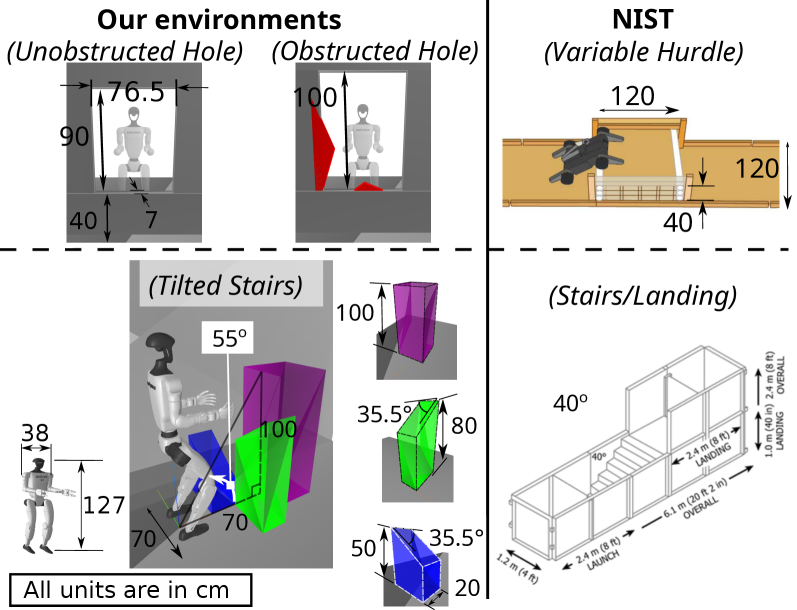
The authors say hardware validation is future work. This version is submitted to IEEE.
A Human’s Take
Confined space is the job humanoids keep promising and rarely show. Planning over volumes instead of points is the right geometry. The numbers I trust are the 0/10 baselines on the obstructed hole: if your knee is not in the plan, the optimizer eats the wall. I will care more when a physical G1 repeats that 15-second hole crossing without a perfect map and a 3-minute offline solve.