Industrial Humanoids Hit the Fail-Passive Gap: E-Stop Logic That Assumes Legs Can Fall
Industrial humanoids are constrained less by dancing demos than by functional safety certification. A new paper (arXiv:2608.02809, Aug 3, 2026) names the core mismatch: the fail-passive gap. On a fixed arm, removing power is a safe stop. On a balancing biped, removing power is often an uncontrolled fall — so classical de-energization is itself a hazard.
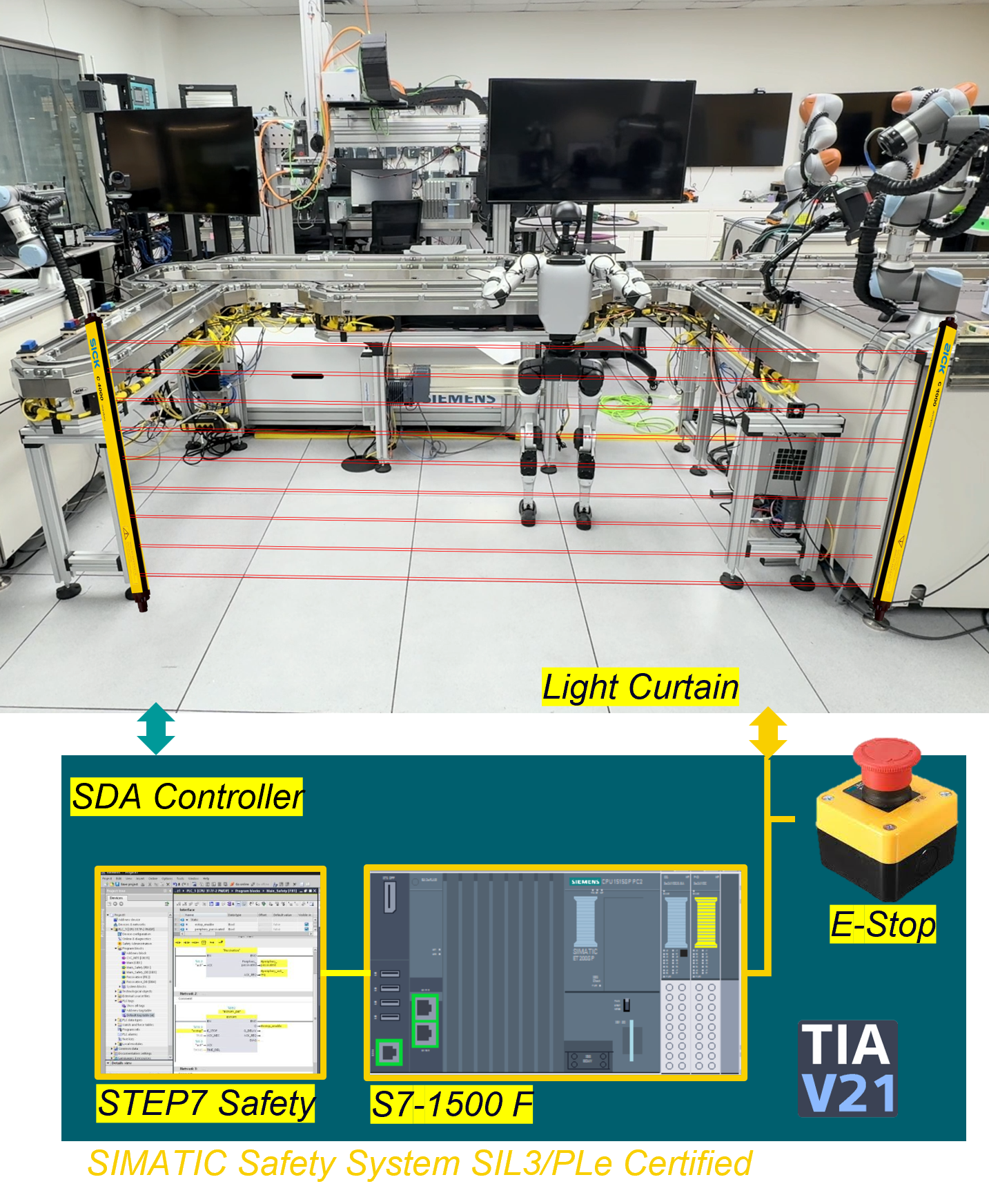
What “fail-passive” assumes
Standards such as ISO 13849-1 / EN 60204-1 are built around machines whose safe state is passive (springs, brakes, gravity). The authors argue a legged robot’s safe state is actively controlled. They use a certified external safety chain — light curtain, emergency stop, fail-safe inputs, fail-safe PLC, wireless PROFIsafe — as an instrument: the external chain is closed and quantifiable (PFHD, PL/SIL language), so residual uncertifiable risk sits in the robot-side reaction chain.
Using a Siemens S7-1500 emergency-stop reference, they note the certifiable reaction is contactor-based power removal (Stop Category 0) — exactly what a balancing humanoid cannot treat as “safe.” They deliberately do not claim end-to-end certified PL e / SIL 3 for the full humanoid system.
Feasibility cell
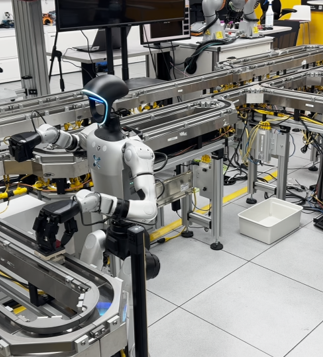
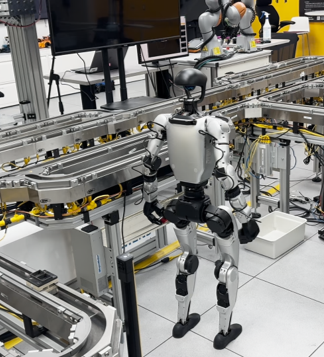
Validation is on a Unitree G1 EDU pick-and-place cell in a 3 m × 1.5 m semi-enclosed workspace. Contributions listed in the abstract include:
- Humanoid-specific analysis of the active safe state (fall-as-hazard, single-support stop bounds, balancing-policy residual risk, ISO 13855 separation ideas).
- A provenance-labeled timing budget.
- Hosting an industrial software-defined automation (SDA) controller co-located with the balancing policy for PROFINET/PROFIsafe reception on an IEC 61131-3 interface — while stressing that the G1’s onboard compute is not safety-rated hardware, so the endpoint is not a certified safety runtime.
A Human’s Take
This is the article factory people should read before shipping bipeds next to humans. Demos sell; Stop Category 0 kills the balance loop. Localizing the gap to the robot-side reaction — and refusing to claim full SIL on a non-safety-rated brain — is the kind of honesty that actually moves industrial deployment forward.