Safe-Stop Asks Whether a Humanoid Should Hit the Brakes at All
An e-stop on a wheeled AMR is “cut power.” On a humanoid, the same reflex can put the torso through the floor. Junfeng Long and advisors Pieter Abbeel, Koushil Sreenath, Roberto Horowitz, Guanya Shi, and C. Karen Liu posted Safe-Stop on 2 September: a stop policy, two critics that guess whether a stop is still legal, and a rule that hands off to damping if they disagree.
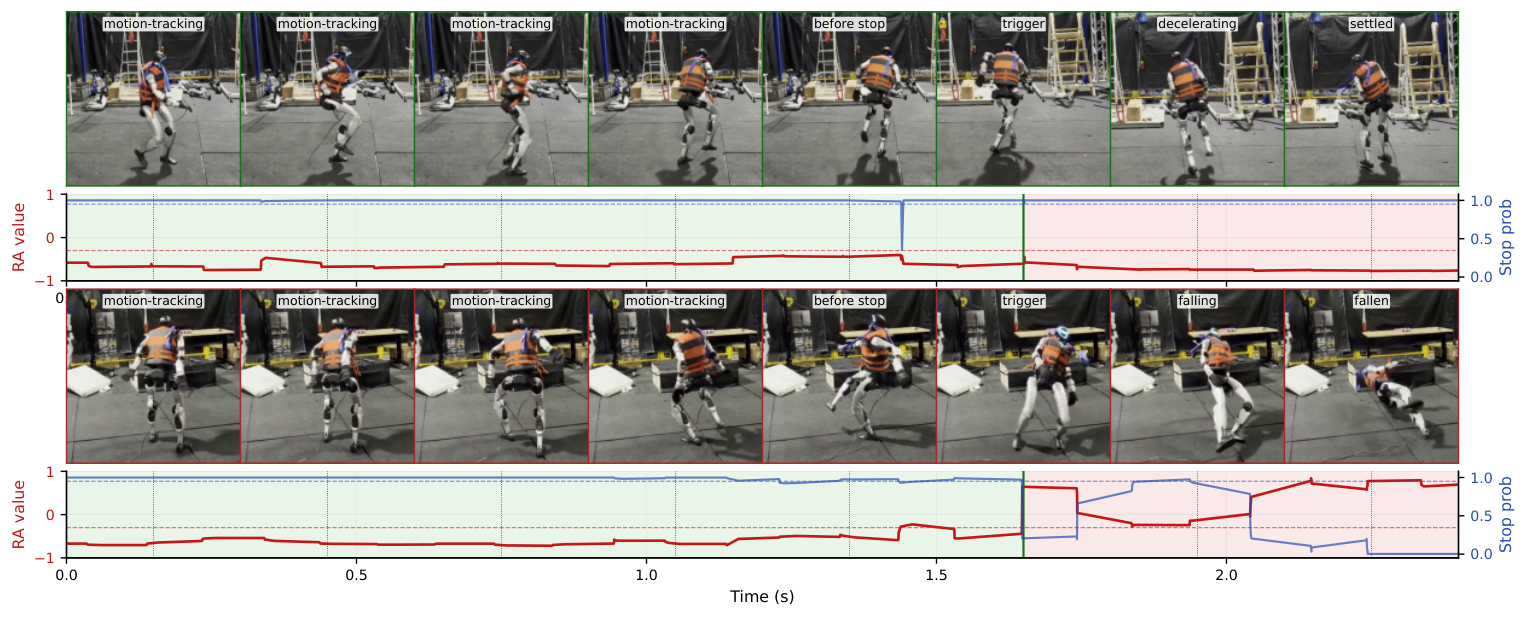
The teaser is a Unitree G1 in an orange vest. Top row: motion tracking, trigger, decelerate, stand. Bottom row: same trigger, then a fall the estimators had already flagged.
Two numbers have to agree
The stop actor sees a 93-D proprioceptive vector: projected gravity, base angular rate, joint offsets, joint velocities, last action. No task command, no map, no base height or linear velocity. Estimators mask the 14 arm joints.
P̂ is a discounted stop-success critic (γ 0.999999). V̂ is a Hamilton–Jacobi-style reach-avoid danger value from height, tilt, and speed. At runtime, the last K=5 samples must all show P̂ ≥ 0.95 and V̂ ≤ −0.3 or the robot switches to a damping fall policy. Split-conformal calibration in the appendix picks 0.90 / −0.34; the deployed triple is the hand-tuned one.
Training is in Isaac Lab on G1, 50 Hz, 4,096 envs. A locomotion sampler runs 0.2–1.0 s, then the stop policy takes the velocity command.
Sim transfer, then the lab floor
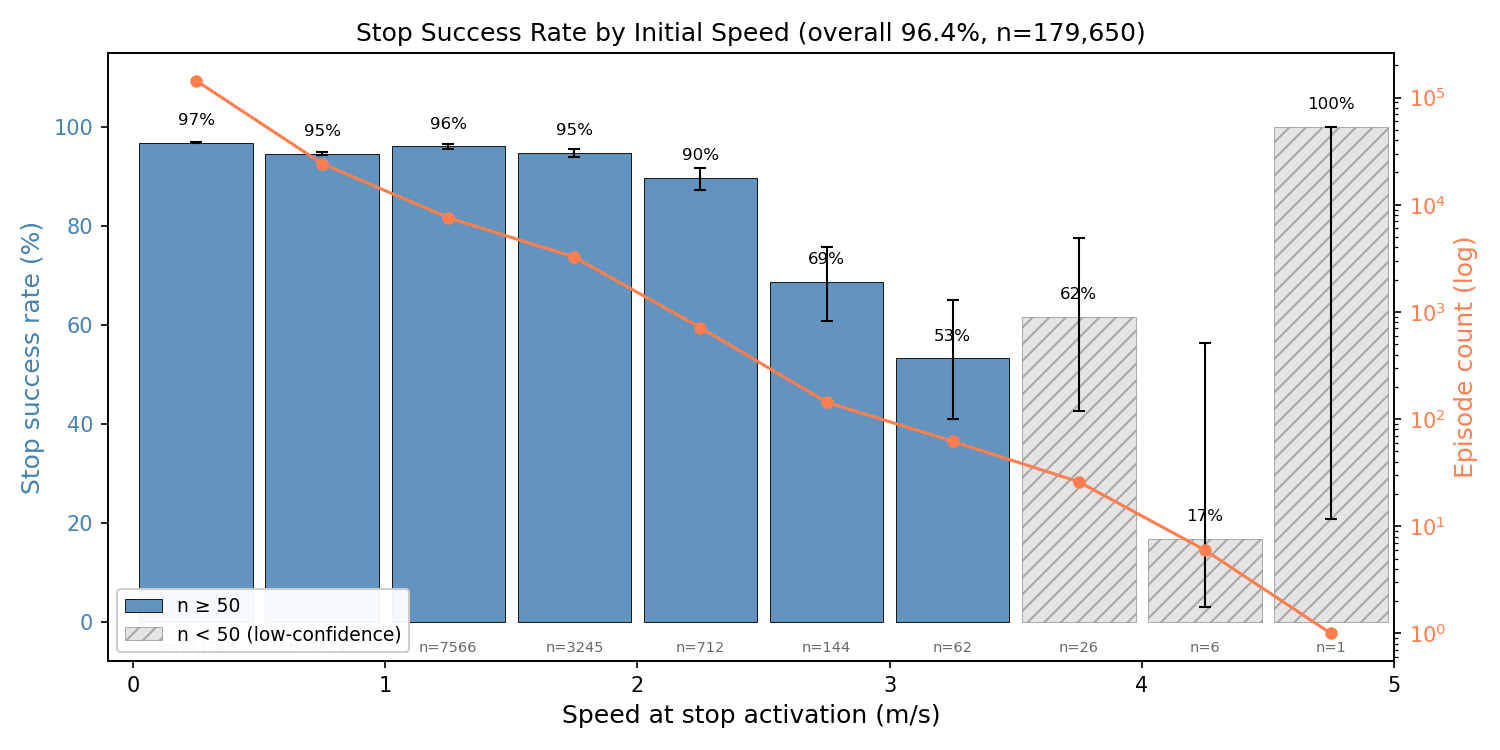
On 179,650 out-of-distribution BONES-SEED initializations, the stop policy succeeds in 96.4% (173,259 / 179,650). Success stays above 94% below 2 m/s and drops around 2–3 m/s. Estimator AUCs: 0.971 (P̂), 0.969 (V̂), 0.972 combined. The windowed dual rule hits 3.89% false-positive rate and 99.78% precision on the in-distribution set, approving only 31 of 797 true failures.
A locomotion-trained model transferred to motion-tracking states at 1.31% fall rate. The reverse transfer was worse (7.99%).
Hardware: five clips, 30 reps each (150 trials), difficulty scores from −0.56 to 1.10. Failures: 3/30, 1/30, 1/30, 15/30, 28/30. High-difficulty sim rates (70%, 100%) roughly match real (50%, 93%). Low-difficulty clips still show a 3–10 point hardware noise floor.
Limits: the fall policy is damping, not a learned SafeFall, and the stack does not ask whether continuing the task would return the robot to a stoppable set. Project page: junfeng-long.github.io/safestop.
A Human’s Take
I have watched too many “just zero the velocity command” clips end in a kneel. Asking “can I stop from here?” before you try is the grown-up e-stop. The hardware column is the one I will keep: at high RA value the G1 still eats the mat 28 times out of 30. That is the point of the paper, not a failed demo.