HumanoidVLN Makes Bipedal Navigation a Physics Problem
Most vision-language navigation (VLN) benchmarks slide an agent through a mesh. HumanoidVLN, posted to arXiv on August 13 by VinMotion in Vietnam with Quan Nguyen at USC, treats that as cheating. The robot has to walk.
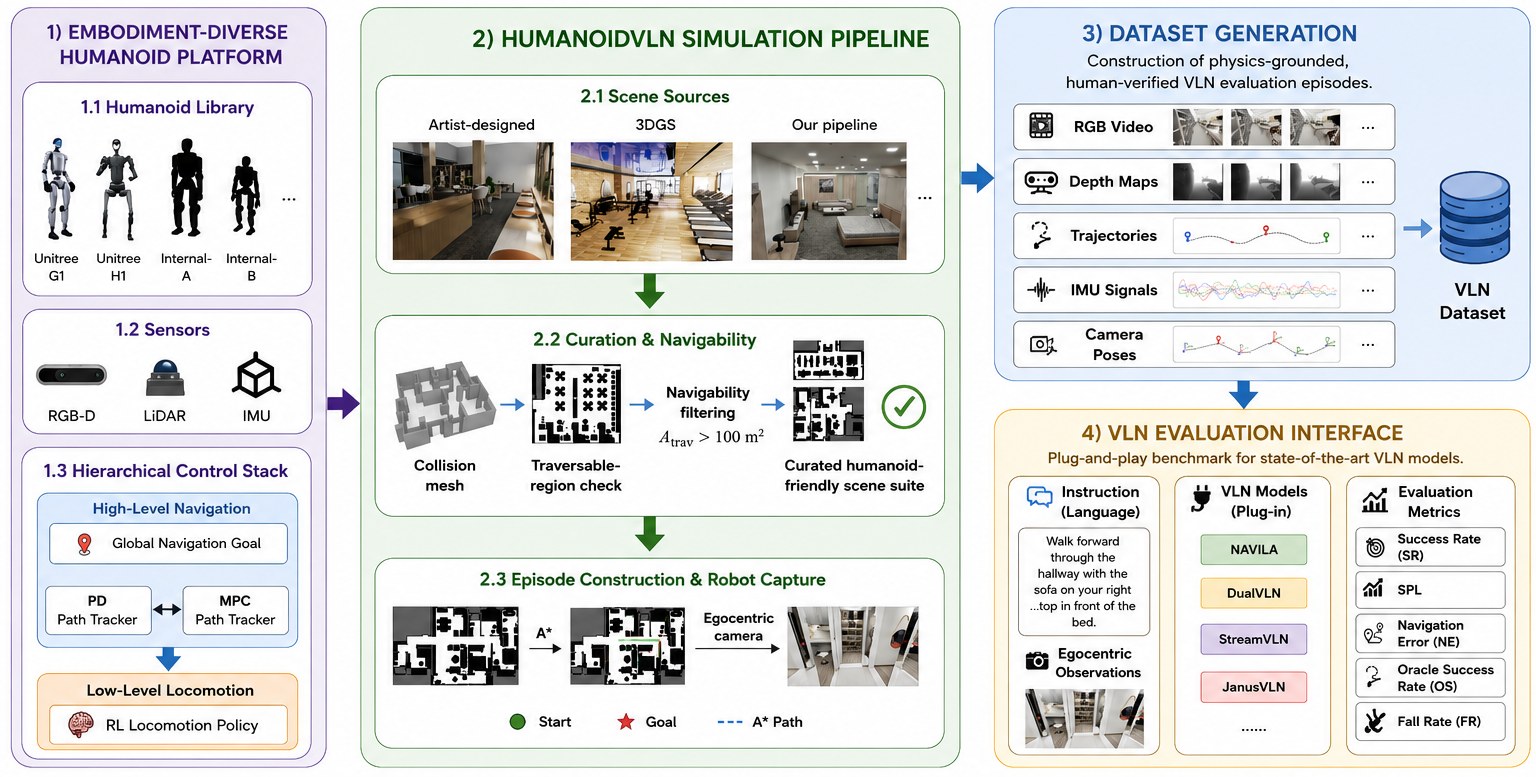
The platform sits on NVIDIA Isaac Sim. Four bipeds share the same scenes: Unitree G1 (12 lower-body DoF, 1.32 m), Unitree H1 (10 DoF, 1.80 m), plus two internal platforms at 1.61 m and 1.17 m. Camera heights run from 1.11 m to 1.72 m. A per-body RL locomotion policy commands joint torques; a PD or MPC tracker sits on top.
Scenes a biped can actually cross
The authors filtered 87 indoor environments for more than 100 m² of traversable floor, mixing artist-built GRScenes with 3D Gaussian Splatting reconstructions. Narrow dollhouse rooms that a wheeled agent can clip through get dropped.
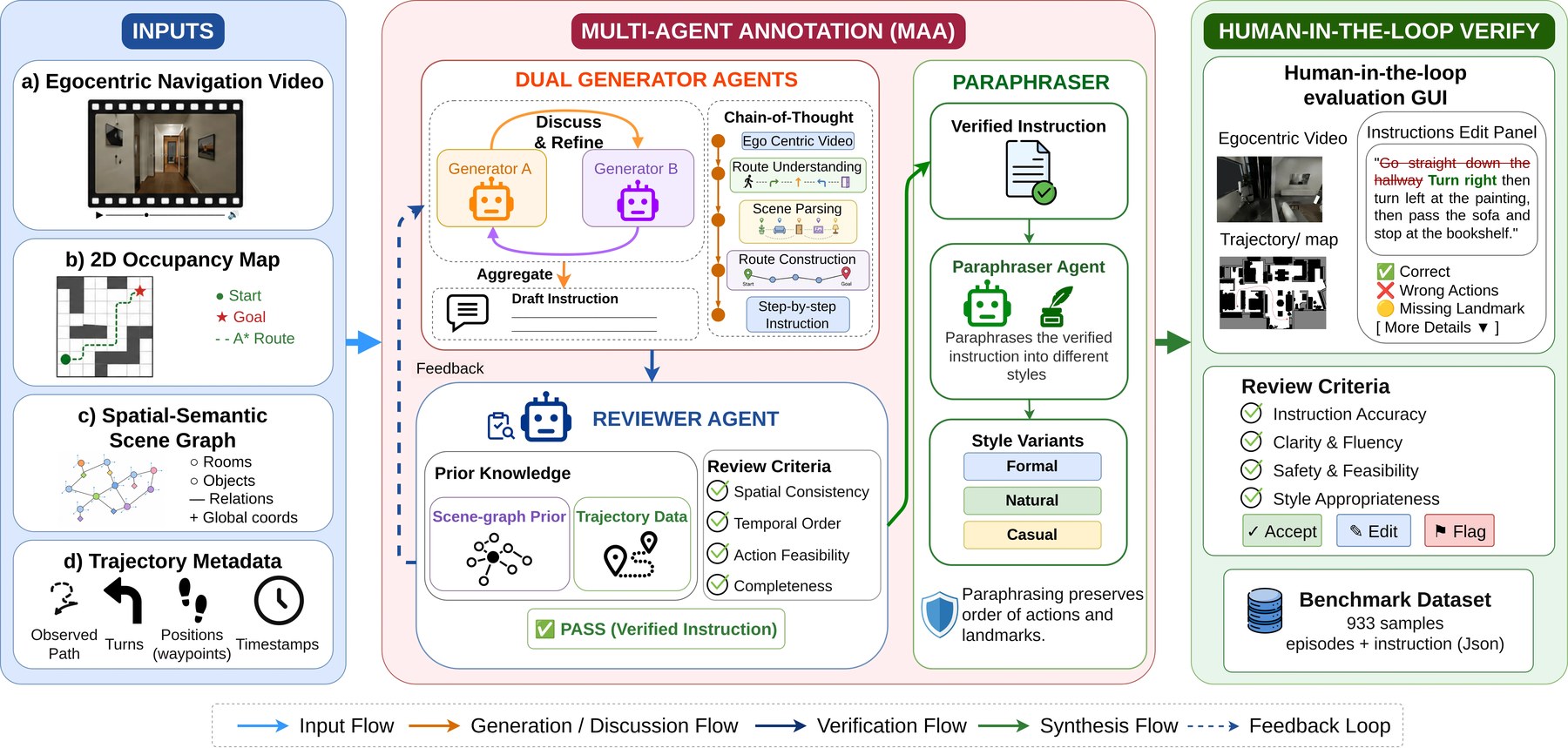
Instructions are not a single-pass VLM dump. A generator-reviewer-paraphraser loop writes one fine-grained route plus three coarse styles (formal, natural, casual), then a human signs off. That yields 933 collision-aware episodes.
Plug-in models already on the bench: NaVILA, DualVLN, StreamVLN, and JanusVLN. Metrics include the usual success rate, SPL, and nDTW, plus fall rate, which wheeled VLN never had to report.
What the numbers say
Across four models and four bodies, JanusVLN posts the best mean success rate at 43.55% and nDTW of 48.38. A 20-episode sim-to-real check with DualVLN on a real G1 reports navigation-error correlation r = 0.935, mean absolute difference 0.68 m, and trajectory similarity 0.782 ± 0.188 nDTW.
Code, benchmark, and data are promised on acceptance at the project page.
A Human’s Take
Teleportation VLN taught models to talk about hallways. It did not teach them to keep a 70-kilo biped upright while the head camera bounces. Fall rate on the scoreboard is the honest part of this paper. Forty-three percent success is not a product number, but a G1 that tracks the same errors in the lab as it does in Isaac is a better starting point than another Habitat leaderboard.