HumanTracker Grades Humanoid Tracking the Way People See It
Most humanoid trackers get scored on mean joint error. HumanTracker (arXiv August 13, accepted to ECCV 2026) argues that number often disagrees with the video. A rollout can look fine on MPJPE and still skate, miss a foot plant, or wobble through a sit-down.
The paper, from Nankai, Tsinghua, Galbot, SJTU, Peking, and Shanghai Qi Zhi, pairs a large optical-mocap test bed with HumanScore, a trajectory reward trained on expert pairwise preferences.
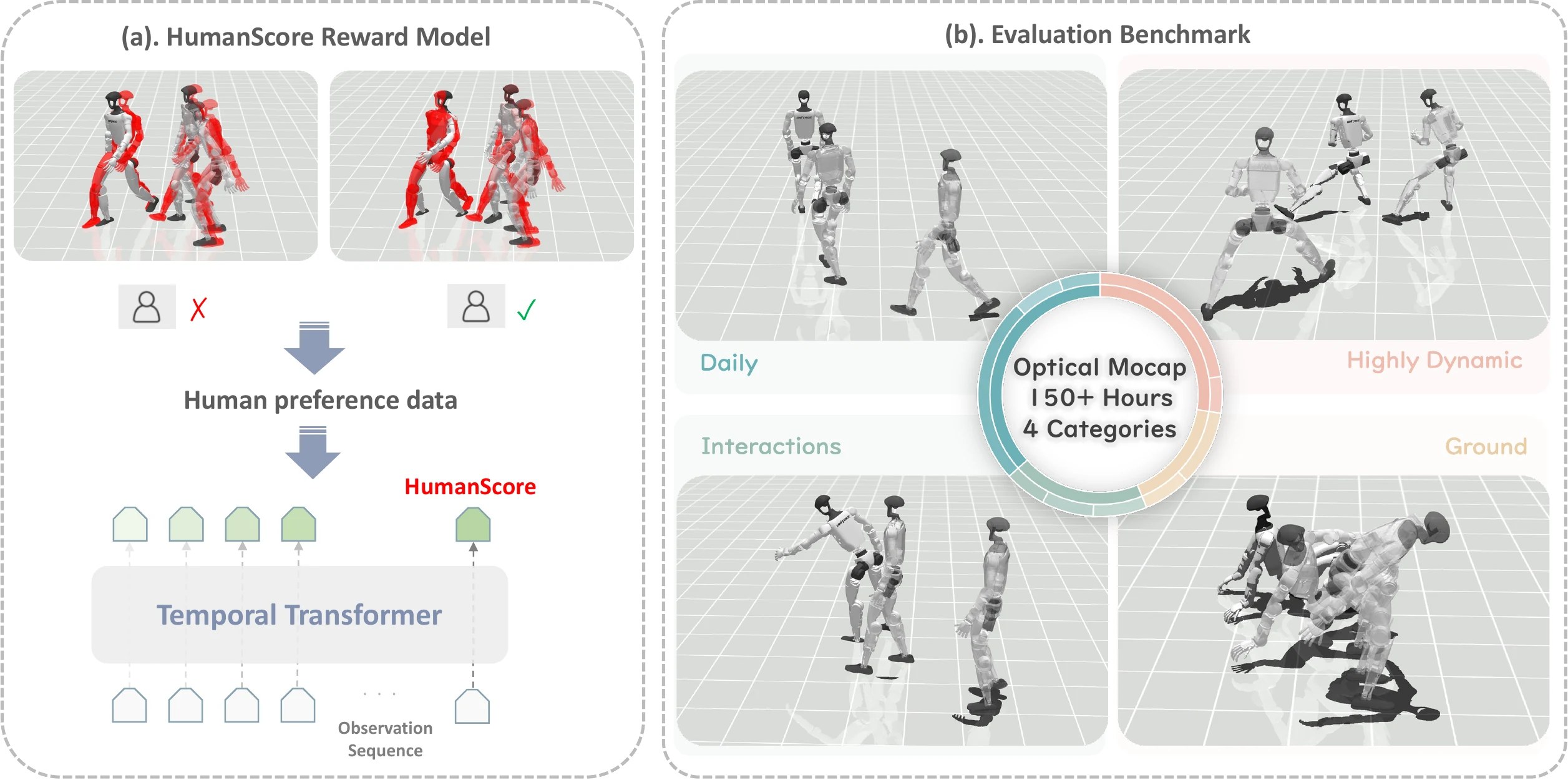
153 hours, four families
The released set is about 153 hours and 25,000 clips from 24 professional performers — dance teachers, fitness coaches, tennis coaches, and mocap actors. Motions are retargeted with GMR onto a common 29-DoF humanoid and cleaned for floating, ground penetration, and broken contacts.
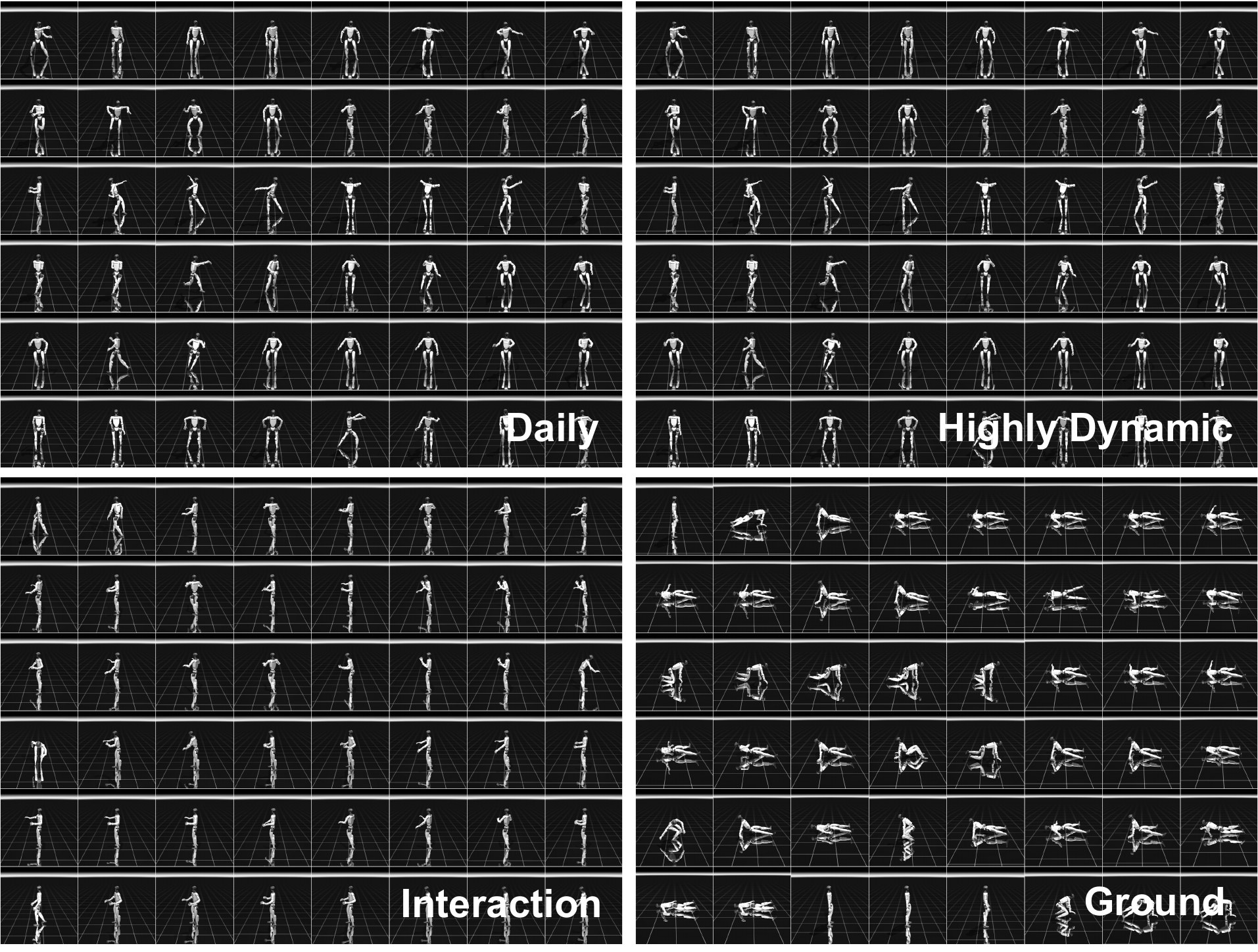
The taxonomy is the useful part. Clips sit in four families so you can see where a tracker dies:
- Daily: 89 hours, 9.7k clips — walking, turning, leftover drift
- Highly Dynamic: 11 hours, 2.7k clips — jumps, kicks, fast footwork
- Interaction: 48 hours, 10.9k clips — hands and whole-body coordination
- Ground: 5 hours, 1.6k clips — kneel, sit, roll, get up
AMASS-style test suites the authors call out are much smaller. Their table lists AMASS at more than 40 hours without category labels, versus HumanTracker’s 153 with four families and text tags. The split is 9:1 train/test, family-balanced.
HumanScore vs the usual numbers
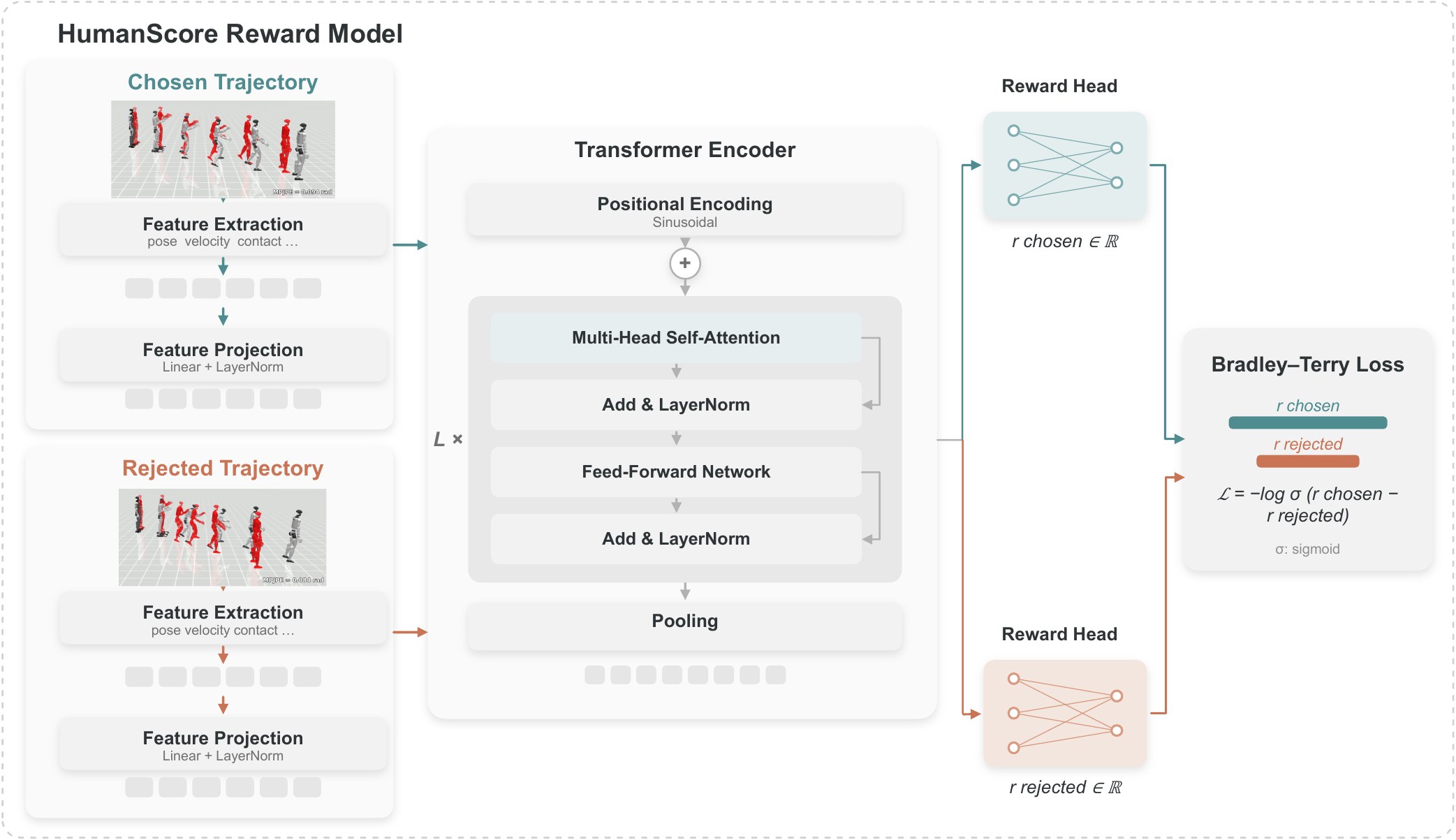
Six doctoral annotators compared synchronized 5-second windows from GMT, TWIST2, SONIC, and Humanoid-GPT. The project page says 6,000 original pairs, doubled by mirroring to 12,000 records (the paper’s abstract says 12K pairs / 24K motions). A Transformer reads a 539-dimensional per-frame state — reference, simulated pose, contacts, root motion — and is trained with a Bradley–Terry loss.
On a family-balanced test set, HumanScore’s align rate is 0.9083. MPJPE sits at 0.8049. Foot-contact accuracy is 0.7882. Longer context helps: one second of window is weaker than five.
Zero-shot on the test split, Humanoid-GPT leads most cells. Daily success is 94.4% with MPJPE 0.046 rad and HumanScore 54.7. Ground is the ugly one: Humanoid-GPT still only finishes 32.9% of episodes; GMT and TWIST2 hit 0.0%. SONIC wins Ground HumanScore (26.5 vs 24.9) even though Humanoid-GPT completes more episodes. That is the paper’s point: finish rate and “does this look planted” are not the same number.
A Human’s Take
I like a metric that punishes skating more than a pretty average joint error. I also want the next version on metal. This whole comparison lives in MuJoCo with a standardized 29-DoF body. A score that agrees with six PhDs watching sim video is a start. A score that agrees with someone watching a G1 miss a stair is the product.