HuMI: Robot-Free Whole-Body Skills on Unitree G1
Teleoperating a humanoid for whole-body demos is slow and brittle. HuMI (Humanoid Manipulation Interface) from Tsinghua University, Shanghai Qi Zhi Institute, Spirit.AI, and Shanghai Jiao Tong University collects robot-free whole-body demonstrations with hardware that fits in a backpack, then trains a hierarchical stack that runs on a Unitree G1.
Paper: arXiv:2602.06643. Project: humanoid-manipulation-interface.github.io.
Portable capture, full-body intent
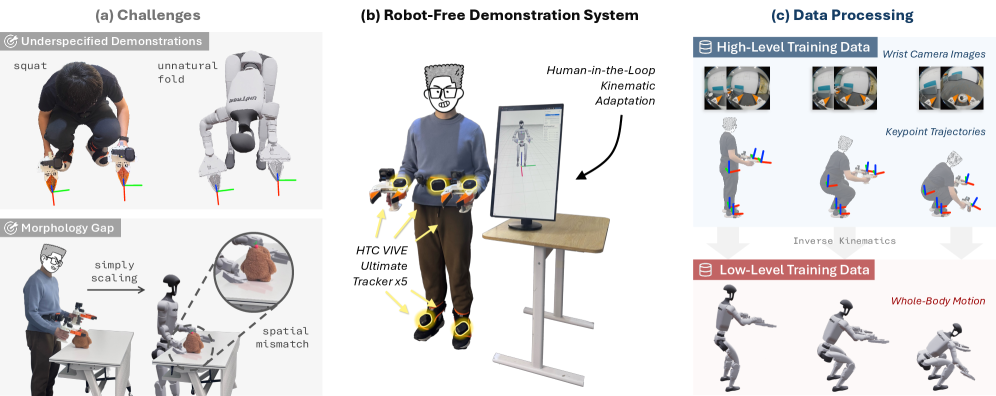
HuMI extends UMI-style handheld grippers (wrist GoPros) with HTC Vive Ultimate trackers on grippers, waist, and feet — five operational frames including the pelvis base. Operators see a real-time IK preview of the G1 so they can adjust motions that would be unreachable or self-colliding if you naively scaled adult human trajectories onto a ~130 cm robot.
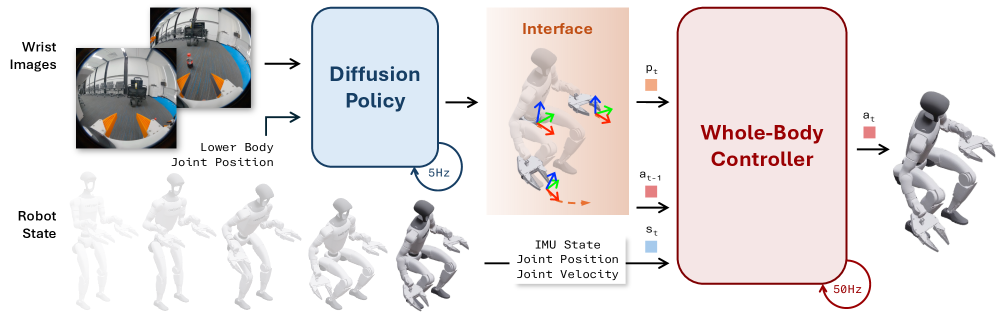
A high-level Diffusion Policy (5 Hz) predicts receding-horizon task-space keypoint chunks. A manipulation-centric whole-body controller (50 Hz) tracks them with adaptive end-effector rewards and variable-speed augmentation. Non-vision-grounded keypoints (pelvis/feet) use relative transforms inside the action chunk to limit open-loop drift.
Tasks and success rates
In-domain capability tasks on the paper’s G1 setup (20 trials where stated):
| Task | Success |
|---|---|
| Marriage-proposal kneel + ring grasp | 17/20 (85%) |
| Unsheathe sword (bimanual) | 17/20 (85%), 15.7 mm avg EE tracking error |
| Dynamic toss into container | 15/20 (75%) |
| Walk 1–2 m, clean table with lint roller | 15/20 (75%) with EE+pelvis interface |
Ablations bite hard: drop human-in-the-loop kinematic preview on the proposal task 85% → 10%; EE-only interface without whole-body keypoints fails the proposal task 0/10; absolute pelvis tracking on walk-and-clean 75% → 0/10.
Generalization and throughput
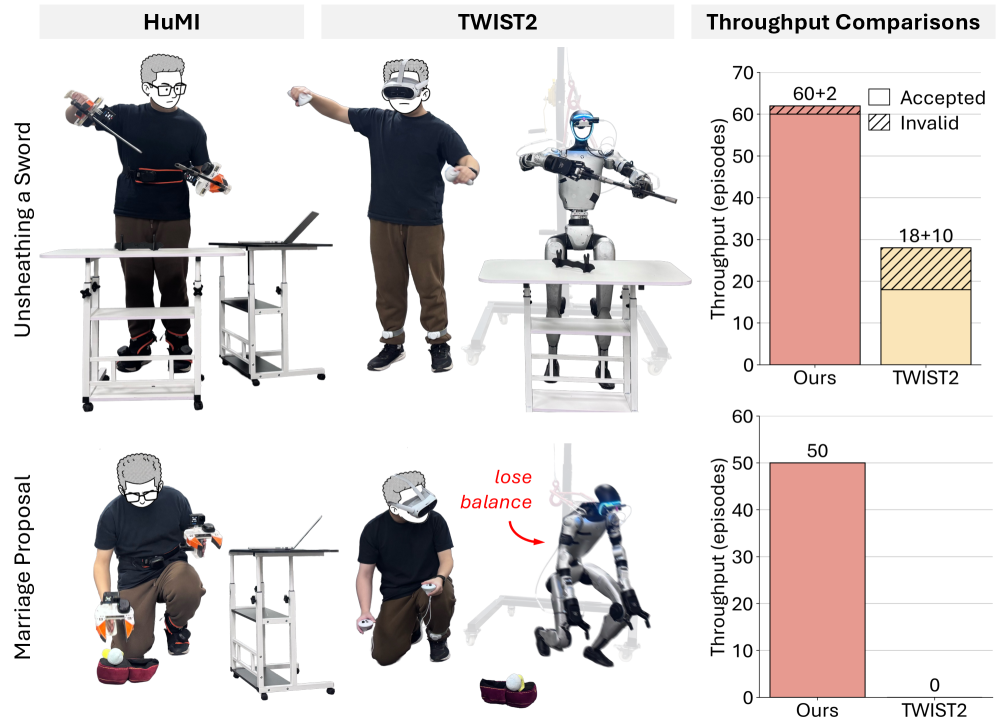
For squat-and-pick bottles, authors collect 350 demos across 7 environments and 7 bottle instances. In unseen environments and objects they report 14/20 (70%) success. Versus TWIST2 teleop on the sword task in a 15-minute session: HuMI 62 episodes (96.7% acceptance) vs 28 (64.3% acceptance) — abstract claims 3× data-collection efficiency overall. Proposal kneeling: HuMI 50 demos in 15 minutes; TWIST2 0 usable deep kneels in the same window.
A Human’s Take
Robot-free whole-body capture only works if the retarget stays honest about object geometry — HuMI’s no-scale + IK preview choice is the right engineering instinct. The TWIST2 comparison on deep kneeling is the money chart: teleop still cannot teach some postures you need for real work.